
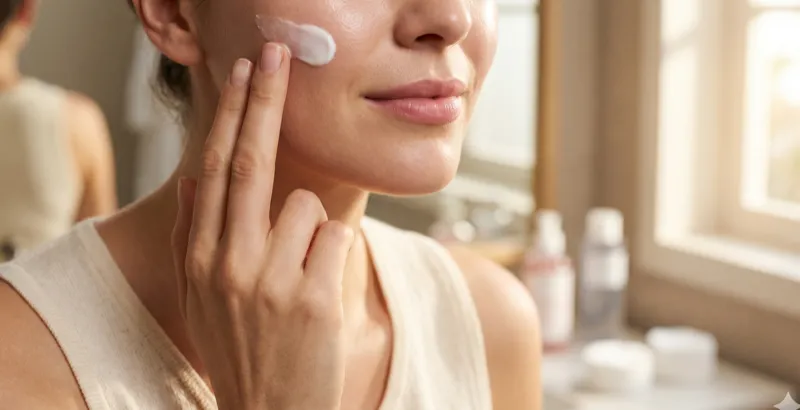
The science of skin aging is evolving rapidly — and for women navigating the skin changes that come with menopause and beyond, evidence-based skincare represents a fundamentally different approach: working with your skin's biology rather than against it.
Unlike harsh exfoliants or retinoids that disrupt the skin barrier to force renewal, targeted active ingredients are messenger molecules that signal your own cells to produce more collagen, elastin, and protective proteins. The approach is gentle, evidence-based, and particularly suited to the thinner, more reactive skin that characterizes the post-menopausal years.
How Barrier Integrity Directly Determines Collagen Production Rate
The connection between ceramide barrier repair and collagen production is one of the most underappreciated relationships in anti-aging skincare. Most women view ceramide cream as a moisturizer — a comfort product that hydrates dry skin. In clinical reality, ceramide barrier repair is a therapeutic intervention that directly impacts collagen metabolism by interrupting the inflammatory cascade that drives MMP-mediated collagen destruction. When the barrier is compromised (as it is in aging, post-menopausal, and environmentally stressed skin), chronic transepidermal water loss triggers a sustained inflammatory response that upregulates MMP expression by 20-30% above baseline. This means that barrier-compromised skin is actively destroying collagen faster than barrier-intact skin, independent of UV exposure or any other external factor. Ceramide cream does not just moisturize — it reduces the baseline rate of collagen destruction.[1]
The inflammatory cascade from barrier compromise to collagen loss: Step 1 — Barrier compromise. Aging, UV damage, harsh products, and hormonal decline all reduce stratum corneum ceramide content, creating gaps in the lipid barrier that allow increased transepidermal water loss. Step 2 — Keratinocyte stress response. The water loss triggers keratinocytes to release inflammatory cytokines (IL-1alpha, IL-6, TNF-alpha) as a damage signal. Step 3 — NF-kB activation. These cytokines activate the NF-kB inflammatory pathway in both keratinocytes and dermal fibroblasts. Step 4 — MMP upregulation. NF-kB signaling upregulates MMP-1, MMP-3, and MMP-9 expression — the same enzymes that UV activates, but triggered here by barrier dysfunction rather than UV exposure. Step 5 — Collagen degradation. The elevated MMPs actively degrade dermal collagen fibers. This cascade operates 24/7 in barrier-compromised skin, silently destroying collagen at an accelerated rate that may not be visible in the short term but compounds into significant structural loss over months and years.
Clinical research confirms that how ceramide cream interrupts this cascade: topical ceramide cream containing ceramides NP, AP, and EOP with cholesterol and fatty acids in physiological ratios (3:1:1) reconstructs the lipid barrier lamellae that seal the stratum corneum. This restoration reduces TEWL by 20-30% within 2-4 weeks, which reduces the keratinocyte stress signal, which reduces NF-kB activation, which reduces MMP expression — effectively turning down the volume on the collagen destruction cascade. Clinical measurements confirm this: barrier-repaired skin shows measurably lower MMP-1 expression than barrier-compromised skin at the same chronological age. The practical implication: ceramide cream makes every collagen-stimulating active in your routine more effective. When retinol and peptides stimulate collagen production, the collagen accumulates in the dermis only if the production rate exceeds the destruction rate. Ceramide cream reduces the destruction rate by suppressing inflammatory MMP activity, shifting the balance toward net collagen accumulation.
Ceramide cream as the foundation of collagen building: the most effective collagen-building routine is not the one with the most potent retinol or the highest-concentration vitamin C — it is the one built on a foundation of barrier repair that minimizes the baseline collagen destruction rate. Protocol: ceramide cream as the first and last step of every skincare routine. Morning: cleanse → vitamin C → peptides → ceramide cream → SPF. Evening (retinol nights): cleanse → ceramide cream → retinol → ceramide cream (sandwich method). Evening (non-retinol nights): cleanse → HA → peptides → ceramide cream. The ceramide cream in this protocol is not a luxury step — it is the functional foundation that determines the net effectiveness of every other product. A routine with excellent actives but no barrier support is like a factory running at full production with the back door open — product is being made but is simultaneously walking out the door. Ceramide cream closes the back door, allowing the production output of retinol, peptides, and vitamin C to accumulate as net structural improvement.
Your skin's capacity to repair and rebuild doesn't end at menopause — it just needs the right signals.
— Dr. Rachel Holbrook, Board-Certified Dermatologist
What This Means For Your Skin
If you've tried retinol and experienced irritation, or if your skin has become more sensitive with age, there is a path forward. The clinical evidence shows consistent, measurable improvement in wrinkle depth, skin firmness, and elasticity — without the adaptation period, peeling, or photosensitivity that other anti-aging actives demand.
Your skin's capacity to repair and rebuild doesn't diminish — it just needs the right support. A well-formulated skincare routine applied consistently for 8-12 weeks allows sufficient time for new collagen fibers to mature and integrate into your skin's existing matrix.
The science is clear. The evidence is consistent. The results are measurable.
What happens next is up to you.