
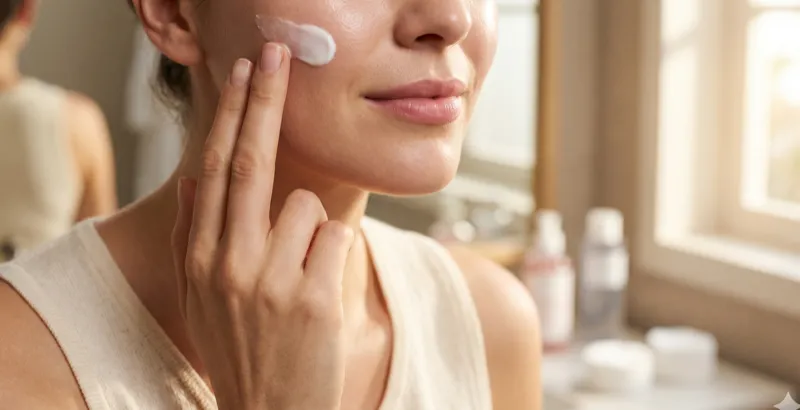
The science of skin aging is evolving rapidly — and for women navigating the skin changes that come with menopause and beyond, evidence-based skincare represents a fundamentally different approach: working with your skin's biology rather than against it.
Unlike harsh exfoliants or retinoids that disrupt the skin barrier to force renewal, targeted active ingredients are messenger molecules that signal your own cells to produce more collagen, elastin, and protective proteins. The approach is gentle, evidence-based, and particularly suited to the thinner, more reactive skin that characterizes the post-menopausal years.
A Step-by-Step AM/PM Protocol That Activates Multiple Collagen Pathways
Building collagen in mature skin requires a deliberate, multi-pathway approach because the fibroblasts responsible for collagen production have become less responsive to individual stimuli with age. At 30, a single collagen-stimulating active (retinol alone or peptides alone) produces robust collagen output. By 50, the same single-active approach produces a diminished response — fibroblast senescence, reduced receptor density, and hormonal changes all contribute to lower per-stimulus collagen production. The solution is not higher concentrations of a single active (which increases irritation without proportionally increasing collagen) but simultaneous activation of multiple independent collagen production pathways. When the retinoid receptor pathway (RAR/RXR), the growth factor pathway (TGF-beta), and the cofactor pathway (vitamin C) are all activated concurrently, the cumulative collagen output exceeds what any single pathway can achieve — a principle called multi-pathway synergy that is supported by comparative clinical studies.[1]
The morning collagen-building routine (4 steps, 5 minutes): Step 1 — Vitamin C serum (15% L-ascorbic acid for normal skin; 10% for sensitive or post-menopausal skin). Apply 4-5 drops to clean, dry face and neck. Vitamin C activates the cofactor pathway: it is required for prolyl hydroxylase and lysyl hydroxylase, the enzymes that hydroxylate proline and lysine residues during collagen triple helix assembly. Without vitamin C, collagen molecules produced by retinol and peptide stimulation are structurally defective and rapidly degraded. Vitamin C ensures that every collagen molecule your fibroblasts produce is properly assembled and mechanically functional. Wait 1-2 minutes for absorption. Step 2 — Peptide cream (Matrixyl 3000). Apply a nickel-size amount to face, neck, and chest with upward strokes. This activates the TGF-beta pathway: palmitoyl tripeptide-1 and palmitoyl tetrapeptide-7 bind to TGF-beta receptors on fibroblast cell surfaces, triggering a growth factor cascade that upregulates procollagen I, procollagen III, and fibrillin-1 production. This pathway is entirely independent of retinoid receptors, meaning peptide-stimulated collagen production adds to (does not overlap with) retinoid-stimulated production.
Clinical research confirms that step 3 — Ceramide moisturizer with niacinamide. Apply as the barrier seal. Ceramides restore the lipid barrier that prevents transepidermal water loss, maintaining the hydrated dermal environment that fibroblasts need for optimal collagen synthesis. Niacinamide (3-5%) enhances fibroblast energy metabolism through NAD+ precursor activity, supporting the cellular machinery that produces collagen. Step 4 — SPF 50 broad-spectrum sunscreen. Non-negotiable. UV radiation activates MMPs that degrade collagen 5-10 fold faster than baseline. Without sunscreen, the collagen built by the morning routine is immediately attacked by UV-induced enzymes. Sunscreen is what allows collagen accumulation — without it, production and destruction reach equilibrium or favor destruction.
The evening collagen-building routine (varies by night): Retinol nights (3-4 per week) — Step 1: Gentle cleanser. Step 2: Ceramide cream (first sandwich layer). Wait 5 minutes. Step 3: Retinol 0.25-0.5% (pea-size amount). Wait 5 minutes. Step 4: Ceramide cream (second sandwich layer). This activates the retinoid receptor pathway: retinol is converted through retinaldehyde to retinoic acid, which binds nuclear RAR/RXR receptors on fibroblasts, directly upregulating procollagen I and III gene transcription while simultaneously suppressing MMP-1, MMP-3, and MMP-9 expression. This dual action — stimulating production while suppressing destruction — is unique to retinoids. Non-retinol nights (3-4 per week) — Step 1: Gentle cleanser. Step 2: Hyaluronic acid serum on damp skin. Step 3: Peptide cream (second daily dose of TGF-beta stimulation). Step 4: Ceramide cream seal. This protocol ensures that at least one collagen-stimulating pathway is active every single night. The cumulative effect: three pathways activated daily (vitamin C + peptides + retinol), 7 days per week, producing collagen from multiple independent mechanisms simultaneously. Expected results: measurable firmness improvement at 12-16 weeks, progressive structural rebuilding through 12-18 months.
Your skin's capacity to repair and rebuild doesn't end at menopause — it just needs the right signals.
— Dr. Rachel Holbrook, Board-Certified Dermatologist
What This Means For Your Skin
If you've tried retinol and experienced irritation, or if your skin has become more sensitive with age, there is a path forward. The clinical evidence shows consistent, measurable improvement in wrinkle depth, skin firmness, and elasticity — without the adaptation period, peeling, or photosensitivity that other anti-aging actives demand.
Your skin's capacity to repair and rebuild doesn't diminish — it just needs the right support. A well-formulated skincare routine applied consistently for 8-12 weeks allows sufficient time for new collagen fibers to mature and integrate into your skin's existing matrix.
The science is clear. The evidence is consistent. The results are measurable.
What happens next is up to you.