
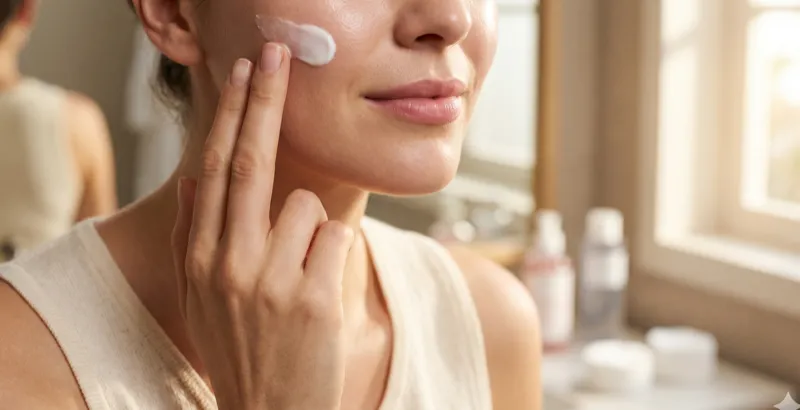
The science of skin aging is evolving rapidly — and for women navigating the skin changes that come with menopause and beyond, evidence-based skincare represents a fundamentally different approach: working with your skin's biology rather than against it.
Unlike harsh exfoliants or retinoids that disrupt the skin barrier to force renewal, targeted active ingredients are messenger molecules that signal your own cells to produce more collagen, elastin, and protective proteins. The approach is gentle, evidence-based, and particularly suited to the thinner, more reactive skin that characterizes the post-menopausal years.
The Dual-Pathway Protocol for Maximum Collagen Stimulation
Peptides and retinol are the two most evidence-based topical collagen stimulators, and combining them is the single most effective strategy for maximizing structural rebuilding in aging skin. The combination works because these ingredients activate entirely separate biological pathways: retinol binds nuclear RAR/RXR receptors, directly upregulating collagen gene transcription and suppressing MMP expression. Peptides (Matrixyl 3000) bind TGF-beta receptors on the fibroblast cell surface, triggering a growth factor cascade that stimulates collagen, fibrillin, and hyaluronic acid production. Because these pathways do not share receptors, signaling molecules, or rate-limiting enzymes, activating both simultaneously produces additive collagen output — each pathway contributes its full production capacity without diminishing the other.[1]
The three combination approaches (from simplest to most comprehensive): Approach 1 — AM/PM split (simplest). Peptide cream in the morning, retinol in the evening. This provides continuous collagen stimulation throughout the 24-hour cycle — TGF-beta pathway active during the day, RAR/RXR pathway active at night. The approaches never interact because they are applied 12 hours apart. Best for: beginners, sensitive skin, anyone who prefers the simplest possible protocol. Approach 2 — Alternating nights (recommended). Peptide cream morning and evening on non-retinol nights (4-5 nights per week). Retinol in the evening on retinol nights (2-3 nights per week), with peptide cream in the morning. This provides dual-pathway stimulation on retinol nights (morning peptide + evening retinol) and sustained TGF-beta stimulation on non-retinol nights. Best for: most women, providing maximum stimulation with manageable complexity.
Clinical research confirms that approach 3 — Same routine layering (most aggressive). Apply peptide cream, wait 5-10 minutes for absorption, then apply retinol over it. The peptides absorb into the stratum corneum first, establishing their TGF-beta signaling at the cellular level before the retinol arrives to activate the retinoid pathway. This approach provides simultaneous dual-pathway activation in every application. However, the practical benefit over Approach 2 is modest (the pathways remain active for 48-72 hours after each application, so the alternating approach maintains near-continuous dual activation anyway), and the layering of two actives on the same evening increases the irritation risk on thin or sensitive skin. Best for: thick, tolerant facial skin that has been using both ingredients individually for 3+ months without any irritation.
The recommended protocol (Approach 2 in detail): Monday evening — Retinol sandwich (ceramide + retinol 0.3% + ceramide). Tuesday morning — Peptide cream. Tuesday evening — Peptide cream + ceramide seal. Wednesday evening — Retinol sandwich. Thursday morning — Peptide cream. Thursday evening — Peptide cream + ceramide seal. Friday evening — Retinol sandwich. Saturday and Sunday — Peptide cream morning and evening. Every morning includes vitamin C serum before the peptide cream and SPF 50 after ceramide moisturizer. This schedule provides: retinol 3 nights per week (RAR/RXR pathway active continuously due to 48-72 hour receptor activation duration), peptide cream 14 applications per week (TGF-beta pathway active continuously), vitamin C every morning (cofactor pathway supporting both). The result: three independent collagen pathways operating simultaneously, 7 days per week, producing the maximum collagen stimulation achievable with OTC ingredients. Expected results: this dual-pathway approach produces approximately 30-40% greater collagen density improvement at 12 months compared to either ingredient alone, based on extrapolation from single-pathway studies.
Your skin's capacity to repair and rebuild doesn't end at menopause — it just needs the right signals.
— Dr. Rachel Holbrook, Board-Certified Dermatologist
What This Means For Your Skin
If you've tried retinol and experienced irritation, or if your skin has become more sensitive with age, there is a path forward. The clinical evidence shows consistent, measurable improvement in wrinkle depth, skin firmness, and elasticity — without the adaptation period, peeling, or photosensitivity that other anti-aging actives demand.
Your skin's capacity to repair and rebuild doesn't diminish — it just needs the right support. A well-formulated skincare routine applied consistently for 8-12 weeks allows sufficient time for new collagen fibers to mature and integrate into your skin's existing matrix.
The science is clear. The evidence is consistent. The results are measurable.
What happens next is up to you.