
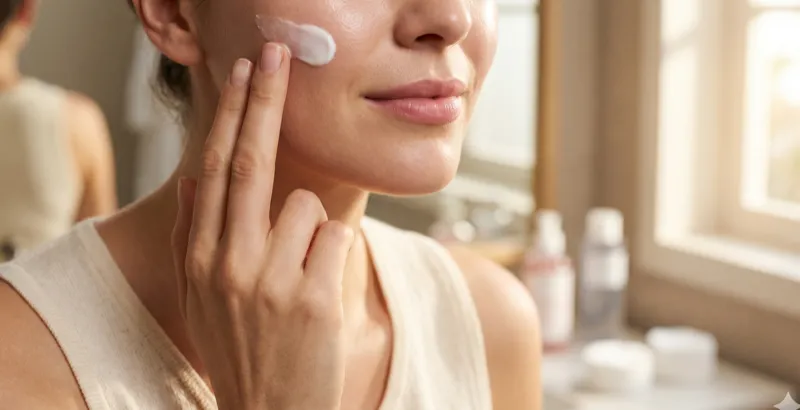
The science of skin aging is evolving rapidly — and for women navigating the skin changes that come with menopause and beyond, evidence-based skincare represents a fundamentally different approach: working with your skin's biology rather than against it.
Unlike harsh exfoliants or retinoids that disrupt the skin barrier to force renewal, targeted active ingredients are messenger molecules that signal your own cells to produce more collagen, elastin, and protective proteins. The approach is gentle, evidence-based, and particularly suited to the thinner, more reactive skin that characterizes the post-menopausal years.
Practical Self-Assessment Methods to Track Your Structural Rebuilding Progress
Measuring collagen improvement at home is essential for maintaining the consistency that collagen building requires. The problem: collagen rebuilding is a gradual biological process — 1-2% improvement per month is imperceptible day-to-day but compounds into dramatic change over 6-12 months. Without measurement, women perceive 'nothing is changing' and abandon treatment precisely when structural improvement is occurring beneath the threshold of daily perception. The solution: simple, reproducible self-assessment methods performed monthly that capture the gradual improvement in objective, comparable data points. These home measurements do not replace clinical instruments (Cutometer, skin ultrasound), but they provide the practical feedback loop that sustains treatment adherence through the long months of structural rebuilding.[1]
Method 1 — The Snap-Back Test (assessing elastic recoil, correlating with collagen density): Using thumb and index finger, gently pinch a fold of skin on the back of the hand (this site mirrors facial skin aging while being easier to test consistently). Hold the pinch for 5 seconds, then release. Using a smartphone stopwatch, measure how long the skin takes to return completely to its flat resting state. Record the time in seconds. Perform the test on the same spot, at the same time of day, with the same hydration status each month. Interpretation: baseline snap-back time at the start of treatment establishes your reference point. After 3-6 months of consistent collagen-building treatment, the snap-back time should decrease — faster return to flat position indicates denser, more resilient dermis. A decrease from 4 seconds to 3 seconds represents meaningful structural improvement. Track the trend line month over month.
Clinical research confirms that method 2 — The Texture Assessment (assessing collagen density at the skin surface): Under bright, consistent natural light (same window, same time of day), gently stretch the skin of the inner forearm and release. Observe the surface texture immediately after release. Photograph the stretched-and-released texture with your phone camera at the same distance each month. Dense, well-collagenized skin shows a smooth, uniform surface upon release — like slightly stretched elastic fabric. Collagen-depleted skin shows visible micro-wrinkling, cross-hatching, or crepey texture — the reduced structural scaffolding cannot maintain smooth surface tension. As collagen improves with treatment, the post-stretch surface becomes progressively smoother, with fewer visible microlines.
Method 3 — Monthly Progress Photography (the most valuable tracking tool): Take a standardized facial photograph monthly under consistent conditions: same location, same lighting (natural window light from the same angle), same distance from camera, same facial expression (neutral), same time of day. Store photos in a dedicated album for comparison. Compare month 1 to month 3, month 3 to month 6, month 6 to month 12. The changes that are invisible day-to-day become clearly visible in these monthly comparisons: firmer jawline definition, reduced wrinkle depth, improved skin texture and radiance, more even tone. Side-by-side comparison of month 1 and month 12 typically produces a dramatic 'I didn't realize how much it changed' reaction that validates the investment in consistent treatment. Tips for optimal progress photography: (a) Avoid flash — it flattens shadows that reveal skin texture. (b) Use natural light from a window to one side — this creates subtle shadows that reveal surface topography. (c) Take photos at the same time of day — morning skin looks different from evening skin due to hydration status and gravitational effects. (d) Include the same background elements for consistent framing. (e) Take photos makeup-free and product-free (after cleansing, before routine). Monthly self-assessment transforms collagen building from an act of faith into a tracked, measurable process — maintaining the motivation and consistency that determines ultimate success.
Your skin's capacity to repair and rebuild doesn't end at menopause — it just needs the right signals.
— Dr. Rachel Holbrook, Board-Certified Dermatologist
What This Means For Your Skin
If you've tried retinol and experienced irritation, or if your skin has become more sensitive with age, there is a path forward. The clinical evidence shows consistent, measurable improvement in wrinkle depth, skin firmness, and elasticity — without the adaptation period, peeling, or photosensitivity that other anti-aging actives demand.
Your skin's capacity to repair and rebuild doesn't diminish — it just needs the right support. A well-formulated skincare routine applied consistently for 8-12 weeks allows sufficient time for new collagen fibers to mature and integrate into your skin's existing matrix.
The science is clear. The evidence is consistent. The results are measurable.
What happens next is up to you.