
The science of skin aging is evolving rapidly — and for women navigating the skin changes that come with menopause and beyond, evidence-based skincare represents a fundamentally different approach: working with your skin's biology rather than against it.
Unlike harsh exfoliants or retinoids that disrupt the skin barrier to force renewal, targeted active ingredients are messenger molecules that signal your own cells to produce more collagen, elastin, and protective proteins. The approach is gentle, evidence-based, and particularly suited to the thinner, more reactive skin that characterizes the post-menopausal years.
Reversing the Paper-Thin Texture Through Structural Rebuilding and Deep Hydration
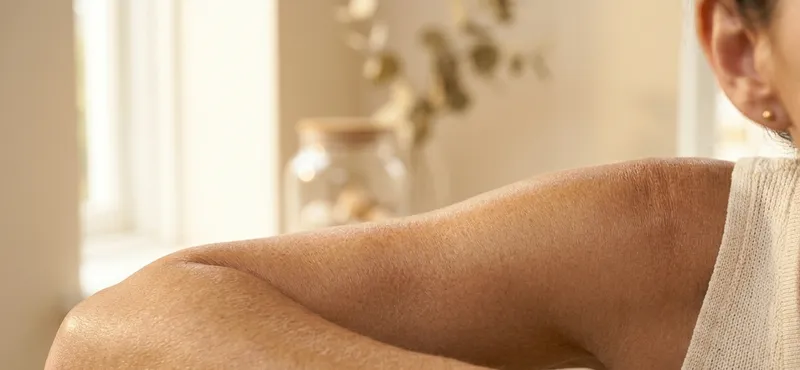
Crepey skin on the arms — the thin, papery, finely wrinkled texture that resembles crêpe paper — is one of the most common body skin concerns for women over 40, yet it receives far less treatment attention than facial aging. The arms are particularly vulnerable because the skin on the upper arms and inner forearms has relatively thin dermis, fewer sebaceous glands than the face (resulting in less natural lipid protection), and chronic UV exposure from short-sleeved clothing. By 50, the typical woman's arm skin has lost 30-40% of its collagen density, the elastic fibers have fragmented beyond functional recoil, and the glycosaminoglycan content (particularly hyaluronic acid) has declined to the point where the skin cannot retain sufficient water to maintain plump, smooth surface tension. The result is a tissue that folds, crinkles, and wrinkles with minimal mechanical input — even gently pressing the skin creates creases that take seconds to resolve rather than snapping back instantly.[1]
What distinguishes crepey texture from regular wrinkles is the diffuse, uniform nature of the structural deterioration. Wrinkles are localized folds at specific sites of mechanical stress (expression lines, joint creases). Crepey texture is a broad-area structural failure affecting the entire dermal matrix — collagen density, elastic fiber integrity, and water-binding capacity are all simultaneously depleted across the whole tissue. This means treatment must address the entire affected area rather than targeting specific lines. The three structural deficits require three corresponding interventions: collagen depletion → retinol or peptide therapy to stimulate new collagen synthesis; elastic fiber fragmentation → protective strategies (retinoids suppress MMPs that fragment elastin, antioxidants neutralize free radicals that cleave elastic fibers); glycosaminoglycan depletion → hyaluronic acid and ceramide-based hydration therapy to restore water-binding capacity.
Clinical research confirms that the body-specific treatment protocol for crepey arms differs from facial treatment in important ways: the arm skin tolerates higher retinol concentrations than facial skin (0.5-1.0% versus 0.25% for face) because it is thicker and less reactive, but it also absorbs topical products less efficiently because the stratum corneum on the body is denser than on the face. This means products need to be applied more generously and may benefit from enhanced penetration strategies. Step 1 — Body retinol cream at 0.5% applied to the entire upper arm area every evening. Start every other evening for the first 2 weeks to assess tolerance, then increase to nightly. Body retinol stimulates collagen production and accelerates the turnover of the thin, damaged epidermal layer. Step 2 — Alpha-hydroxy acid (AHA) body lotion at 10-12% glycolic acid applied on alternating evenings from retinol. AHA exfoliation removes the accumulated dead keratinocytes that contribute to the rough, papery texture and enhances the penetration of subsequent hydrating products.
Step 3 — Intensive hydration: after the active treatment step (retinol or AHA), apply a body cream containing both hyaluronic acid and ceramides. The HA draws water into the depleted dermis while the ceramides repair the body's barrier function, preventing the chronic transepidermal water loss that perpetuates crepey texture. For maximum effect, apply to slightly damp skin after bathing and seal with a thin layer of body oil (squalane or jojoba). Step 4 — Weekly intensive treatment: once per week, apply a thick layer of body cream to the arms, wrap loosely with cling film or wear a long-sleeved cotton shirt, and leave overnight. This occlusive treatment creates a hydration chamber that delivers 8 hours of deep moisturization, producing visibly improved texture by morning. Step 5 — Daily SPF on exposed arms: the arms receive significant cumulative UV exposure from daily activities, and unprotected exposure continues to degrade the collagen and elastin you're trying to rebuild. Apply SPF 30+ body sunscreen to the arms every morning during warmer months. Expected timeline: texture improvement from hydration at 2-4 weeks, measurable collagen improvement at 8-16 weeks, progressive structural rebuilding continuing for 6-12 months.
Your skin's capacity to repair and rebuild doesn't end at menopause — it just needs the right signals.
— Dr. Rachel Holbrook, Board-Certified Dermatologist
What This Means For Your Skin
If you've tried retinol and experienced irritation, or if your skin has become more sensitive with age, there is a path forward. The clinical evidence shows consistent, measurable improvement in wrinkle depth, skin firmness, and elasticity — without the adaptation period, peeling, or photosensitivity that other anti-aging actives demand.
Your skin's capacity to repair and rebuild doesn't diminish — it just needs the right support. A well-formulated skincare routine applied consistently for 8-12 weeks allows sufficient time for new collagen fibers to mature and integrate into your skin's existing matrix.
The science is clear. The evidence is consistent. The results are measurable.
What happens next is up to you.