
The science of skin aging is evolving rapidly — and for women navigating the skin changes that come with menopause and beyond, evidence-based skincare represents a fundamentally different approach: working with your skin's biology rather than against it.
Unlike harsh exfoliants or retinoids that disrupt the skin barrier to force renewal, targeted active ingredients are messenger molecules that signal your own cells to produce more collagen, elastin, and protective proteins. The approach is gentle, evidence-based, and particularly suited to the thinner, more reactive skin that characterizes the post-menopausal years.
Why Skin Texture Deteriorates Rapidly During the Hormonal Transition
The rapid development of crepey skin during menopause is directly caused by the estrogen decline that accelerates collagen loss from a gradual 1-2% per year to a dramatic 2-3% per year — with studies showing that women lose up to 30% of their skin collagen in the first five years after menopause. This is not a gradual, imperceptible change; it is a structural collapse that many women describe as their skin suddenly looking and feeling different within a 2-3 year window. The mechanism is well-established: estrogen stimulates collagen synthesis through direct action on fibroblast estrogen receptors, and when estrogen levels fall during menopause, fibroblast collagen production drops correspondingly. Simultaneously, estrogen normally suppresses matrix metalloproteinases (MMPs) — the enzymes that break down existing collagen — and the loss of this suppression means collagen is being degraded faster while also being produced more slowly.[1]
The three-layer structural collapse that creates crepey texture: Layer 1 — Collagen network thinning. The dense collagen matrix that provides the dermis its structural integrity loses fiber density and cross-linking strength. The dermis literally becomes thinner and less resilient, unable to maintain the smooth surface tension that keeps skin looking plump and firm. Layer 2 — Elastic fiber fragmentation. Elastic fibers — the rubber-band-like proteins that allow skin to stretch and snap back — cannot be regenerated in adulthood. Once they fragment (through UV damage, MMP degradation, and the mechanical stress of daily movement), they are permanently lost. Without functional elastic fibers, the skin stretches but doesn't recoil, creating the permanent creasing and wrinkling characteristic of crepey texture. Layer 3 — Glycosaminoglycan depletion. Hyaluronic acid and other GAGs in the dermal extracellular matrix bind water molecules that give skin its hydrated volume. Estrogen stimulates GAG production, and its decline reduces the skin's water-binding capacity. The resulting chronic dermal dehydration removes the plump fullness that masks early structural changes.
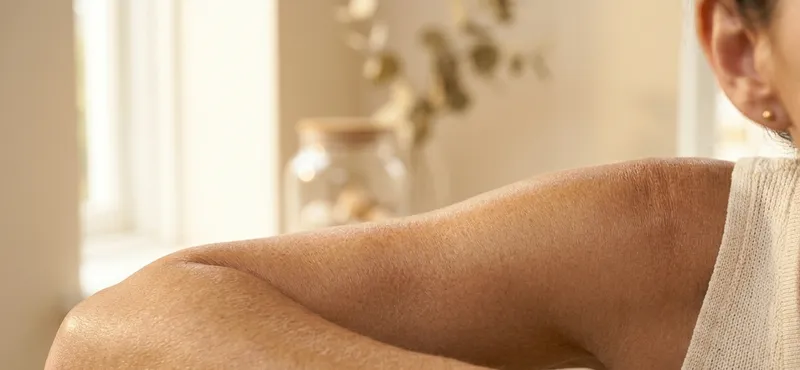
Clinical research confirms that why certain body areas develop crepey texture before others: the progression follows a predictable pattern based on baseline skin thickness, UV exposure history, and mechanical stress. Inner upper arms — thin skin, moderate UV exposure, constant movement from arm motion. This is typically the first body site to show crepey changes, often noticed in the early 40s. Neck — very thin skin, chronic UV exposure from clothing necklines, constant movement from head turning. Décolleté — thin skin, chronic UV exposure, sleep compression. Inner thighs — thin skin, constant friction from movement. Forearms — moderate skin thickness but heavy cumulative UV exposure. The face develops wrinkles rather than diffuse crepey texture because facial skin has more sebaceous glands (providing natural lipid protection) and more robust blood supply (supporting repair mechanisms).
The implications for treatment: since crepey skin represents a compound structural failure (not just one deficit), effective treatment must address all three layers simultaneously. Collagen stimulation alone (retinol, peptides) improves density but doesn't restore elasticity or hydration. Hydration alone (HA, ceramides) improves appearance temporarily but doesn't rebuild structure. Elastic fiber protection alone (antioxidants, retinoids) prevents further degradation but doesn't restore what's been lost. The comprehensive approach — collagen stimulation + elastic fiber protection + deep hydration — addresses all three deficits and produces the most meaningful improvement. The timing window matters: women who begin treatment in early perimenopause (when collagen loss is just accelerating) preserve more structural integrity and achieve better long-term outcomes than those who begin after menopause when significant collagen has already been lost. However, improvement is achievable at any stage — the dermis retains the capacity to produce new collagen in response to retinoid and peptide stimulation regardless of age, though the rate and extent of improvement are greater when more baseline structure remains.
Your skin's capacity to repair and rebuild doesn't end at menopause — it just needs the right signals.
— Dr. Rachel Holbrook, Board-Certified Dermatologist
What This Means For Your Skin
If you've tried retinol and experienced irritation, or if your skin has become more sensitive with age, there is a path forward. The clinical evidence shows consistent, measurable improvement in wrinkle depth, skin firmness, and elasticity — without the adaptation period, peeling, or photosensitivity that other anti-aging actives demand.
Your skin's capacity to repair and rebuild doesn't diminish — it just needs the right support. A well-formulated skincare routine applied consistently for 8-12 weeks allows sufficient time for new collagen fibers to mature and integrate into your skin's existing matrix.
The science is clear. The evidence is consistent. The results are measurable.
What happens next is up to you.