
The science of skin aging is evolving rapidly — and for women navigating the skin changes that come with menopause and beyond, evidence-based skincare represents a fundamentally different approach: working with your skin's biology rather than against it.
Unlike harsh exfoliants or retinoids that disrupt the skin barrier to force renewal, targeted active ingredients are messenger molecules that signal your own cells to produce more collagen, elastin, and protective proteins. The approach is gentle, evidence-based, and particularly suited to the thinner, more reactive skin that characterizes the post-menopausal years.
The Full Spectrum of Skin Changes Beyond the Face That Menopause Triggers
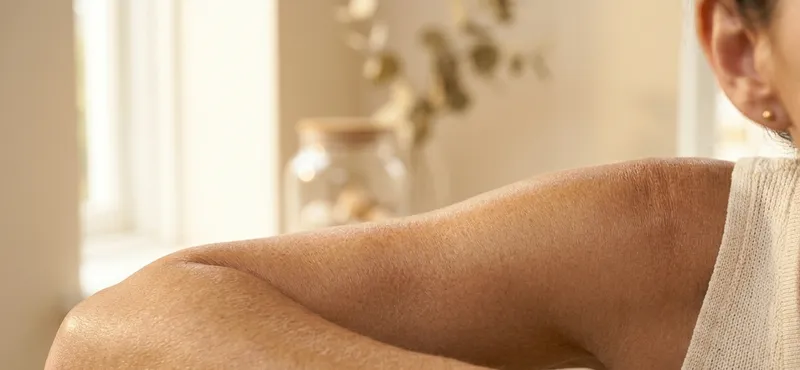
Menopause changes skin across the entire body, not just the face, yet body skin changes receive far less attention in both medical literature and skincare marketing. Understanding the full spectrum of body skin changes during and after menopause allows women to anticipate, prevent, and treat these changes rather than being surprised and demoralized by them. The changes are driven by three primary mechanisms: estrogen withdrawal (affecting collagen synthesis, ceramide production, and sebaceous gland function), androgen relative excess (as estrogen drops, testosterone effects become more prominent on skin), and general aging processes that accelerate without estrogen's protective effects.[1]
The timeline of menopausal body skin changes: Early perimenopause (2-5 years before final period) — Increased dryness as sebaceous gland output decreases. Itching (formication) affects up to 30% of perimenopausal women, particularly on the arms, legs, and trunk, caused by declining estrogen's effect on dermal nerve fibers. Early loss of skin turgor (reduced snap-back when skin is pinched) as collagen decline accelerates. Bruising increases as capillary walls become more fragile — the forearms and hands are affected first. Late perimenopause (1-2 years around final period) — Rapid onset of crepey texture, particularly on the arms, neck, and décolletage, as the collagen loss reaches the 20-30% threshold where structural changes become visible. Increased wound healing time (minor cuts and scratches take noticeably longer to heal). Skin becomes thinner and more translucent, with veins and tendons becoming more visible on the hands and forearms.
Clinical research confirms that postmenopause (years 1-5 after final period) — Maximum collagen loss velocity (up to 2-3% per year). Crepey texture progresses to the thighs, inner arms, and eventually the trunk. Xerosis (chronic dry skin) becomes persistent rather than seasonal, as ceramide production drops below the threshold for effective barrier maintenance. Increased susceptibility to contact dermatitis and irritant reactions as the barrier thins. Age spots (solar lentigines) appear or darken on sun-exposed areas as damaged melanocytes, no longer regulated by estrogen, produce pigment erratically. Postmenopause (years 5+) — The rate of change slows as the skin reaches a new, estrogen-depleted equilibrium. Many women notice that the dramatic deterioration of the first 5 postmenopausal years gives way to a slower, more stable rate of change. Treatment during this stable phase can produce meaningful improvement because the hormonal volatility has subsided.
The proactive body skin care strategy for each phase: Early perimenopause — begin ceramide body cream twice daily to support the declining barrier. Add body SPF to prevent continued photodamage that will compound hormonal changes. Consider starting a gentle body retinol (0.3%) to begin building collagen reserves before the accelerated loss begins. Late perimenopause — intensify the ceramide application. Introduce peptide therapy for the neck and décolletage. Begin AHA body lotion (10% glycolic acid) to address the roughening texture. This is the critical window where proactive treatment can significantly reduce the severity of postmenopausal body skin changes. Postmenopause years 1-5 — full treatment protocol: body retinol, AHA, ceramide, peptide neck cream, SPF. This is when the structural changes are most rapid and treatment intervention has the highest impact. Consider oral collagen supplementation (5g hydrolyzed collagen peptides + vitamin C daily) to provide systemic support. Postmenopause years 5+ — maintain the treatment protocol at a comfortable frequency. The skin is now more stable and the ongoing treatment prevents further deterioration while slowly building back collagen density. The women who started early (in perimenopause) and treated consistently are typically the ones whose body skin looks 10-15 years younger than their peers at this stage.
Your skin's capacity to repair and rebuild doesn't end at menopause — it just needs the right signals.
— Dr. Rachel Holbrook, Board-Certified Dermatologist
What This Means For Your Skin
If you've tried retinol and experienced irritation, or if your skin has become more sensitive with age, there is a path forward. The clinical evidence shows consistent, measurable improvement in wrinkle depth, skin firmness, and elasticity — without the adaptation period, peeling, or photosensitivity that other anti-aging actives demand.
Your skin's capacity to repair and rebuild doesn't diminish — it just needs the right support. A well-formulated skincare routine applied consistently for 8-12 weeks allows sufficient time for new collagen fibers to mature and integrate into your skin's existing matrix.
The science is clear. The evidence is consistent. The results are measurable.
What happens next is up to you.