
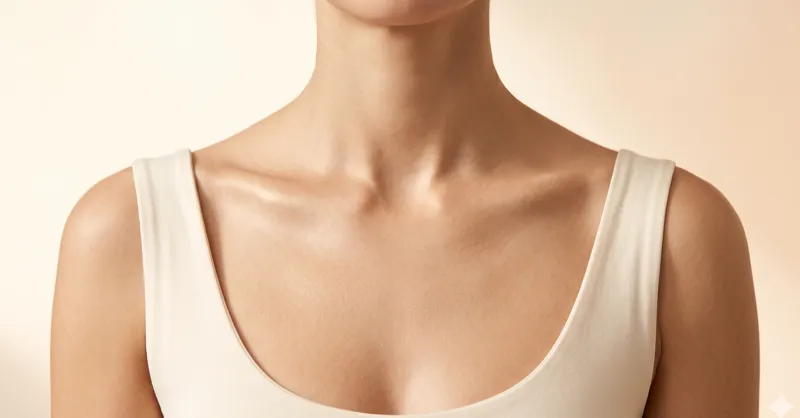
The science of skin aging is evolving rapidly — and for women navigating the skin changes that come with menopause and beyond, evidence-based skincare represents a fundamentally different approach: working with your skin's biology rather than against it.
Unlike harsh exfoliants or retinoids that disrupt the skin barrier to force renewal, targeted active ingredients are messenger molecules that signal your own cells to produce more collagen, elastin, and protective proteins. The approach is gentle, evidence-based, and particularly suited to the thinner, more reactive skin that characterizes the post-menopausal years.
What to Look For in a Chest-Specific Anti-Wrinkle Treatment
Choosing the best cream for décolletage wrinkles requires understanding what distinguishes chest skin from facial skin — and why the best face cream is not automatically the best chest cream. The décolleté's thinner dermis (0.5-0.8mm versus 1.0-1.5mm on the face), fewer sebaceous glands, and greater cumulative sun damage create a skin environment where ingredient selection, concentration, and vehicle formulation all require adjustment from facial products. The ideal décolletage cream must simultaneously deliver collagen-stimulating actives at concentrations that produce structural rebuilding while protecting the compromised barrier from the irritation that aggressive formulations frequently cause on this sensitive area. This dual requirement — efficacy without irritation — is the central challenge, and it eliminates many facial anti-aging products that rely on high-concentration retinoids or aggressive exfoliating acids.[1]
The ideal décolletage cream contains five evidence-based ingredients in specific concentration ranges: (1) Peptides (Matrixyl 3000 or palmitoyl pentapeptide-4) at 3-8% — the primary collagen stimulant. Peptides are the ideal lead active for the décolleté because they provide measurable collagen stimulation without irritation, photosensitivity, or barrier compromise. Look for the peptide listed in the first 5-7 ingredients on the product label — this indicates functional concentration. Products listing peptides near the end of the ingredient list contain decorative amounts (0.01-0.1%) that are biologically inactive. (2) Ceramides (ceramide NP, ceramide AP, ceramide EOP) — the barrier repair component. The décolleté's impaired barrier requires external ceramide supplementation to reduce transepidermal water loss and maintain the hydrated environment that collagen-stimulating actives need to function. (3) Niacinamide (vitamin B3) at 3-5% — supports ceramide production endogenously, provides anti-inflammatory activity that calms the sensitized chest skin, and has mild collagen-stimulating properties of its own.
Clinical research confirms that (4) Hyaluronic acid (multi-molecular-weight) — provides immediate hydration-mediated wrinkle reduction while the slower collagen rebuilding proceeds. Low-molecular-weight HA (50-300 kDa) penetrates the upper dermis for deeper plumping; high-molecular-weight HA (1,000-1,800 kDa) remains on the surface, creating a moisture-retaining film. The combination provides both immediate cosmetic improvement and sustained hydration. (5) Squalane or shea butter — the emollient and occlusive component. The décolleté's limited sebaceous activity means it requires more robust occlusion than facial skin. A cream with a richer emollient base prevents the rapid evaporation of water-phase actives (HA, niacinamide) from the chest's surface. Ingredients to avoid in a décolletage cream: high-concentration retinol (>0.25% is too aggressive for most chest skin), alpha-hydroxy acids at exfoliating concentrations (>8% glycolic, >10% lactic — these compromise the already-thin barrier), fragrance (unnecessary irritant for sensitized skin), and alcohol denat (strips barrier lipids from an already oil-poor area).
Application technique for maximum décolletage cream efficacy: (1) Apply to slightly damp skin — the residual moisture from toning or misting enhances ingredient penetration and hyaluronic acid activation. (2) Use a generous amount — most women under-apply to the chest. The entire décolleté area from clavicle to breast tissue line requires approximately one-half to one full pump of cream. (3) Apply in upward strokes from the breast line toward the clavicle — this gentle upward massage promotes lymphatic drainage and prevents the downward pulling that contributes to gravitational laxity. (4) Extend to the sides of the neck — the lateral neck receives the same UV exposure as the chest and benefits from the same treatment. (5) Apply morning and evening for sustained active ingredient delivery. (6) Follow with SPF 50 in the morning — no cream, regardless of ingredients, can improve décolletage wrinkles if ongoing UV damage continues to degrade collagen faster than the treatment rebuilds it. The best cream produces zero results if sunscreen is omitted. Expected results with a properly formulated décolletage cream: visible texture improvement at 4-6 weeks (hydration effects), measurable wrinkle reduction at 12-16 weeks (collagen rebuilding), progressive firmness improvement through 6-12 months (cumulative structural remodeling).
Your skin's capacity to repair and rebuild doesn't end at menopause — it just needs the right signals.
— Dr. Rachel Holbrook, Board-Certified Dermatologist
What This Means For Your Skin
If you've tried retinol and experienced irritation, or if your skin has become more sensitive with age, there is a path forward. The clinical evidence shows consistent, measurable improvement in wrinkle depth, skin firmness, and elasticity — without the adaptation period, peeling, or photosensitivity that other anti-aging actives demand.
Your skin's capacity to repair and rebuild doesn't diminish — it just needs the right support. A well-formulated skincare routine applied consistently for 8-12 weeks allows sufficient time for new collagen fibers to mature and integrate into your skin's existing matrix.
The science is clear. The evidence is consistent. The results are measurable.
What happens next is up to you.