
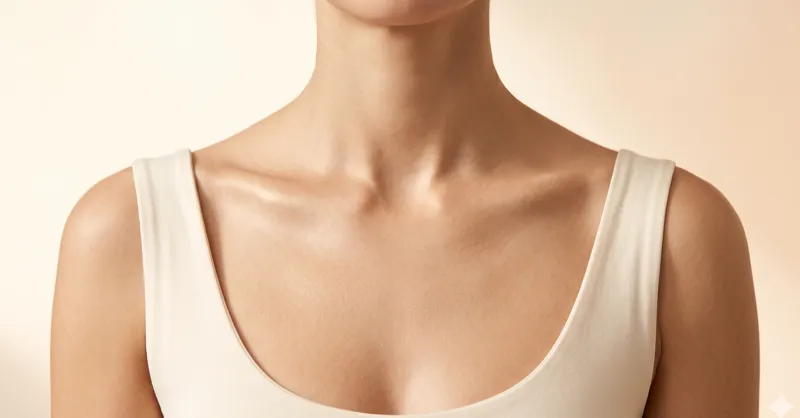
The science of skin aging is evolving rapidly — and for women navigating the skin changes that come with menopause and beyond, evidence-based skincare represents a fundamentally different approach: working with your skin's biology rather than against it.
Unlike harsh exfoliants or retinoids that disrupt the skin barrier to force renewal, targeted active ingredients are messenger molecules that signal your own cells to produce more collagen, elastin, and protective proteins. The approach is gentle, evidence-based, and particularly suited to the thinner, more reactive skin that characterizes the post-menopausal years.
How to Use Retinoids on the Décolleté Without Damaging Thin Skin
Retinol on chest skin is both safe and beneficial — when applied correctly. The concern about using retinol on the décolleté is valid because the chest skin is physiologically different from facial skin in ways that affect retinoid tolerance: it is thinner (0.5-0.8mm versus 1.0-1.5mm), has fewer sebaceous glands (less natural lipid protection), and often has a compromised barrier from decades of UV exposure. These factors combine to make the chest more susceptible to retinoid dermatitis — the redness, burning, peeling, and dryness that occur when retinol overwhelms the skin's metabolic and barrier capacity. However, the same factors that make the chest vulnerable to irritation also make it highly responsive to properly dosed retinoid therapy — the thinner dermis allows greater drug delivery per unit of product, meaning lower concentrations on the chest achieve similar fibroblast stimulation as higher concentrations on the face.[1]
The safe retinol protocol for chest skin: Concentration — maximum 0.25% retinol for the décolleté. Most women will see optimal results at 0.15-0.25%, a range that provides meaningful retinoid receptor activation without overwhelming the thin barrier. Never apply a 0.5% or 1.0% facial retinol product to the chest — the increased absorption through thinner skin effectively doubles or triples the local concentration, virtually guaranteeing retinoid dermatitis. If your facial retinol is 0.5%, either use a separate 0.25% product for the chest or dilute the facial product by mixing 50/50 with ceramide cream before chest application. Frequency — start with once per week and increase to a maximum of twice weekly over 8-12 weeks. The chest should never receive retinol more than 3 times per week, and most women achieve excellent results at 1-2 applications weekly. Application method — always use the ceramide sandwich: apply ceramide cream first, wait 5 minutes, apply retinol, wait 5 minutes, apply second layer of ceramide cream. This buffered delivery reduces peak retinol concentration at the skin surface while maintaining dermal delivery.
Clinical research confirms that warning signs that indicate retinol is too aggressive for your chest: (1) Persistent redness lasting more than 24 hours after application — normal retinoid response produces mild, transient pinkness that resolves within 12 hours. (2) Burning or stinging during or after application — the chest should never burn from properly dosed retinol. (3) Visible peeling or flaking — while facial skin often tolerates mild retinoid peeling, chest skin peeling indicates barrier damage. (4) Increased dryness or tightness — the already oil-poor chest cannot tolerate further barrier depletion. If any of these signs appear: stop retinol for 2 weeks, apply ceramide cream twice daily to rebuild the barrier, then restart at a lower concentration or frequency. Never push through chest irritation — unlike facial skin, which has more sebaceous support for self-repair, damaged chest barrier function can take 3-4 weeks to recover.
Why retinol is worth the careful approach: the benefits of retinol on chest skin — when applied safely — are substantial. (1) Collagen stimulation — retinoid receptor activation upregulates procollagen I and III gene expression, increasing the structural protein density in the décolleté dermis. This directly addresses the primary cause of chest wrinkles and crepiness. (2) MMP suppression — retinoids suppress the expression of MMP-1, MMP-3, and MMP-9, reducing the enzymatic degradation of existing collagen and elastin. This dual action — building new structure while protecting existing structure — makes retinol uniquely effective among anti-aging actives. (3) Epidermal thickening — retinoids stimulate keratinocyte proliferation, thickening the epidermis. This is particularly valuable on the thin chest skin, where even modest epidermal thickening improves texture and resilience. (4) Pigment reduction — retinoids accelerate keratinocyte turnover, shedding melanin-containing surface cells faster and reducing the mottled hyperpigmentation common on the sun-damaged chest. Expected results with safe chest retinol use: texture improvement at 8-12 weeks, visible wrinkle reduction at 16-24 weeks, progressive firmness and tone improvement through 6-12 months.
Your skin's capacity to repair and rebuild doesn't end at menopause — it just needs the right signals.
— Dr. Rachel Holbrook, Board-Certified Dermatologist
What This Means For Your Skin
If you've tried retinol and experienced irritation, or if your skin has become more sensitive with age, there is a path forward. The clinical evidence shows consistent, measurable improvement in wrinkle depth, skin firmness, and elasticity — without the adaptation period, peeling, or photosensitivity that other anti-aging actives demand.
Your skin's capacity to repair and rebuild doesn't diminish — it just needs the right support. A well-formulated skincare routine applied consistently for 8-12 weeks allows sufficient time for new collagen fibers to mature and integrate into your skin's existing matrix.
The science is clear. The evidence is consistent. The results are measurable.
What happens next is up to you.