
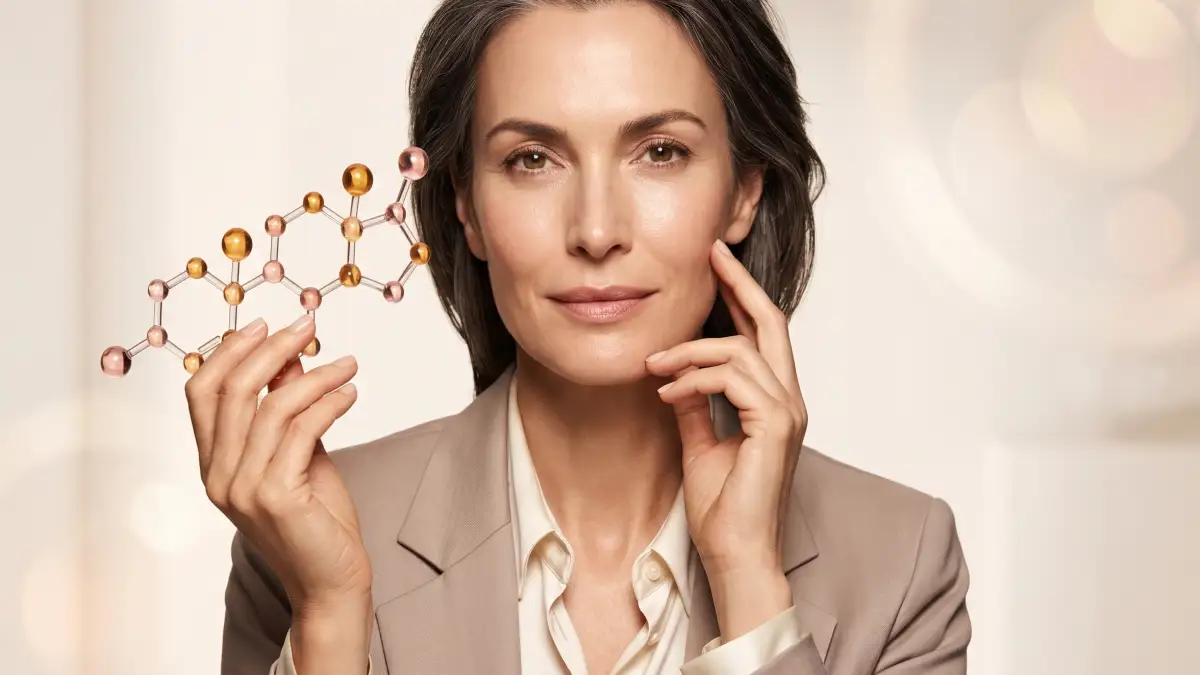
The science of skin aging is evolving rapidly — and for women navigating the skin changes that come with menopause and beyond, evidence-based skincare represents a fundamentally different approach: working with your skin's biology rather than against it.
Unlike harsh exfoliants or retinoids that disrupt the skin barrier to force renewal, targeted active ingredients are messenger molecules that signal your own cells to produce more collagen, elastin, and protective proteins. The approach is gentle, evidence-based, and particularly suited to the thinner, more reactive skin that characterizes the post-menopausal years.
Why Wounds Take Longer to Heal After Menopause
One of the most clinically significant but underappreciated consequences of estrogen decline is impaired wound healing. Post-menopausal women experience measurably slower wound healing compared to premenopausal women — cuts take longer to close, bruises take longer to resolve, and skin recovery after procedures or injuries is prolonged. This is not simply a matter of aging: studies controlling for chronological age have shown that estrogen status is an independent predictor of wound healing speed, and that estrogen replacement accelerates healing in postmenopausal women to rates approaching premenopausal levels.[1]
Estrogen facilitates wound healing through multiple concurrent mechanisms. First, it regulates the inflammatory phase: estrogen modulates macrophage function, preventing excessive inflammation that delays healing while maintaining sufficient inflammatory signaling to initiate repair. In estrogen-depleted skin, wounds show prolonged and dysregulated inflammation — excessive neutrophil infiltration and elevated pro-inflammatory cytokines that delay the transition to the proliferative phase. Second, estrogen directly stimulates the proliferative phase: it promotes fibroblast migration to the wound site, stimulates collagen deposition, enhances angiogenesis (new blood vessel formation to supply the healing tissue), and accelerates re-epithelialization (keratinocyte migration to close the wound surface).
Clinical research confirms that third, estrogen enhances growth factor production at the wound site. Transforming growth factor-beta (TGF-β), vascular endothelial growth factor (VEGF), and platelet-derived growth factor (PDGF) — all critical for wound repair — are produced at higher levels in estrogen-replete skin. Ashcroft and colleagues demonstrated that estrogen replacement therapy in ovariectomized mice restored wound healing speed to pre-ovariectomy levels, with normalized inflammatory responses and increased collagen deposition at wound sites. Clinical studies in postmenopausal women confirmed these findings: topical estrogen applied to wound sites accelerated healing by reducing excessive inflammation and promoting ordered collagen deposition.
The practical implications for menopausal women are significant for both daily life and medical decisions. For daily skin recovery: the slower healing means that minor cuts, scratches, and skin insults require more careful management — gentle cleansing, protective bandaging, and avoidance of irritants that would have been tolerable in younger skin. For cosmetic procedures: recovery from laser treatments, chemical peels, microneedling, and other skin-rejuvenation procedures takes longer in postmenopausal women, and treatment protocols should be adjusted accordingly (longer intervals between sessions, milder settings). For skincare routine tolerance: the reduced healing capacity means that irritating active ingredients (high-concentration retinoids, strong AHAs) should be introduced more gradually and used at lower frequencies. Supporting wound healing through nutrition is also essential — vitamin C, zinc, and protein intake directly support the healing cascade that estrogen decline has impaired, providing the raw materials for collagen deposition and tissue repair even when the hormonal signal is diminished.
Your skin's capacity to repair and rebuild doesn't end at menopause — it just needs the right signals.
— Dr. Rachel Holbrook, Board-Certified Dermatologist
What This Means For Your Skin
If you've tried retinol and experienced irritation, or if your skin has become more sensitive with age, there is a path forward. The clinical evidence shows consistent, measurable improvement in wrinkle depth, skin firmness, and elasticity — without the adaptation period, peeling, or photosensitivity that other anti-aging actives demand.
Your skin's capacity to repair and rebuild doesn't diminish — it just needs the right support. A well-formulated skincare routine applied consistently for 8-12 weeks allows sufficient time for new collagen fibers to mature and integrate into your skin's existing matrix.
The science is clear. The evidence is consistent. The results are measurable.
What happens next is up to you.