
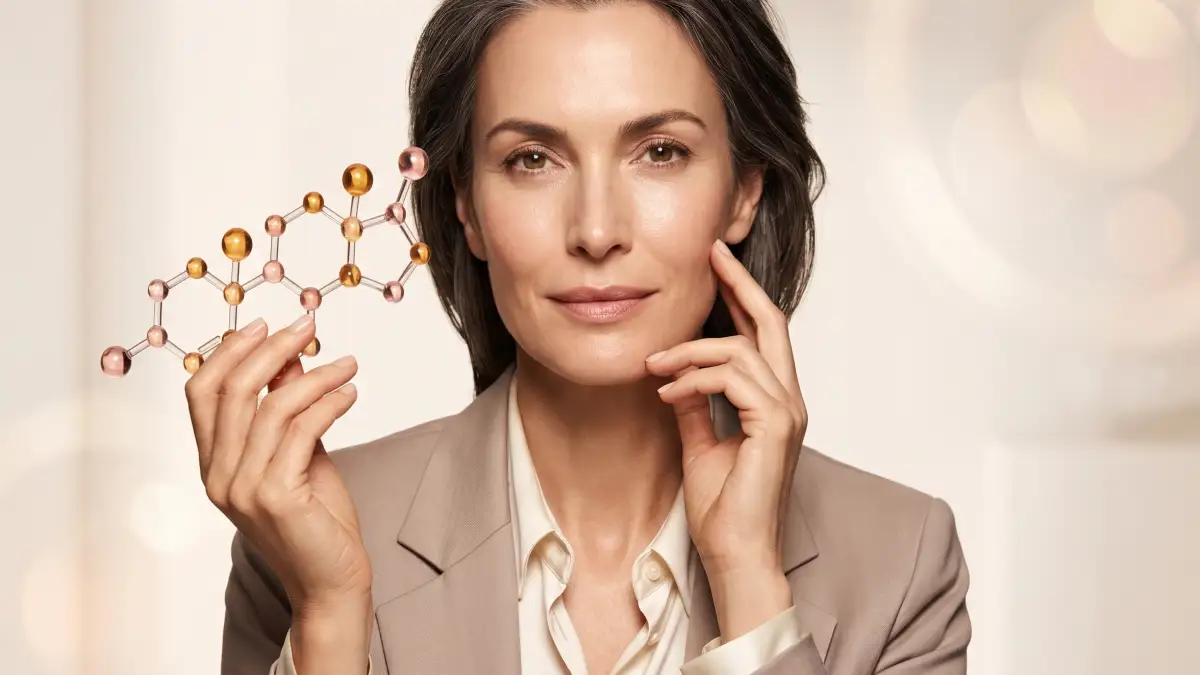
The science of skin aging is evolving rapidly — and for women navigating the skin changes that come with menopause and beyond, evidence-based skincare represents a fundamentally different approach: working with your skin's biology rather than against it.
Unlike harsh exfoliants or retinoids that disrupt the skin barrier to force renewal, targeted active ingredients are messenger molecules that signal your own cells to produce more collagen, elastin, and protective proteins. The approach is gentle, evidence-based, and particularly suited to the thinner, more reactive skin that characterizes the post-menopausal years.
How Dermal Thinning Accelerates After Menopause
Skin thickness is one of the most objective measures of skin aging — and it is directly correlated with estrogen levels. Brincat's research demonstrated that postmenopausal women lose 1.13% of skin thickness per year, a decline that parallels the loss of bone density so closely that skin thickness has been proposed as a non-invasive marker for osteoporosis risk. The thinning occurs primarily in the dermis, where the loss of collagen and glycosaminoglycans reduces the structural matrix that gives skin its volume and resilience.[1]
The dermis is composed of approximately 70% collagen by dry weight, with the remainder consisting of elastin, hyaluronic acid, and other glycosaminoglycans embedded in a ground substance matrix. When estrogen declines, fibroblast activity decreases across all these components simultaneously — producing less collagen, less elastin, and less hyaluronic acid. The result is a dermis that is both thinner (less structural protein) and drier (less water-binding hyaluronic acid). Ultrasound studies show measurable reduction in dermal thickness within two years of menopause onset, with the rate accelerating in women who experience abrupt estrogen withdrawal (surgical menopause) compared to gradual natural menopause.
Clinical research confirms that thin skin is not merely a cosmetic concern — it has functional consequences. Thinner skin is more vulnerable to mechanical injury (bruising, tearing), slower to heal when damaged, more susceptible to photoaging from UV exposure (less dermal cushioning means UV penetrates to deeper structures), and less effective as a barrier against environmental insults. Women who notice that their skin bruises more easily, heals more slowly, or feels 'papery' after menopause are experiencing the functional consequences of estrogen-mediated dermal thinning.
Addressing skin thickness decline requires stimulating fibroblast activity through non-estrogenic pathways. Topical retinoids are the most evidence-based intervention — tretinoin has been shown to increase dermal thickness by stimulating collagen synthesis and fibroblast proliferation through retinoic acid receptor activation, independent of estrogen. Niacinamide (vitamin B3) enhances epidermal and dermal protein production, contributing to overall skin thickness. Hyaluronic acid — both topical and oral — supports dermal hydration and volume. The combination of these interventions can partially compensate for the estrogen-driven thinning, though they cannot fully replicate estrogen's comprehensive effect on dermal maintenance. Regular sunscreen use is essential because UV damage compounds estrogen-mediated thinning, producing accelerated dermal deterioration through dual-pathway destruction.
Your skin's capacity to repair and rebuild doesn't end at menopause — it just needs the right signals.
— Dr. Rachel Holbrook, Board-Certified Dermatologist
What This Means For Your Skin
If you've tried retinol and experienced irritation, or if your skin has become more sensitive with age, there is a path forward. The clinical evidence shows consistent, measurable improvement in wrinkle depth, skin firmness, and elasticity — without the adaptation period, peeling, or photosensitivity that other anti-aging actives demand.
Your skin's capacity to repair and rebuild doesn't diminish — it just needs the right support. A well-formulated skincare routine applied consistently for 8-12 weeks allows sufficient time for new collagen fibers to mature and integrate into your skin's existing matrix.
The science is clear. The evidence is consistent. The results are measurable.
What happens next is up to you.