
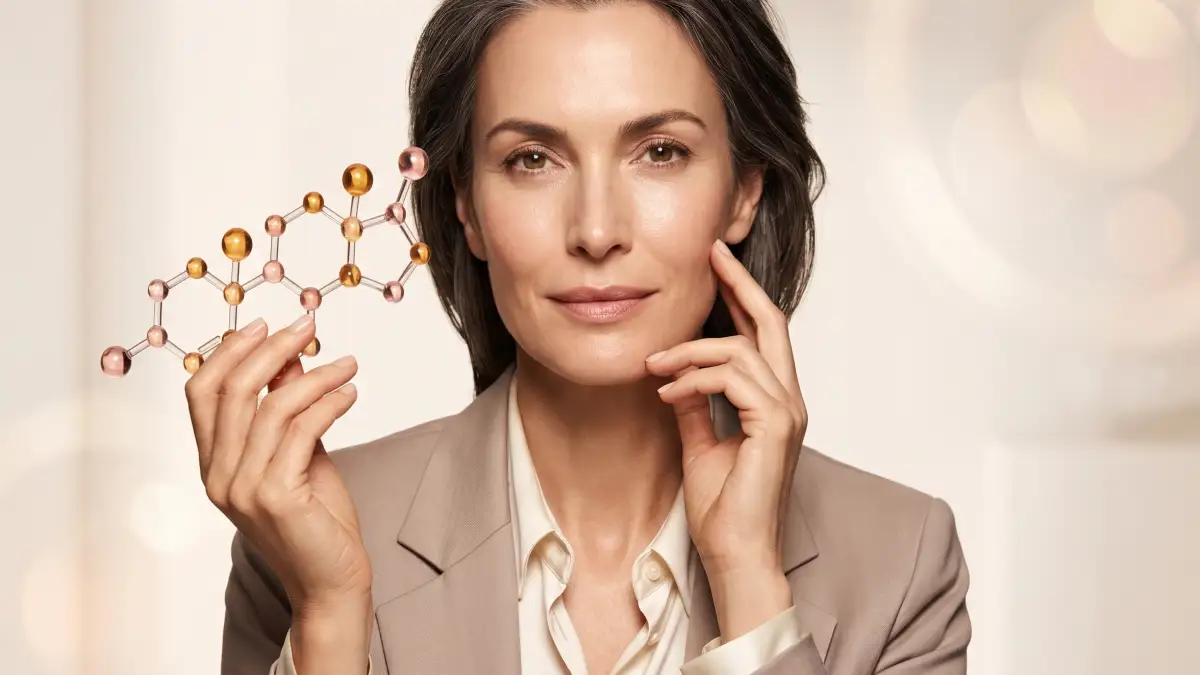
The science of skin aging is evolving rapidly — and for women navigating the skin changes that come with menopause and beyond, evidence-based skincare represents a fundamentally different approach: working with your skin's biology rather than against it.
Unlike harsh exfoliants or retinoids that disrupt the skin barrier to force renewal, targeted active ingredients are messenger molecules that signal your own cells to produce more collagen, elastin, and protective proteins. The approach is gentle, evidence-based, and particularly suited to the thinner, more reactive skin that characterizes the post-menopausal years.
Why Menopause Depletes Hyaluronic Acid and Moisture
The persistent, unrelenting dryness that develops during menopause is not simply an inconvenience — it reflects a fundamental change in the skin's capacity to produce and retain moisture, driven directly by estrogen withdrawal. Estrogen stimulates hyaluronic acid synthase enzymes (HAS1, HAS2, HAS3) in both keratinocytes and fibroblasts, maintaining the hyaluronic acid content that accounts for the skin's water-binding capacity. A single gram of hyaluronic acid holds up to 6 liters of water, and when estrogen-driven HA production declines, the skin's moisture reservoir depletes dramatically.[1]
The hydration loss is compounded by concurrent damage to the skin barrier. Estrogen supports the production of ceramides, cholesterol, and fatty acids that compose the stratum corneum lipid matrix — the waterproof barrier that prevents trans-epidermal water loss (TEWL). When estrogen declines, ceramide production decreases, the lipid barrier becomes compromised, and TEWL increases measurably. Studies show that postmenopausal women have 20-30% higher TEWL than premenopausal women of similar age, meaning the skin loses moisture faster while simultaneously producing less hyaluronic acid to replace it. This dual deficit — reduced moisture production plus increased moisture loss — creates the deep, persistent dryness that menopausal women report as qualitatively different from the dry skin they experienced in younger years.
Clinical research confirms that the clinical consequences extend beyond discomfort. Dehydrated skin is mechanically weaker (more prone to fine lines from simple facial expressions), less resilient (slower to recover from compression or stretching), and more susceptible to irritation and sensitization (a compromised barrier allows irritant penetration). The relationship between hydration and visible aging is direct: dehydrated skin exaggerates every wrinkle and fine line because the collapsed hyaluronic acid matrix no longer plumps the tissue between collagen fibers. Many women report that their wrinkles appear dramatically worse in winter or in dry climates — this is the hydration component of aging becoming visible when environmental conditions further stress already-depleted moisture reserves.
Addressing estrogen-related hydration loss requires targeting both hyaluronic acid production and barrier repair. Topical hyaluronic acid (multi-weight formulations with low, medium, and high molecular weight HA) provides immediate surface hydration and signals keratinocytes to increase endogenous HA production. Ceramide-containing moisturizers repair the lipid barrier, reducing TEWL. Niacinamide (3-5%) stimulates ceramide synthesis independent of estrogen pathways. Oral hyaluronic acid supplementation (120-240mg daily) has shown clinical benefit for skin hydration in controlled trials. Phytoestrogens (topical genistein) can partially reactivate HA synthase enzymes through ERβ binding. The key principle is barrier-first: repair the lipid barrier to stop moisture loss, then replenish hyaluronic acid to restore the moisture reservoir. This layered approach compensates for both aspects of estrogen-mediated hydration decline.
Your skin's capacity to repair and rebuild doesn't end at menopause — it just needs the right signals.
— Dr. Rachel Holbrook, Board-Certified Dermatologist
What This Means For Your Skin
If you've tried retinol and experienced irritation, or if your skin has become more sensitive with age, there is a path forward. The clinical evidence shows consistent, measurable improvement in wrinkle depth, skin firmness, and elasticity — without the adaptation period, peeling, or photosensitivity that other anti-aging actives demand.
Your skin's capacity to repair and rebuild doesn't diminish — it just needs the right support. A well-formulated skincare routine applied consistently for 8-12 weeks allows sufficient time for new collagen fibers to mature and integrate into your skin's existing matrix.
The science is clear. The evidence is consistent. The results are measurable.
What happens next is up to you.