
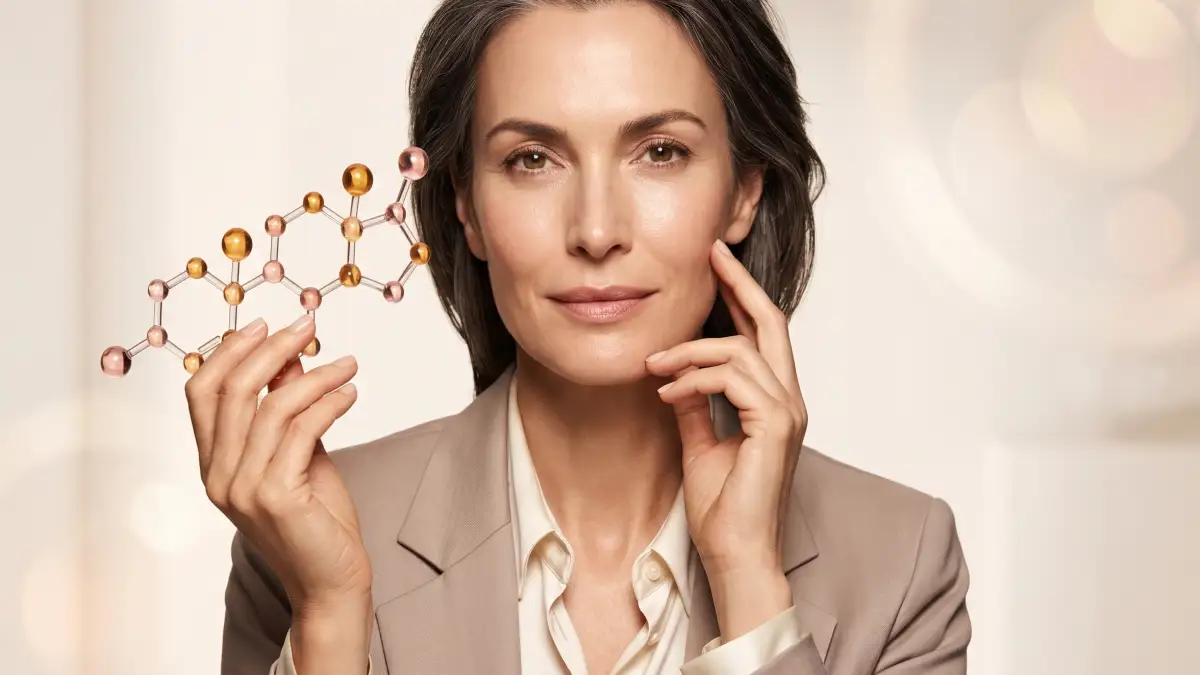
The science of skin aging is evolving rapidly — and for women navigating the skin changes that come with menopause and beyond, evidence-based skincare represents a fundamentally different approach: working with your skin's biology rather than against it.
Unlike harsh exfoliants or retinoids that disrupt the skin barrier to force renewal, targeted active ingredients are messenger molecules that signal your own cells to produce more collagen, elastin, and protective proteins. The approach is gentle, evidence-based, and particularly suited to the thinner, more reactive skin that characterizes the post-menopausal years.
Non-HRT Ingredients That Mimic Estrogen's Skin Benefits
For women who cannot or prefer not to use hormone replacement therapy, a growing arsenal of non-hormonal ingredients can partially replicate estrogen's skin benefits by activating overlapping cellular pathways. No single ingredient replaces estrogen's comprehensive effect — but a strategic combination of multiple ingredients, each addressing different aspects of estrogen's protective function, can meaningfully slow menopausal skin aging and partially compensate for the hormonal deficit. The approach requires understanding which aspects of estrogen function each alternative addresses.[1]
Phytoestrogens (topical genistein, daidzein, equol) — these are the closest functional analogs to estrogen, binding directly to ERβ receptors on skin cells. Topical formulations containing 1-4% soy isoflavones have demonstrated measurable increases in collagen content, skin thickness, and hydration in postmenopausal women. They address the receptor-mediated component of estrogen's skin protection. DHEA (dehydroepiandrosterone) — this adrenal hormone precursor is converted to estrogen locally in the skin by the enzyme aromatase. Topical DHEA (1-2%) has shown clinical benefit for improving skin thickness, sebum production, and overall skin quality in postmenopausal women, effectively providing a local source of estrogen to the skin without significant systemic hormonal effects.
Clinical research confirms that retinoids (tretinoin, retinol, retinaldehyde) — while not estrogenic, retinoids activate many of the same downstream gene targets as estrogen through an independent receptor system (RAR/RXR). They stimulate collagen I and III gene expression, increase fibroblast proliferation, enhance hyaluronic acid production, and inhibit matrix metalloproteinases. Retinoids are the most evidence-based non-hormonal intervention for skin collagen stimulation and partially compensate for the loss of estrogen-mediated collagen gene activation. Bakuchiol — a plant-derived retinol alternative that shows both retinoid-like and phytoestrogenic properties, making it a dual-pathway ingredient particularly suitable for menopausal skin that is too sensitive for prescription retinoids.
The optimal non-HRT protocol combines multiple alternatives for maximum pathway coverage. Morning: vitamin C serum (antioxidant protection for existing collagen and elastin) + phytoestrogen cream or serum (ERβ activation) + peptide serum containing Matrixyl and GHK-Cu (growth factor signaling for collagen synthesis) + ceramide-rich moisturizer (barrier repair) + SPF 30+. Evening: retinoid (prescription tretinoin or over-the-counter retinol, applied to tolerance) + DHEA cream if available by prescription (local estrogen conversion) + multi-weight hyaluronic acid serum (hydration replacement) + niacinamide 3-5% (ceramide synthesis stimulation) + restorative night cream. This comprehensive protocol addresses collagen stimulation (retinoid + peptides + phytoestrogens), hydration restoration (HA + ceramides + niacinamide), antioxidant protection (vitamin C), and partial estrogen pathway restoration (phytoestrogens + DHEA). It requires more products and more pathways than HRT to achieve a partial effect — but for women who cannot use hormones, it represents the most complete non-hormonal approach available.
Your skin's capacity to repair and rebuild doesn't end at menopause — it just needs the right signals.
— Dr. Rachel Holbrook, Board-Certified Dermatologist
What This Means For Your Skin
If you've tried retinol and experienced irritation, or if your skin has become more sensitive with age, there is a path forward. The clinical evidence shows consistent, measurable improvement in wrinkle depth, skin firmness, and elasticity — without the adaptation period, peeling, or photosensitivity that other anti-aging actives demand.
Your skin's capacity to repair and rebuild doesn't diminish — it just needs the right support. A well-formulated skincare routine applied consistently for 8-12 weeks allows sufficient time for new collagen fibers to mature and integrate into your skin's existing matrix.
The science is clear. The evidence is consistent. The results are measurable.
What happens next is up to you.