
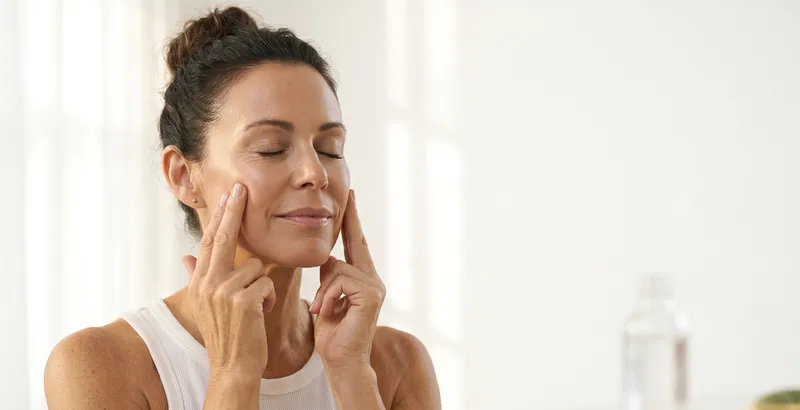
The science of skin aging is evolving rapidly — and for women navigating the skin changes that come with menopause and beyond, evidence-based skincare represents a fundamentally different approach: working with your skin's biology rather than against it.
Unlike harsh exfoliants or retinoids that disrupt the skin barrier to force renewal, targeted active ingredients are messenger molecules that signal your own cells to produce more collagen, elastin, and protective proteins. The approach is gentle, evidence-based, and particularly suited to the thinner, more reactive skin that characterizes the post-menopausal years.
Combining Facial Exercises with Gua Sha and Jade Roller Techniques
The integration of facial massage tools with face yoga exercises represents a multimodal approach to facial rejuvenation that addresses complementary aspects of tissue aging. Gua sha — a traditional Chinese medicine technique involving scraping a smooth-edged tool across lubricated skin — creates controlled microtrauma that stimulates localized inflammatory response, fibroblast activation, and increased blood perfusion. When combined with face yoga's muscle-strengthening effects, the result is a comprehensive protocol targeting both the muscular and connective tissue layers of the face. Jade rollers and similar rolling tools provide gentler mechanical stimulation focused on lymphatic drainage and product penetration enhancement. Understanding the distinct mechanisms of each tool allows for strategic sequencing within a face yoga practice: active muscle exercises build structural support, gua sha remodels fascial tissue and stimulates collagen production, and rolling tools optimize fluid balance and surface skin quality.[1]
Clinical evidence for facial gua sha demonstrates measurable increases in microcirculation lasting 20-25 minutes post-treatment, with repeated application sessions producing cumulative improvements in dermal blood flow capacity. A 2019 study using laser speckle contrast imaging documented a 400% increase in superficial blood perfusion immediately following facial gua sha, with residual elevation of 20-30% above baseline persisting for several hours. This enhanced perfusion delivers oxygen and nutrients to fibroblasts while removing metabolic waste products, creating an optimal environment for collagen synthesis. When performed before face yoga exercises, gua sha may prime the muscles for more effective contraction through increased local temperature and blood flow. When performed after exercises, it may enhance recovery and facilitate the removal of exercise-induced metabolic byproducts. The mechanical pressure of gua sha also breaks down fascial adhesions that accumulate with age, improving tissue glide and reducing the tethered appearance of deep wrinkles.
Clinical research confirms that jade roller and crystal roller tools operate primarily through gentle lymphatic stimulation and mechanical product absorption enhancement. The rolling motion, performed in outward and upward directions following lymphatic drainage pathways, assists in moving interstitial fluid toward regional lymph nodes for clearance. Clinical studies measuring facial circumference before and after roller use demonstrate measurable reductions in periorbital puffiness within 5-10 minutes of application. Cold jade or stone rollers provide additional vasoconstrictive benefit that temporarily reduces redness and tightens superficial skin. However, it is important to note that roller tools do not provide the deep tissue manipulation or fibroblast stimulation achieved by gua sha, and their effects are primarily transient rather than cumulative. Within a face yoga protocol, rollers are best positioned as a post-exercise recovery tool or morning de-puffing technique rather than a primary anti-aging intervention.
An evidence-based protocol integrating all three modalities would follow this sequence for maximum synergistic benefit: Begin with 2-3 minutes of gua sha to increase blood flow, break fascial adhesions, and warm the tissues. Progress to 8-10 minutes of active face yoga exercises while tissues are optimally perfused and pliable. Conclude with 2-3 minutes of jade roller application for lymphatic drainage, skin cooling, and serum absorption. Hygiene considerations are paramount — tools must be cleaned before and after each use with alcohol or mild soap to prevent bacterial transfer to facial skin. Pressure calibration is critical: gua sha should produce transient redness (sha) without bruising or pain, requiring medium-firm pressure at approximately 30-degree angles to the skin surface. Women on blood thinners, those with rosacea or active acne, or those with extremely thin, fragile skin should use lighter pressure or avoid gua sha in affected areas. Tool material (jade, rose quartz, stainless steel, bian stone) has minimal impact on efficacy compared to technique and consistency.
Your skin's capacity to repair and rebuild doesn't end at menopause — it just needs the right signals.
— Dr. Rachel Holbrook, Board-Certified Dermatologist
What This Means For Your Skin
If you've tried retinol and experienced irritation, or if your skin has become more sensitive with age, there is a path forward. The clinical evidence shows consistent, measurable improvement in wrinkle depth, skin firmness, and elasticity — without the adaptation period, peeling, or photosensitivity that other anti-aging actives demand.
Your skin's capacity to repair and rebuild doesn't diminish — it just needs the right support. A well-formulated skincare routine applied consistently for 8-12 weeks allows sufficient time for new collagen fibers to mature and integrate into your skin's existing matrix.
The science is clear. The evidence is consistent. The results are measurable.
What happens next is up to you.