
The science of skin aging is evolving rapidly — and for women navigating the skin changes that come with menopause and beyond, evidence-based skincare represents a fundamentally different approach: working with your skin's biology rather than against it.
Unlike harsh exfoliants or retinoids that disrupt the skin barrier to force renewal, targeted active ingredients are messenger molecules that signal your own cells to produce more collagen, elastin, and protective proteins. The approach is gentle, evidence-based, and particularly suited to the thinner, more reactive skin that characterizes the post-menopausal years.
Jade vs Rose Quartz vs Bian Stone vs Stainless Steel
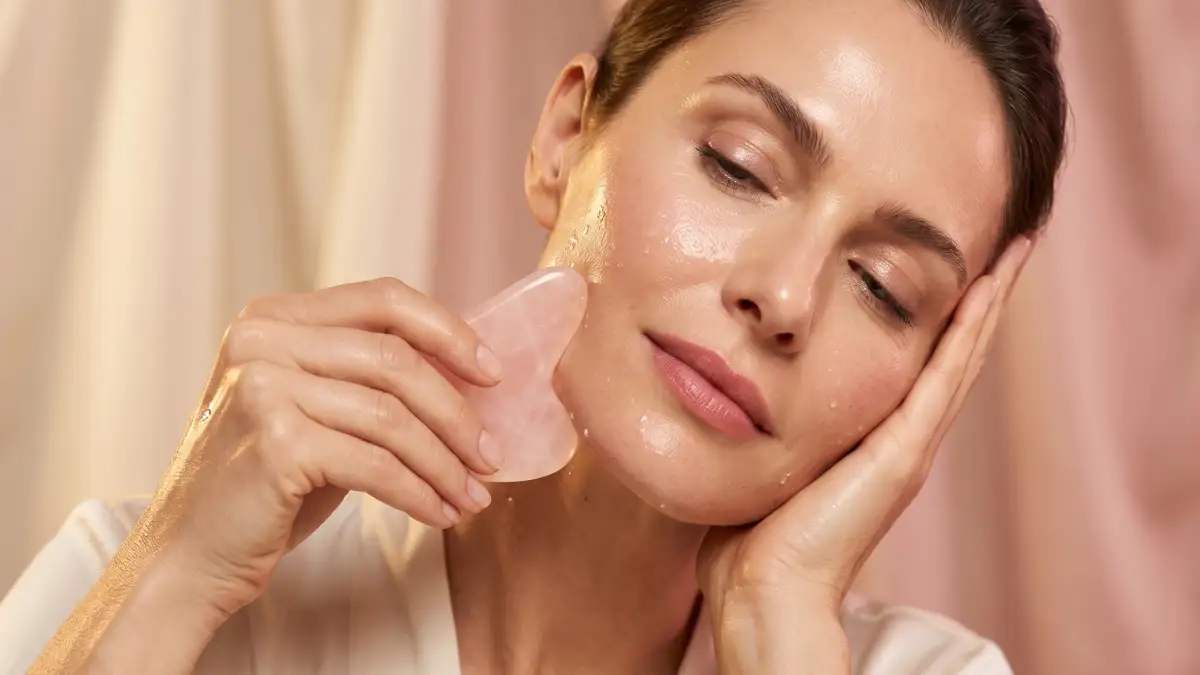
The gua sha tool market offers an overwhelming variety of materials, shapes, and price points — but the clinical evidence is clear that therapeutic outcomes depend primarily on technique, tool shape, and edge profile rather than stone composition. The four most common materials — nephrite jade, rose quartz, bian stone, and stainless steel — each offer practical advantages, but none possesses the mystical healing properties frequently claimed in marketing. Understanding the functional differences between these materials allows women to make an informed choice based on practical performance rather than unsubstantiated claims.[1]
Nephrite jade has been the traditional material for gua sha tools throughout Chinese medical history. Its primary practical advantages are its exceptional smoothness, moderate weight that provides natural pressure feedback, and slow thermal conductivity that allows the stone to retain coolness when refrigerated. Jade is relatively hard on the Mohs scale (6-6.5), making it resistant to chipping and durable for daily use. The weight of genuine jade provides a satisfying heft that allows the tool to do much of the pressure work, reducing the tendency for beginners to apply excessive manual force.
Clinical research confirms that rose quartz offers similar practical benefits to jade with slightly different thermal properties. It tends to stay cool slightly longer than jade due to its crystalline structure, making it marginally better for periorbital depuffing applications. Bian stone, a volcanic mineral traditionally used in Chinese medicine, is claimed to emit far-infrared radiation and ultrasonic pulses, though these claims lack rigorous scientific validation at therapeutically meaningful intensities. Stainless steel tools represent the most hygienic option — they can be fully sterilized, will never harbor bacteria in microscopic surface pores, and retain cold temperature longer than any stone material.
The most important factor in tool selection is edge profile rather than material. The tool should have multiple edge profiles: a concave curve for the jawline and cheekbones, a flat edge for broader surfaces like the forehead and neck, and a pointed tip for the periorbital area and around the nose. Heart-shaped and wing-shaped gua sha tools typically provide the best variety of edge profiles in a single implement. Regardless of material chosen, the tool must be completely smooth with no rough edges, chips, or surface imperfections that could scratch or irritate the skin during firm-pressure strokes.
Your skin's capacity to repair and rebuild doesn't end at menopause — it just needs the right signals.
— Dr. Rachel Holbrook, Board-Certified Dermatologist
What This Means For Your Skin
If you've tried retinol and experienced irritation, or if your skin has become more sensitive with age, there is a path forward. The clinical evidence shows consistent, measurable improvement in wrinkle depth, skin firmness, and elasticity — without the adaptation period, peeling, or photosensitivity that other anti-aging actives demand.
Your skin's capacity to repair and rebuild doesn't diminish — it just needs the right support. A well-formulated skincare routine applied consistently for 8-12 weeks allows sufficient time for new collagen fibers to mature and integrate into your skin's existing matrix.
The science is clear. The evidence is consistent. The results are measurable.
What happens next is up to you.