
The science of skin aging is evolving rapidly — and for women navigating the skin changes that come with menopause and beyond, evidence-based skincare represents a fundamentally different approach: working with your skin's biology rather than against it.
Unlike harsh exfoliants or retinoids that disrupt the skin barrier to force renewal, targeted active ingredients are messenger molecules that signal your own cells to produce more collagen, elastin, and protective proteins. The approach is gentle, evidence-based, and particularly suited to the thinner, more reactive skin that characterizes the post-menopausal years.
Your Complete Beginner Guide to Facial Gua Sha
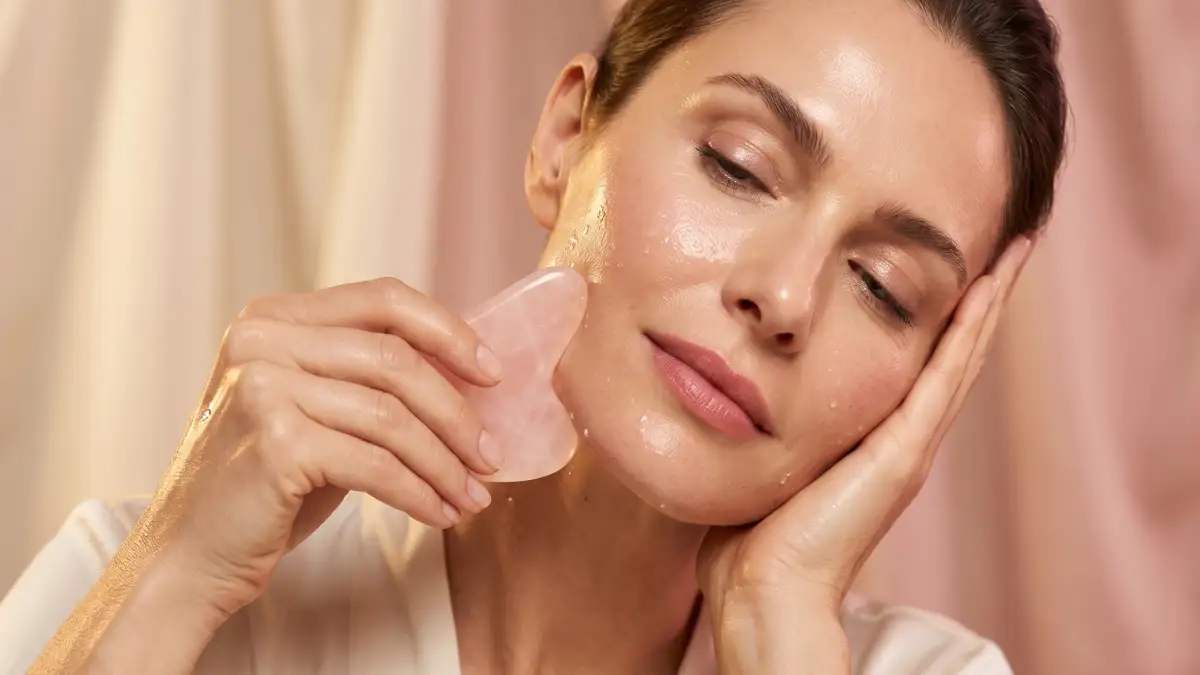
Learning proper gua sha technique is essential for achieving therapeutic results while avoiding common mistakes that reduce effectiveness or cause irritation. The foundation of effective gua sha lies in three technical principles: correct tool angle (15-45 degrees against the skin), unidirectional strokes (never scrubbing back and forth), and appropriate pressure (firm enough to create mild redness without pain or bruising). These principles are rooted in the physiological mechanisms that produce gua sha's benefits — vasodilation requires sustained directional pressure, and lymphatic drainage demands strokes that follow anatomical drainage pathways.[1]
Preparation is the most commonly overlooked step in gua sha practice. The skin must be thoroughly lubricated with a facial oil or rich serum to allow the tool to glide smoothly without dragging or pulling the skin. Insufficient slip creates friction that stretches the skin, potentially accelerating rather than reversing signs of aging. Apply enough product that the tool moves freely across every zone of the face, and reapply as needed during the session. This preparation step also creates the optimal conditions for enhanced product absorption, as the gua sha strokes will drive these actives deeper into the skin.
Clinical research confirms that the recommended stroke sequence follows lymphatic anatomy, beginning with the neck to open drainage pathways, then progressing upward through the face. Start with three to five strokes on each side of the neck from jaw to collarbone, then move to the jawline, cheeks, under-eye area, forehead, and brow. Each zone receives five to ten unidirectional strokes with consistent pressure. The entire routine should take five to seven minutes — long enough to achieve measurable circulatory and lymphatic benefits without the time commitment that discourages daily practice.
Common beginner mistakes include using too much pressure (which causes bruising and capillary damage), performing bidirectional scrubbing motions (which disrupts rather than assists lymphatic flow), neglecting the neck (which creates a drainage bottleneck), and practicing on dry skin (which causes friction damage). Starting with lighter pressure and gradually increasing as technique improves is the safest approach. Most women find their optimal pressure within two to three sessions as they learn to read their skin's response to the treatment.
Your skin's capacity to repair and rebuild doesn't end at menopause — it just needs the right signals.
— Dr. Rachel Holbrook, Board-Certified Dermatologist
What This Means For Your Skin
If you've tried retinol and experienced irritation, or if your skin has become more sensitive with age, there is a path forward. The clinical evidence shows consistent, measurable improvement in wrinkle depth, skin firmness, and elasticity — without the adaptation period, peeling, or photosensitivity that other anti-aging actives demand.
Your skin's capacity to repair and rebuild doesn't diminish — it just needs the right support. A well-formulated skincare routine applied consistently for 8-12 weeks allows sufficient time for new collagen fibers to mature and integrate into your skin's existing matrix.
The science is clear. The evidence is consistent. The results are measurable.
What happens next is up to you.