
The science of skin aging is evolving rapidly — and for women navigating the skin changes that come with menopause and beyond, evidence-based skincare represents a fundamentally different approach: working with your skin's biology rather than against it.
Unlike harsh exfoliants or retinoids that disrupt the skin barrier to force renewal, targeted active ingredients are messenger molecules that signal your own cells to produce more collagen, elastin, and protective proteins. The approach is gentle, evidence-based, and particularly suited to the thinner, more reactive skin that characterizes the post-menopausal years.
How Gua Sha Reverses Visible Signs of Facial Aging
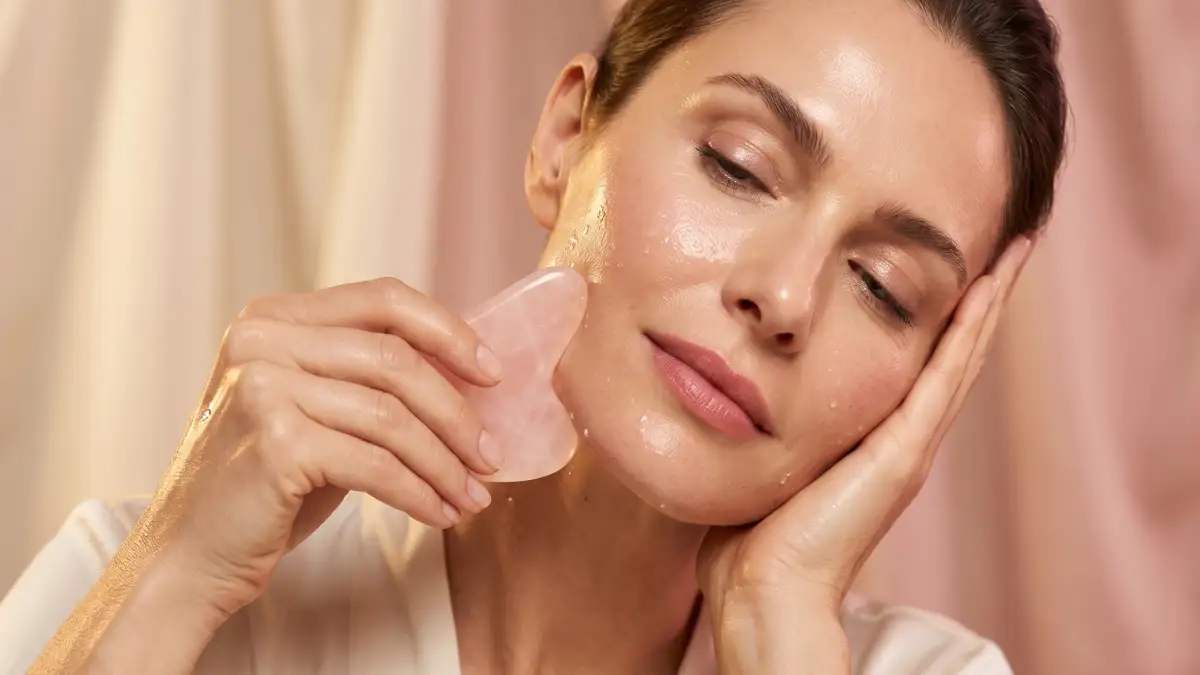
Gua sha has been practiced in traditional Chinese medicine for over 2,000 years, but only recently has clinical science validated its remarkable effects on aging skin. The technique involves stroking the skin with a smooth-edged tool using firm, unidirectional pressure — a process that triggers a cascade of physiological responses including vasodilation, increased lymphatic flow, and fibroblast activation. For women over 40, these effects directly address the primary mechanisms of facial aging: reduced circulation, collagen degradation, and lymphatic stagnation.[1]
The landmark study by Nielsen and colleagues measured a 400% increase in surface microcirculation during gua sha treatment — a magnitude of improvement that no topical product can replicate. This dramatic surge in blood flow delivers oxygen and nutrients directly to dermal fibroblasts, the cells responsible for producing collagen and elastin. As estrogen levels decline during perimenopause and menopause, fibroblast activity naturally decreases, making this external stimulation increasingly valuable for maintaining skin structure and firmness.
Clinical research confirms that beyond circulation, gua sha produces measurable improvements in lymphatic drainage — the system responsible for removing cellular waste, excess fluid, and inflammatory mediators from facial tissue. Age-related lymphatic sluggishness contributes significantly to facial puffiness, dull complexion, and the loss of defined facial contours. Regular gua sha practice mechanically assists lymphatic flow, reducing interstitial fluid accumulation and restoring the sculpted appearance that characterizes youthful facial architecture.
Research by Miyaji and colleagues demonstrated that consistent facial massage increases dermal collagen and elastin fiber density — providing structural evidence that mechanical stimulation translates into measurable anti-aging tissue remodeling. When combined with evidence-based active ingredients such as retinoids, peptides, and vitamin C, gua sha creates a synergistic effect: the enhanced circulation drives these actives deeper into the dermis while the mechanical stimulation upregulates the cellular machinery needed to utilize them.
Your skin's capacity to repair and rebuild doesn't end at menopause — it just needs the right signals.
— Dr. Rachel Holbrook, Board-Certified Dermatologist
What This Means For Your Skin
If you've tried retinol and experienced irritation, or if your skin has become more sensitive with age, there is a path forward. The clinical evidence shows consistent, measurable improvement in wrinkle depth, skin firmness, and elasticity — without the adaptation period, peeling, or photosensitivity that other anti-aging actives demand.
Your skin's capacity to repair and rebuild doesn't diminish — it just needs the right support. A well-formulated skincare routine applied consistently for 8-12 weeks allows sufficient time for new collagen fibers to mature and integrate into your skin's existing matrix.
The science is clear. The evidence is consistent. The results are measurable.
What happens next is up to you.