
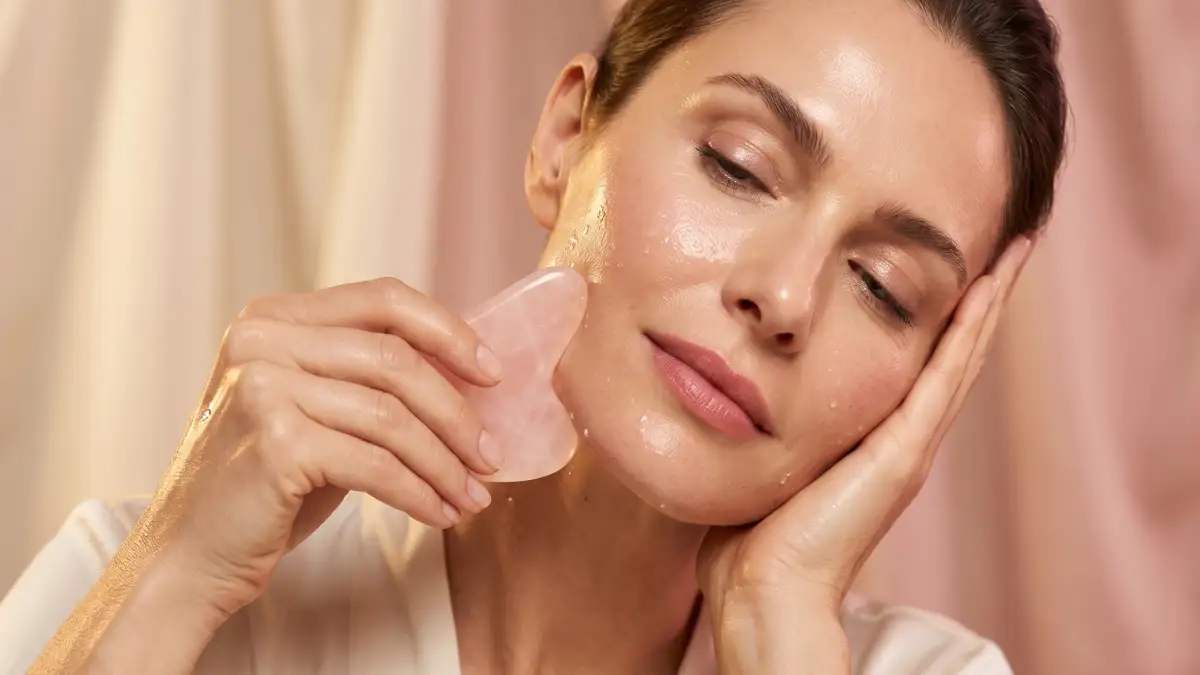
The science of skin aging is evolving rapidly — and for women navigating the skin changes that come with menopause and beyond, evidence-based skincare represents a fundamentally different approach: working with your skin's biology rather than against it.
Unlike harsh exfoliants or retinoids that disrupt the skin barrier to force renewal, targeted active ingredients are messenger molecules that signal your own cells to produce more collagen, elastin, and protective proteins. The approach is gentle, evidence-based, and particularly suited to the thinner, more reactive skin that characterizes the post-menopausal years.
What to Realistically Expect From Gua Sha Over Time
Understanding realistic timelines for gua sha results is essential for maintaining the consistency needed to achieve lasting benefits. The physiological effects of gua sha operate on multiple timescales: immediate effects (within minutes), short-term adaptations (days to weeks), and long-term tissue remodeling (months). Each timeline corresponds to different biological mechanisms, and setting accurate expectations prevents premature abandonment of a technique that delivers compounding returns.[1]
Immediate effects are visible after a single session. The 400% increase in microcirculation documented by Nielsen produces an instant flush of warmth and color, while lymphatic drainage reduces visible puffiness — particularly around the eyes and jawline. These acute effects typically last 2-4 hours as enhanced blood flow gradually returns to baseline. Many women notice that their skin appears more luminous and their facial contours appear more defined immediately after treatment, though these effects are transient without consistent practice.
Clinical research confirms that short-term adaptations emerge between weeks two and four of consistent daily practice. As the lymphatic system becomes more efficient through regular mechanical stimulation, baseline puffiness decreases measurably. Skin tone becomes more even as improved circulation delivers nutrients more effectively across all facial zones. The facial muscles begin responding to the consistent directional pressure, and the initial lifting effect becomes more pronounced and longer-lasting between sessions.
Long-term tissue remodeling requires 8-12 weeks of consistent practice, aligning with the skin's natural collagen turnover cycle. Miyaji's research demonstrated increased collagen and elastin fiber density with sustained facial massage — changes that represent genuine structural improvement rather than temporary fluid redistribution. At this stage, women typically report that their skin feels firmer, their jawline appears more defined, and the overall facial architecture shows measurable improvement compared to their baseline.
Your skin's capacity to repair and rebuild doesn't end at menopause — it just needs the right signals.
— Dr. Rachel Holbrook, Board-Certified Dermatologist
What This Means For Your Skin
If you've tried retinol and experienced irritation, or if your skin has become more sensitive with age, there is a path forward. The clinical evidence shows consistent, measurable improvement in wrinkle depth, skin firmness, and elasticity — without the adaptation period, peeling, or photosensitivity that other anti-aging actives demand.
Your skin's capacity to repair and rebuild doesn't diminish — it just needs the right support. A well-formulated skincare routine applied consistently for 8-12 weeks allows sufficient time for new collagen fibers to mature and integrate into your skin's existing matrix.
The science is clear. The evidence is consistent. The results are measurable.
What happens next is up to you.