
The science of skin aging is evolving rapidly — and for women navigating the skin changes that come with menopause and beyond, evidence-based skincare represents a fundamentally different approach: working with your skin's biology rather than against it.
Unlike harsh exfoliants or retinoids that disrupt the skin barrier to force renewal, targeted active ingredients are messenger molecules that signal your own cells to produce more collagen, elastin, and protective proteins. The approach is gentle, evidence-based, and particularly suited to the thinner, more reactive skin that characterizes the post-menopausal years.
Restoring Defined Facial Contours After 40
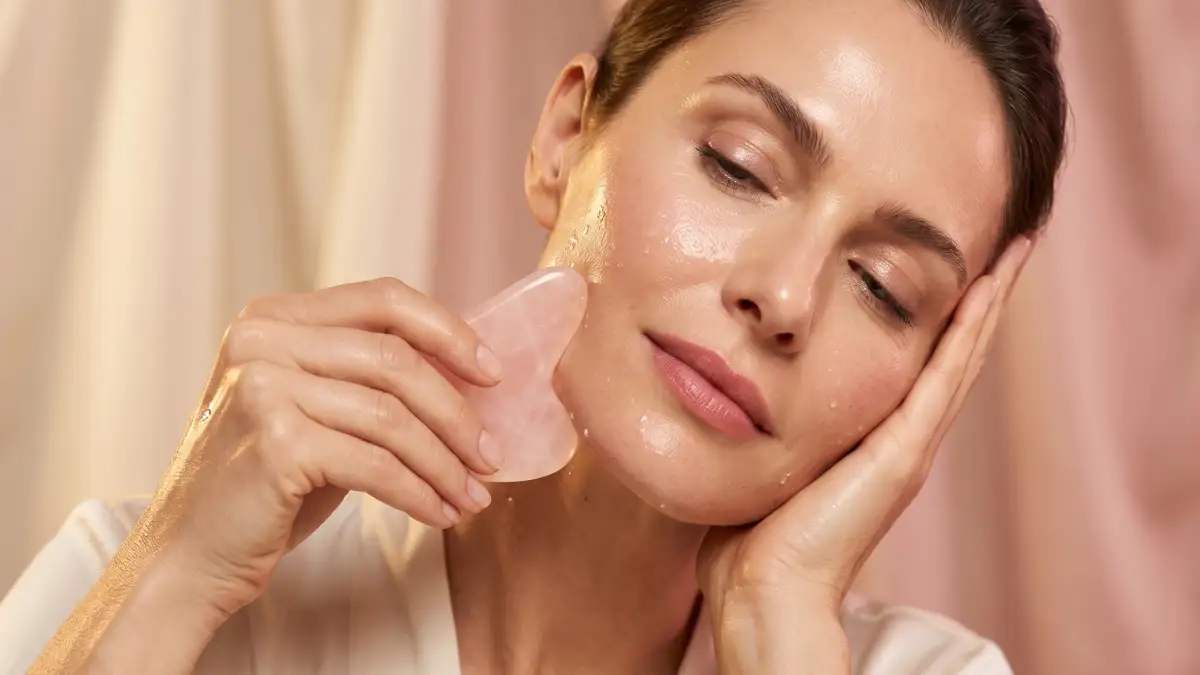
Jawline definition is one of the most significant markers of facial youth, and its loss — driven by bone resorption, fat pad descent, and skin laxity — is one of the earliest visible signs of aging. Gua sha provides a non-invasive approach to jawline sculpting that addresses multiple contributors simultaneously: the firm upward strokes stimulate muscle tone in the masseter and platysma, promote lymphatic drainage that reduces jowl-area fluid retention, and increase collagen production along the mandibular border where structural support is most critical.[1]
The biomechanics of jawline sculpting with gua sha require specific tool angles and pressure gradients that differ from general facial massage. The tool should be held at approximately 15-30 degrees against the skin, with firm pressure applied from the chin along the mandibular border toward the earlobe. This angle allows the tool edge to engage the periosteum — the membrane covering the jawbone — which triggers mechanotransduction signals that stimulate local bone-preserving cellular activity. Studies on mechanical loading of facial bones suggest that consistent pressure may help counteract the age-related bone resorption that contributes to jowl formation.
Clinical research confirms that the platysma muscle, which spans from the chest to the lower face, plays a critical role in jawline definition. As this muscle weakens and descends with age, it pulls the overlying skin downward, creating the characteristic banding and sagging associated with an aging neck and jawline. Gua sha strokes directed upward along the platysma — from the clavicle to the jawline — counteract this gravitational descent by promoting muscle fiber engagement and increasing blood flow to this often-neglected area.
For optimal jawline sculpting results, clinicians recommend combining gua sha with targeted product application. Applying a peptide-rich serum or retinol formulation to the jawline before gua sha treatment allows the enhanced circulation to drive these collagen-stimulating actives into the specific tissue where structural support is most needed. The mechanical stimulation of gua sha upregulates fibroblast activity in the treated area, creating a localized environment of increased collagen synthesis precisely where jowl formation threatens facial contour definition.
Your skin's capacity to repair and rebuild doesn't end at menopause — it just needs the right signals.
— Dr. Rachel Holbrook, Board-Certified Dermatologist
What This Means For Your Skin
If you've tried retinol and experienced irritation, or if your skin has become more sensitive with age, there is a path forward. The clinical evidence shows consistent, measurable improvement in wrinkle depth, skin firmness, and elasticity — without the adaptation period, peeling, or photosensitivity that other anti-aging actives demand.
Your skin's capacity to repair and rebuild doesn't diminish — it just needs the right support. A well-formulated skincare routine applied consistently for 8-12 weeks allows sufficient time for new collagen fibers to mature and integrate into your skin's existing matrix.
The science is clear. The evidence is consistent. The results are measurable.
What happens next is up to you.