
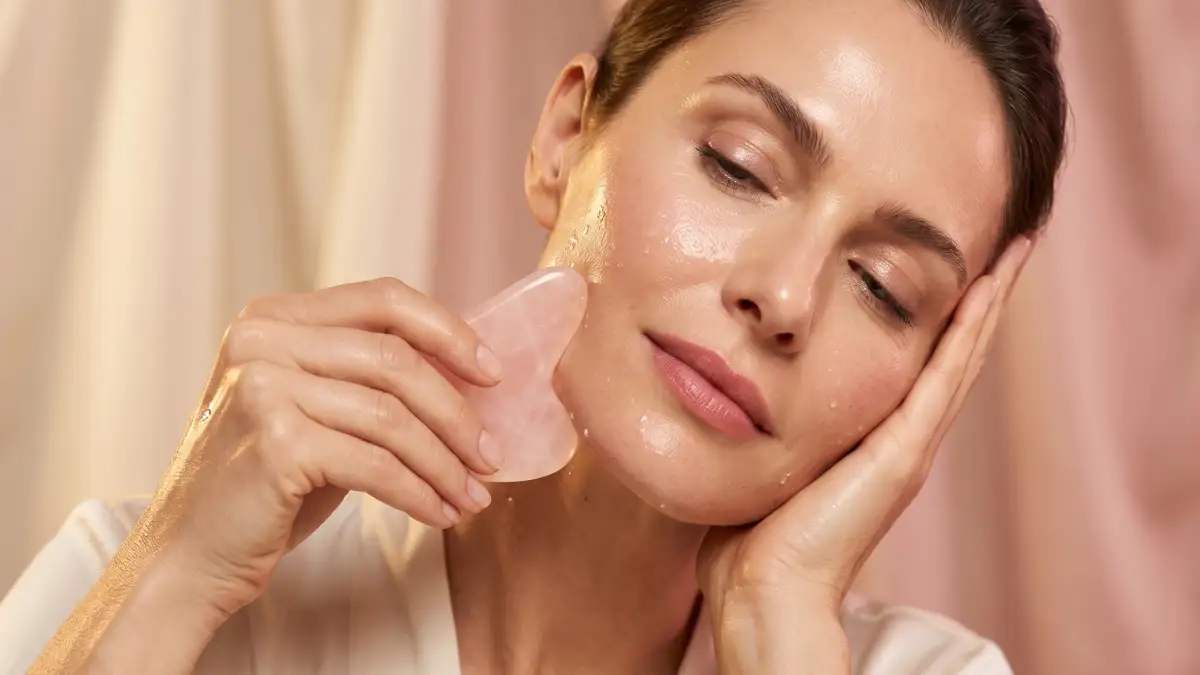
The science of skin aging is evolving rapidly — and for women navigating the skin changes that come with menopause and beyond, evidence-based skincare represents a fundamentally different approach: working with your skin's biology rather than against it.
Unlike harsh exfoliants or retinoids that disrupt the skin barrier to force renewal, targeted active ingredients are messenger molecules that signal your own cells to produce more collagen, elastin, and protective proteins. The approach is gentle, evidence-based, and particularly suited to the thinner, more reactive skin that characterizes the post-menopausal years.
Sculpting the Neck and Submental Area With Gua Sha
The neck and submental area — the region beneath the chin — are among the first areas to reveal aging due to the unique anatomical challenges of this zone. The platysma muscle, a thin sheet of muscle spanning from the chest to the lower face, weakens and separates with age, creating visible banding and contributing to the appearance of a double chin. The skin of the neck contains fewer sebaceous glands and less subcutaneous fat than the face, making it more susceptible to crepiness and sagging. Gua sha provides targeted mechanical intervention for these specific concerns, addressing muscle tone, lymphatic drainage, and collagen stimulation in an area that most skincare routines neglect.[1]
The technique for neck gua sha emphasizes upward strokes that counteract gravitational descent and direct lymphatic fluid toward the supraclavicular lymph nodes — the terminal drainage point for the entire head and neck. Beginning at the clavicle, the tool is swept upward along the sternocleidomastoid muscle toward the ear, using firm, deliberate pressure. For the submental area, strokes move from the center of the chin outward along the mandibular border, lifting the tissue upward and toward the ear. This directional protocol ensures that mobilized fluid drains efficiently rather than pooling in the tissue.
Clinical research confirms that the platysma muscle responds measurably to the mechanical stimulation of consistent gua sha practice. The firm, upward strokes create a training effect similar to isometric exercise — the muscle fibers engage against the resistance of the tool, promoting tone and reducing the slack that contributes to neck banding and submental fullness. While gua sha cannot replicate the results of surgical intervention for significant platysmal banding, it represents the most effective non-invasive approach for maintaining and improving platysma tone, particularly when practiced preventatively beginning in the early 40s.
Lymphatic drainage is particularly important for reducing submental fullness, as fluid retention beneath the chin creates volume that exaggerates the appearance of a double chin. The submental area lacks the natural muscular pumping action that assists lymphatic flow elsewhere in the body, making it especially prone to fluid accumulation. Dedicated gua sha drainage strokes — moving from the center of the submental area outward and downward toward the submandibular lymph nodes — mechanically clear this stagnant fluid, producing immediate volume reduction that becomes more sustained with consistent daily practice over four to six weeks.
Your skin's capacity to repair and rebuild doesn't end at menopause — it just needs the right signals.
— Dr. Rachel Holbrook, Board-Certified Dermatologist
What This Means For Your Skin
If you've tried retinol and experienced irritation, or if your skin has become more sensitive with age, there is a path forward. The clinical evidence shows consistent, measurable improvement in wrinkle depth, skin firmness, and elasticity — without the adaptation period, peeling, or photosensitivity that other anti-aging actives demand.
Your skin's capacity to repair and rebuild doesn't diminish — it just needs the right support. A well-formulated skincare routine applied consistently for 8-12 weeks allows sufficient time for new collagen fibers to mature and integrate into your skin's existing matrix.
The science is clear. The evidence is consistent. The results are measurable.
What happens next is up to you.