
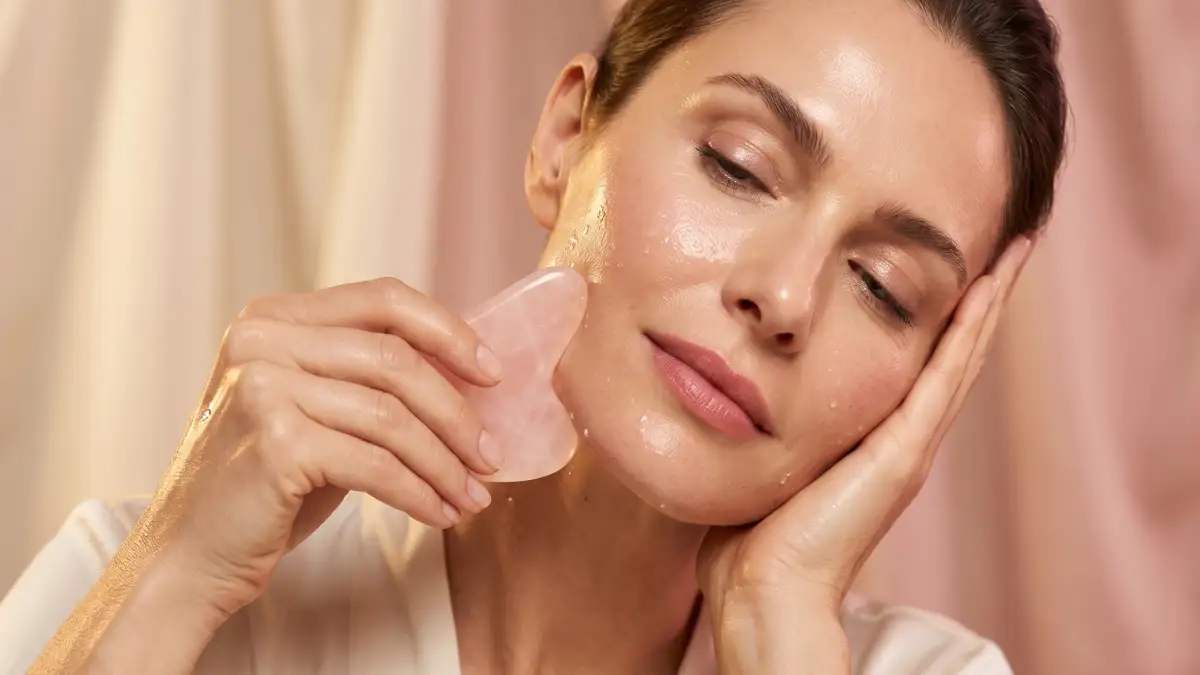
The science of skin aging is evolving rapidly — and for women navigating the skin changes that come with menopause and beyond, evidence-based skincare represents a fundamentally different approach: working with your skin's biology rather than against it.
Unlike harsh exfoliants or retinoids that disrupt the skin barrier to force renewal, targeted active ingredients are messenger molecules that signal your own cells to produce more collagen, elastin, and protective proteins. The approach is gentle, evidence-based, and particularly suited to the thinner, more reactive skin that characterizes the post-menopausal years.
Activating Your Face's Natural Detox System
The lymphatic system is the body's primary waste removal network, and the face contains an intricate web of superficial lymphatic vessels that are uniquely responsive to external manipulation. Unlike the cardiovascular system, the lymphatic system has no central pump — it relies entirely on muscle contractions, breathing, and external pressure to move fluid through its vessels. This anatomical reality makes gua sha one of the most effective interventions for facial lymphatic health, as the firm, directional strokes provide the mechanical force that these vessels require to function optimally.[1]
Age-related lymphatic decline is a significant but often overlooked contributor to facial aging. After age 40, lymphatic vessel density decreases and the remaining vessels become less efficient at removing interstitial fluid and metabolic waste. This sluggishness manifests as morning puffiness that takes longer to resolve, a dull or sallow complexion from accumulated cellular debris, and the gradual loss of facial definition as fluid accumulates in the subcutaneous tissue. Gua sha directly counteracts this decline by providing consistent mechanical assistance to compromised lymphatic vessels.
Clinical research confirms that the correct technique for lymphatic drainage via gua sha follows specific anatomical pathways — always stroking toward the nearest lymph node cluster. For the face, this means directing strokes from the center outward and downward toward the preauricular nodes (in front of the ears), submandibular nodes (under the jaw), and ultimately toward the supraclavicular nodes at the base of the neck. Beginning each session with gentle neck strokes to open the terminal drainage points ensures that mobilized fluid has a clear exit pathway, preventing the counterproductive redistribution of lymph.
Clinical observations consistently demonstrate that women who perform lymphatic-focused gua sha for five minutes daily show measurable reductions in facial circumference at the jawline and under-eye area within two weeks. The reduction in inflammatory mediators also improves skin clarity and reduces the appearance of acne, rosacea flares, and periorbital discoloration — conditions that are exacerbated by lymphatic stagnation and the accumulation of pro-inflammatory waste products in facial tissue.
Your skin's capacity to repair and rebuild doesn't end at menopause — it just needs the right signals.
— Dr. Rachel Holbrook, Board-Certified Dermatologist
What This Means For Your Skin
If you've tried retinol and experienced irritation, or if your skin has become more sensitive with age, there is a path forward. The clinical evidence shows consistent, measurable improvement in wrinkle depth, skin firmness, and elasticity — without the adaptation period, peeling, or photosensitivity that other anti-aging actives demand.
Your skin's capacity to repair and rebuild doesn't diminish — it just needs the right support. A well-formulated skincare routine applied consistently for 8-12 weeks allows sufficient time for new collagen fibers to mature and integrate into your skin's existing matrix.
The science is clear. The evidence is consistent. The results are measurable.
What happens next is up to you.