
The science of skin aging is evolving rapidly — and for women navigating the skin changes that come with menopause and beyond, evidence-based skincare represents a fundamentally different approach: working with your skin's biology rather than against it.
Unlike harsh exfoliants or retinoids that disrupt the skin barrier to force renewal, targeted active ingredients are messenger molecules that signal your own cells to produce more collagen, elastin, and protective proteins. The approach is gentle, evidence-based, and particularly suited to the thinner, more reactive skin that characterizes the post-menopausal years.
Gentle Depuffing Technique for the Delicate Eye Area
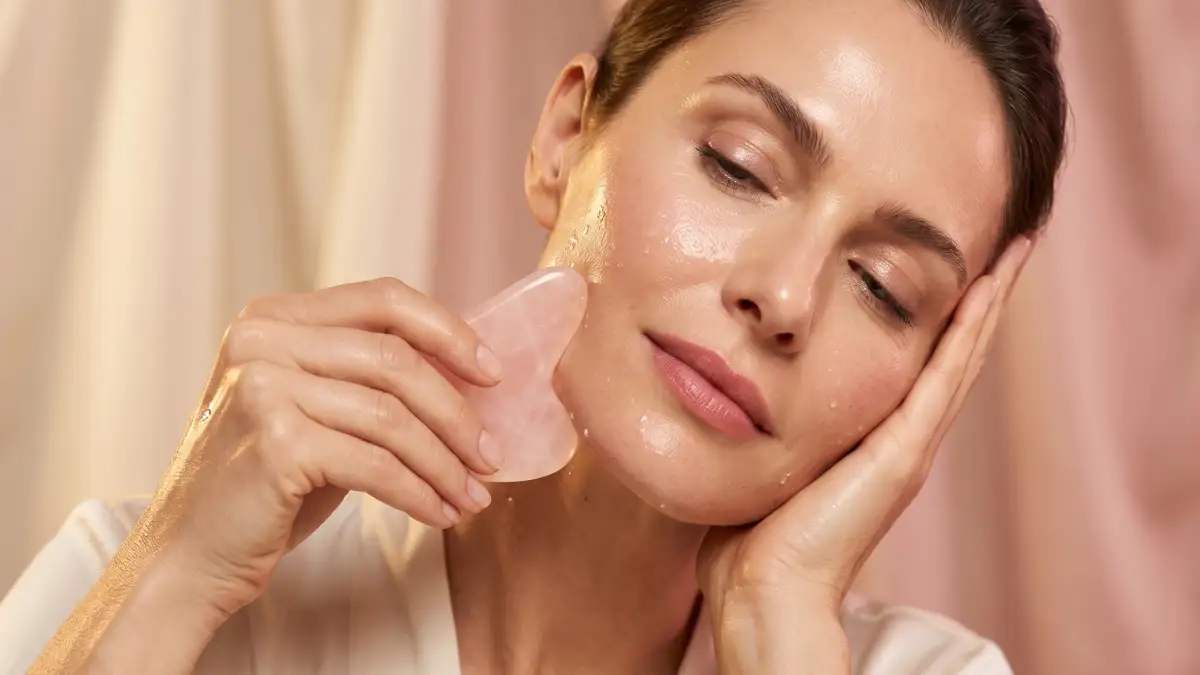
The periorbital area presents unique challenges for anti-aging intervention due to its exceptionally thin skin — approximately 0.5mm compared to 2mm elsewhere on the face — and its dense network of superficial blood vessels and lymphatic channels. Under-eye puffiness results primarily from fluid accumulation in this delicate tissue, driven by lymphatic stagnation, allergic responses, sodium retention, and the age-related weakening of the orbital septum that allows periorbital fat pads to protrude. Gua sha offers a targeted, gentle approach to periorbital depuffing that addresses the lymphatic component without risking damage to this fragile tissue.[1]
The technique for periorbital gua sha differs substantially from the firm pressure used on other facial zones. The tool must be held nearly flat against the skin — at approximately 5-10 degrees — with only the weight of the tool providing pressure. Strokes move from the inner canthus (beside the nose) outward toward the temple, following the natural drainage pathway toward the preauricular lymph nodes. Each stroke should be slow and deliberate, taking approximately three seconds to traverse the under-eye area. This gentle approach prevents capillary damage while providing sufficient mechanical force to mobilize stagnant lymphatic fluid.
Clinical research confirms that cooling the gua sha tool before periorbital use provides additional therapeutic benefit. The vasoconstricting effect of cold temperature reduces the dilation of superficial blood vessels that contributes to dark circles, while the cold sensation triggers a mild anti-inflammatory response that further reduces puffiness. Storing the gua sha tool in the refrigerator overnight creates an optimal temperature differential that enhances both the immediate depuffing effect and the overall comfort of the treatment.
Consistent morning application produces the most significant results for under-eye puffiness, as fluid naturally accumulates in the periorbital area during sleep due to the horizontal position and reduced lymphatic activity. A 60-90 second periorbital gua sha routine performed before skincare application can reduce visible puffiness by 40-60% within minutes, and regular practice over four to six weeks helps retrain lymphatic drainage patterns to prevent the chronic fluid accumulation that characterizes persistent under-eye bags.
Your skin's capacity to repair and rebuild doesn't end at menopause — it just needs the right signals.
— Dr. Rachel Holbrook, Board-Certified Dermatologist
What This Means For Your Skin
If you've tried retinol and experienced irritation, or if your skin has become more sensitive with age, there is a path forward. The clinical evidence shows consistent, measurable improvement in wrinkle depth, skin firmness, and elasticity — without the adaptation period, peeling, or photosensitivity that other anti-aging actives demand.
Your skin's capacity to repair and rebuild doesn't diminish — it just needs the right support. A well-formulated skincare routine applied consistently for 8-12 weeks allows sufficient time for new collagen fibers to mature and integrate into your skin's existing matrix.
The science is clear. The evidence is consistent. The results are measurable.
What happens next is up to you.