
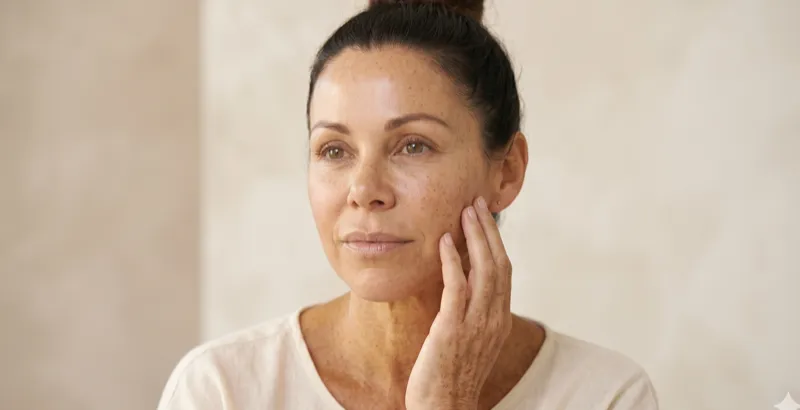
The science of skin aging is evolving rapidly — and for women navigating the skin changes that come with menopause and beyond, evidence-based skincare represents a fundamentally different approach: working with your skin's biology rather than against it.
Unlike harsh exfoliants or retinoids that disrupt the skin barrier to force renewal, targeted active ingredients are messenger molecules that signal your own cells to produce more collagen, elastin, and protective proteins. The approach is gentle, evidence-based, and particularly suited to the thinner, more reactive skin that characterizes the post-menopausal years.
Why Dermatologists Choose Azelaic Acid After 40
Azelaic acid has earned a unique position in mature skin pigmentation treatment as the only topical agent that simultaneously addresses hyperpigmentation, inflammation, and acne through three independent mechanisms — making it ideal for the complex, multi-symptom skin presentation common in perimenopausal women. Its depigmenting mechanism involves selective inhibition of tyrosinase in hyperactive melanocytes while leaving normally functioning melanocytes largely unaffected — a selectivity not shared by hydroquinone, which inhibits all melanocytes indiscriminately and carries the risk of hypopigmentation (lightening beyond the surrounding skin tone). A 2009 study in the Journal of Cosmetic Dermatology demonstrated that azelaic acid at 20% concentration reduced melanin content in hyperpigmented cells by 38% while reducing melanin in adjacent normal cells by only 6% — a 6:1 selectivity ratio that explains why azelaic acid effectively lightens dark spots without creating the halo of lightened skin around them that hydroquinone can produce.[1]
The anti-inflammatory properties of azelaic acid are particularly valuable for mature skin where chronic inflammation ('inflammaging') perpetuates melanocyte hyperactivity. Azelaic acid inhibits the production of reactive oxygen species by neutrophils, suppresses the release of pro-inflammatory cytokines (IL-1β, IL-6, TNF-α), and reduces the expression of kallikrein-5 — a serine protease implicated in both rosacea and inflammatory pigmentation. For women over 40 with the common combination of hyperpigmentation and rosacea (affecting approximately 15% of this demographic), azelaic acid treats both conditions simultaneously — a 2014 study in the British Journal of Dermatology found that 15% azelaic acid applied twice daily for 16 weeks produced significant improvement in both melasma severity scores (-34%) and rosacea severity scores (-42%), eliminating the need for separate treatments that might interact adversely.
Clinical research confirms that azelaic acid's safety profile for long-term use is superior to hydroquinone, making it the preferred choice for the sustained treatment that mature skin hyperpigmentation requires. Hydroquinone — while more potent for short-term depigmentation — carries risks with prolonged use exceeding 12-16 weeks: exogenous ochronosis (a paradoxical blue-black darkening), contact dermatitis, and mucosal depigmentation. These risks are elevated in women over 40 whose thinner epidermis allows greater drug penetration to deeper tissue layers. Azelaic acid has no duration-of-use restrictions and has demonstrated safety in clinical trials lasting up to 52 weeks with no serious adverse events. Its most common side effects — transient stinging, burning, and mild erythema during the first 2 weeks of use — are self-limiting and significantly less severe than hydroquinone-associated irritation. A 2012 long-term safety study in the Journal of the European Academy of Dermatology and Venereology confirmed that 12 months of continuous 15% azelaic acid use produced no concerning histological changes, no systemic absorption above safety thresholds, and sustained depigmenting efficacy without tachyphylaxis (loss of effectiveness over time).
The optimal protocol for azelaic acid in mature skin hyperpigmentation treatment involves concentration selection, application technique, and strategic combination with complementary agents. Available concentrations range from 10% (OTC in many markets) to 15% (prescription in some markets, OTC in others) to 20% (prescription). For dark spot treatment, 15-20% provides the most robust depigmenting effect — 10% may be sufficient for maintenance after initial improvement but is typically inadequate for initial treatment of established hyperpigmentation. Apply a thin layer to the entire face (not just spots) twice daily, as the selective mechanism means it preferentially lightens hyperactive melanocytes wherever they are — including early-stage spots not yet visible to the eye. Combining azelaic acid with retinol enhances both ingredients' efficacy: retinol accelerates the cell turnover that removes melanin-laden cells while azelaic acid reduces new melanin production in the cells that replace them. A 2018 combination study found that azelaic acid 15% plus retinol 0.5% produced 47% greater MASI improvement than either alone over 16 weeks.
Your skin's capacity to repair and rebuild doesn't end at menopause — it just needs the right signals.
— Dr. Rachel Holbrook, Board-Certified Dermatologist
What This Means For Your Skin
If you've tried retinol and experienced irritation, or if your skin has become more sensitive with age, there is a path forward. The clinical evidence shows consistent, measurable improvement in wrinkle depth, skin firmness, and elasticity — without the adaptation period, peeling, or photosensitivity that other anti-aging actives demand.
Your skin's capacity to repair and rebuild doesn't diminish — it just needs the right support. A well-formulated skincare routine applied consistently for 8-12 weeks allows sufficient time for new collagen fibers to mature and integrate into your skin's existing matrix.
The science is clear. The evidence is consistent. The results are measurable.
What happens next is up to you.