
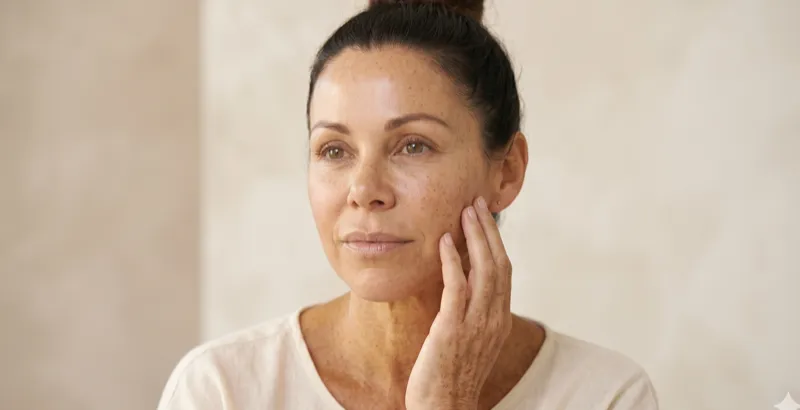
The science of skin aging is evolving rapidly — and for women navigating the skin changes that come with menopause and beyond, evidence-based skincare represents a fundamentally different approach: working with your skin's biology rather than against it.
Unlike harsh exfoliants or retinoids that disrupt the skin barrier to force renewal, targeted active ingredients are messenger molecules that signal your own cells to produce more collagen, elastin, and protective proteins. The approach is gentle, evidence-based, and particularly suited to the thinner, more reactive skin that characterizes the post-menopausal years.
Topicals to Professional Treatments for Dark Spots
Dark spot removal after 40 spans a spectrum from conservative topical therapy to professional procedural intervention, with the optimal approach depending on spot type, depth, severity, and the individual's skin sensitivity and treatment budget. Topical treatments represent the first-line approach because they are accessible, affordable, and carry the lowest risk of adverse effects — particularly post-inflammatory hyperpigmentation (PIH), which is the most feared complication of any pigmentation treatment. The most evidence-supported topical depigmenting agents include: hydroquinone (2% OTC, 4% prescription — the most potent topical melanin inhibitor, with 40-60% pigment reduction at 12 weeks in controlled trials), vitamin C (15-20% L-ascorbic acid — tyrosinase inhibitor with antioxidant and collagen benefits), azelaic acid (15-20% — inhibits tyrosinase and has anti-inflammatory properties ideal for melasma), arbutin (a natural hydroquinone derivative with slower but gentler action), tranexamic acid (3-5% topical or 250mg oral twice daily — inhibits plasmin-mediated melanocyte activation), and niacinamide (4-5% — blocks melanosome transfer rather than melanin production).[1]
Chemical peels for dark spot treatment deliver controlled acid-induced exfoliation that removes melanin-laden surface cells faster than natural turnover. For women over 40, the peel depth must be carefully calibrated: superficial peels (glycolic acid 30-50%, lactic acid 30-40%, or salicylic acid 20-30%) remove the outermost corneocyte layers containing surface melanin, with 1-3 days of mild flaking and minimal PIH risk. Medium-depth peels (TCA 15-35%, Jessner's solution) penetrate to the papillary dermis and can address deeper melanin deposits, but carry 5-15% PIH risk in women over 40 with Fitzpatrick skin types III-VI. A 2018 systematic review in Dermatologic Surgery analyzed 14 trials of chemical peels for facial hyperpigmentation and found that serial superficial glycolic acid peels (30-50%, performed every 2-4 weeks for 6 sessions) produced a mean 35% reduction in melanin index with a PIH rate of only 3% — making serial superficial peels the safest procedural approach for mature skin with hyperpigmentation.
Clinical research confirms that laser and light-based treatments offer the most dramatic dark spot removal but carry correspondingly higher risk on mature skin. Q-switched Nd:YAG laser (1064nm) selectively targets melanin-containing cells through selective photothermolysis — the melanin absorbs the laser energy and is destroyed while surrounding tissue is preserved. For discrete solar lentigines, a single Q-switched laser session can achieve 80-95% clearance, with the treated spots forming a thin crust that sloughs within 7-10 days to reveal lighter skin beneath. However, the risk of PIH and hypopigmentation (lightening beyond the surrounding skin tone) increases with age and darker skin tones — a 2019 retrospective study found PIH rates of 12% in women aged 40-50 and 22% in women over 60 following Q-switched laser treatment for facial lentigines. Intense Pulsed Light (IPL) provides a gentler alternative with lower PIH risk (5-8%) but requires 3-5 sessions for equivalent clearance. Fractional non-ablative laser (1540nm, 1927nm) treats hyperpigmentation while simultaneously stimulating collagen, offering a dual benefit for mature skin, though it requires 4-6 sessions.
For women over 40 managing dark spots at home, the evidence-based protocol combines daily topical depigmentation with accelerated cell turnover and rigorous sun protection. Morning: vitamin C serum (15% L-ascorbic acid) for tyrosinase inhibition and antioxidant protection, followed by niacinamide moisturizer (4-5%) for melanosome transfer blocking, and mineral sunscreen with iron oxides (SPF 50, tinted) for UV and visible light protection. Evening: retinol (0.3-0.5%) for cell turnover acceleration, applied to the entire face to prevent new spots while allowing existing melanin-laden cells to shed faster. For targeted treatment of stubborn spots: apply azelaic acid 15-20% or tranexamic acid 3-5% serum directly to individual dark spots after retinol. This protocol produces visible spot lightening by weeks 8-12, with progressive improvement through 24 weeks. The critical success factor is sunscreen adherence — a 2020 study found that women who maintained >90% daily sunscreen compliance showed 2.8 times greater dark spot improvement than those with 50-70% compliance, regardless of which topical depigmenting agents they used.
Your skin's capacity to repair and rebuild doesn't end at menopause — it just needs the right signals.
— Dr. Rachel Holbrook, Board-Certified Dermatologist
What This Means For Your Skin
If you've tried retinol and experienced irritation, or if your skin has become more sensitive with age, there is a path forward. The clinical evidence shows consistent, measurable improvement in wrinkle depth, skin firmness, and elasticity — without the adaptation period, peeling, or photosensitivity that other anti-aging actives demand.
Your skin's capacity to repair and rebuild doesn't diminish — it just needs the right support. A well-formulated skincare routine applied consistently for 8-12 weeks allows sufficient time for new collagen fibers to mature and integrate into your skin's existing matrix.
The science is clear. The evidence is consistent. The results are measurable.
What happens next is up to you.