
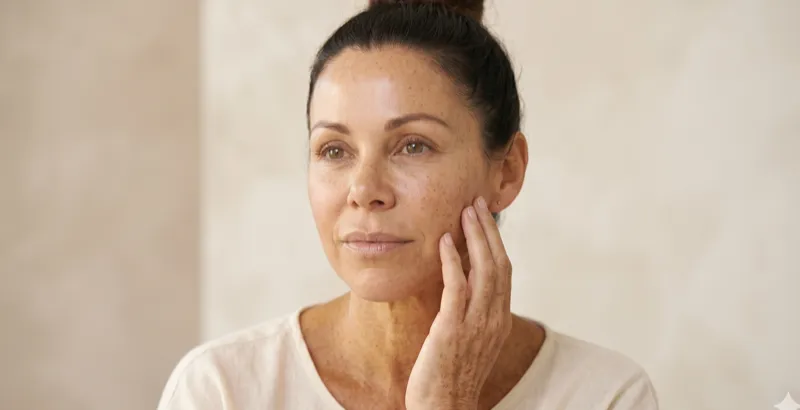
The science of skin aging is evolving rapidly — and for women navigating the skin changes that come with menopause and beyond, evidence-based skincare represents a fundamentally different approach: working with your skin's biology rather than against it.
Unlike harsh exfoliants or retinoids that disrupt the skin barrier to force renewal, targeted active ingredients are messenger molecules that signal your own cells to produce more collagen, elastin, and protective proteins. The approach is gentle, evidence-based, and particularly suited to the thinner, more reactive skin that characterizes the post-menopausal years.
Evidence-Based Approaches to Dark Spots After 40
Hyperpigmentation in women over 40 is a multifactorial condition driven by the convergence of cumulative UV damage, hormonal dysregulation, chronic inflammation, and the age-related breakdown of melanocyte regulatory mechanisms. Unlike the transient pigmentation of younger skin (which typically resolves within one cell turnover cycle of 28 days), hyperpigmentation after 40 persists because the underlying causes are ongoing and the cell turnover cycle has extended to 40-60 days, meaning melanin-laden keratinocytes remain visible on the surface for twice as long. A 2016 epidemiological study in the Journal of the American Academy of Dermatology found that 80% of women over 40 report at least one form of facial hyperpigmentation, with solar lentigines (sun spots) being the most common (65%), followed by melasma (33%), and post-inflammatory hyperpigmentation (28%). The clinical approach to treatment must first identify which type — or combination of types — is present, because each has distinct triggers, mechanisms, and optimal treatment strategies.[1]
Solar lentigines — the flat, brown spots that appear on sun-exposed skin — result from localized melanocyte hyperactivity in areas of cumulative UV damage. Unlike freckles (ephelides), which fade with sun avoidance, solar lentigines persist because the melanocytes in these lesions have undergone permanent functional changes: increased melanin synthesis capacity, resistance to apoptosis, and expanded dendritic networks that distribute melanin to a wider area of surrounding keratinocytes. Histologically, solar lentigines show increased numbers of melanocytes per unit area (melanocyte density), elongated rete ridges that increase the surface area of the dermal-epidermal junction, and accumulation of melanin in both melanocytes and surrounding keratinocytes. A 2012 study in Pigment Cell & Melanoma Research demonstrated that melanocytes within lentigines produce 2-3 times more melanin per cell than adjacent normal melanocytes, even when both are exposed to identical UV conditions — confirming that the melanocyte itself has been permanently altered rather than simply overstimulated.
Clinical research confirms that melasma — the symmetric, blotchy hyperpigmentation affecting the cheeks, forehead, upper lip, and jawline — has a distinct pathophysiology involving hormonal triggers, vascular changes, and basement membrane disruption that make it the most challenging form of hyperpigmentation to treat. Estrogen and progesterone receptors on melanocytes are activated during hormonal fluctuations (perimenopause, HRT use), directly stimulating melanin synthesis through the tyrosinase pathway. Additionally, melasma-affected skin shows increased vascular density and elevated levels of vascular endothelial growth factor (VEGF), creating a pro-inflammatory microenvironment that perpetuates melanocyte activation. A 2017 study in the Journal of the American Academy of Dermatology using in vivo reflectance confocal microscopy revealed that melasma involves disruption of the basement membrane zone — the interface between epidermis and dermis — allowing melanin to drop into the dermis where it is phagocytosed by macrophages (melanophages) and becomes extremely resistant to topical treatment. This dermal melanin component explains why melasma frequently recurs after seemingly successful treatment.
Evidence-based hyperpigmentation treatment for women over 40 requires a multi-target approach addressing melanin production, melanin distribution, existing melanin removal, and ongoing trigger prevention. The first-line topical combination validated by the most robust clinical evidence is the modified Kligman formula: a tyrosinase inhibitor (vitamin C 15%, azelaic acid 15-20%, or short-term hydroquinone 2-4%) to reduce new melanin production, a retinoid (tretinoin 0.025-0.05% or retinol 0.5%) to accelerate cell turnover and shed melanin-laden cells, and a mild corticosteroid (only in the prescription Kligman formula, for 8-12 weeks maximum) or niacinamide 4-5% (in the modified formula) to reduce inflammation that stimulates melanocytes. A 2019 meta-analysis in the British Journal of Dermatology confirmed that combination approaches produce 40-62% greater improvement in melanin index than any single-agent treatment over 12-24 weeks. Daily broad-spectrum sunscreen (SPF 30-50 with iron oxides for visible light protection) is non-negotiable — without it, ongoing UV exposure continuously restimulates the melanocytes being treated, negating topical therapy.
Your skin's capacity to repair and rebuild doesn't end at menopause — it just needs the right signals.
— Dr. Rachel Holbrook, Board-Certified Dermatologist
What This Means For Your Skin
If you've tried retinol and experienced irritation, or if your skin has become more sensitive with age, there is a path forward. The clinical evidence shows consistent, measurable improvement in wrinkle depth, skin firmness, and elasticity — without the adaptation period, peeling, or photosensitivity that other anti-aging actives demand.
Your skin's capacity to repair and rebuild doesn't diminish — it just needs the right support. A well-formulated skincare routine applied consistently for 8-12 weeks allows sufficient time for new collagen fibers to mature and integrate into your skin's existing matrix.
The science is clear. The evidence is consistent. The results are measurable.
What happens next is up to you.