
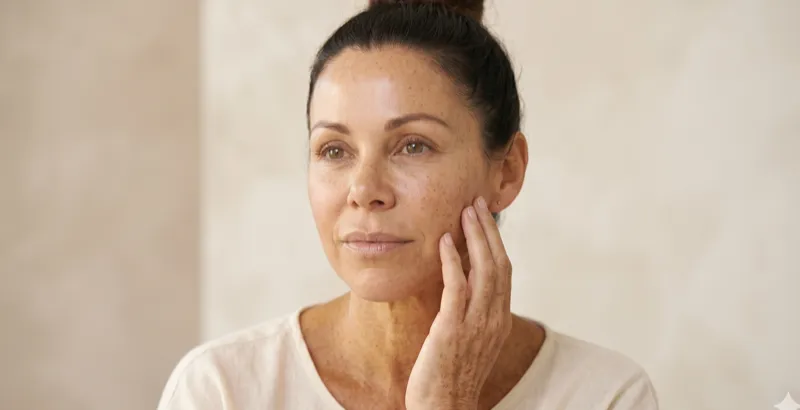
The science of skin aging is evolving rapidly — and for women navigating the skin changes that come with menopause and beyond, evidence-based skincare represents a fundamentally different approach: working with your skin's biology rather than against it.
Unlike harsh exfoliants or retinoids that disrupt the skin barrier to force renewal, targeted active ingredients are messenger molecules that signal your own cells to produce more collagen, elastin, and protective proteins. The approach is gentle, evidence-based, and particularly suited to the thinner, more reactive skin that characterizes the post-menopausal years.
How Retinoids Accelerate Dark Spot Resolution
Retinol addresses hyperpigmentation through a mechanism distinct from direct melanin inhibitors: by accelerating the epidermal cell turnover cycle, retinol speeds the replacement of melanin-laden surface keratinocytes with fresher cells containing less melanin. In mature skin, where the cell turnover cycle has extended to 40-60 days, melanin-laden cells remain visible on the surface nearly twice as long as in younger skin — this extended transit time is the primary reason dark spots persist longer after 40. Retinol restores the turnover cycle toward its youthful 28-day baseline by binding retinoic acid receptors that upregulate genes governing keratinocyte proliferation in the basal layer. A 2006 study in Clinical Interventions in Aging documented that 12 weeks of retinol use reduced the average cell turnover time in women aged 40-55 from 52 days to 34 days — a 35% acceleration that proportionally speeds the resolution of melanin-laden surface cells.[1]
Beyond accelerating cell turnover, retinoids directly modulate melanocyte behavior at the gene expression level. Retinoic acid (the active metabolite of retinol) downregulates tyrosinase gene transcription in melanocytes, reduces the expression of melanocyte-specific transcription factor MITF (which governs melanin synthesis gene programs), and inhibits the transfer of melanosomes from melanocytes to keratinocytes through effects on dendritic morphology. A 2012 study in Experimental Dermatology demonstrated that retinoid-treated melanocytes showed 40% shorter dendrites with 25% fewer melanosome-containing tips compared to untreated controls — effectively reducing the physical reach of melanin distribution even when melanin production continues. This dual mechanism (faster removal of pigmented cells plus reduced melanin loading of replacement cells) makes retinoids uniquely effective for progressive dark spot fading that improves with each turnover cycle.
Clinical research confirms that the retinol protocol for dark spot treatment on mature skin must balance efficacy against the increased sensitivity that makes aggressive retinoid use counterproductive. Over-aggressive retinoid therapy can trigger inflammatory reactions that cause post-inflammatory hyperpigmentation — paradoxically creating new dark marks while attempting to treat existing ones. The evidence-based introduction schedule for hyperpigmentation treatment: start with retinol 0.25% applied every third evening for 2 weeks, advance to every other evening for 2 weeks, then nightly from week 5. If tolerated well at 8 weeks, advance to retinol 0.5%. The retinol should be applied to the entire face (not just dark spots) because the accelerated turnover and tyrosinase-suppressing effects are most effective as full-face treatment — this also prevents new spots from forming in untreated areas. Apply to dry skin 20 minutes after cleansing, and buffer with a ceramide moisturizer applied before or after retinol if sensitivity occurs.
Combining retinol with complementary depigmenting agents in a coordinated protocol maximizes dark spot fading while distributing the treatment burden across multiple mechanisms rather than relying on a single aggressive intervention. The optimal combination protocol for mature skin: morning — vitamin C serum 15% (tyrosinase inhibition + antioxidant UV protection) + niacinamide moisturizer 4-5% (melanosome transfer inhibition) + tinted mineral sunscreen SPF 50 (UV + visible light protection); evening — retinol 0.3-0.5% (cell turnover acceleration + melanocyte modulation) + azelaic acid 15% spot treatment on stubborn spots (selective tyrosinase inhibition + anti-inflammation). This five-agent protocol addresses hyperpigmentation at every step of the melanin cascade: production (vitamin C + azelaic acid), transfer (niacinamide), surface persistence (retinol), and stimulation prevention (sunscreen). A 2020 study in the Journal of Cosmetic Dermatology evaluating a similar multi-target approach found 62% greater MASI improvement at 16 weeks compared to retinol monotherapy — with no increase in adverse events because the burden is distributed across multiple gentle mechanisms rather than concentrated in a single aggressive one.
Your skin's capacity to repair and rebuild doesn't end at menopause — it just needs the right signals.
— Dr. Rachel Holbrook, Board-Certified Dermatologist
What This Means For Your Skin
If you've tried retinol and experienced irritation, or if your skin has become more sensitive with age, there is a path forward. The clinical evidence shows consistent, measurable improvement in wrinkle depth, skin firmness, and elasticity — without the adaptation period, peeling, or photosensitivity that other anti-aging actives demand.
Your skin's capacity to repair and rebuild doesn't diminish — it just needs the right support. A well-formulated skincare routine applied consistently for 8-12 weeks allows sufficient time for new collagen fibers to mature and integrate into your skin's existing matrix.
The science is clear. The evidence is consistent. The results are measurable.
What happens next is up to you.