
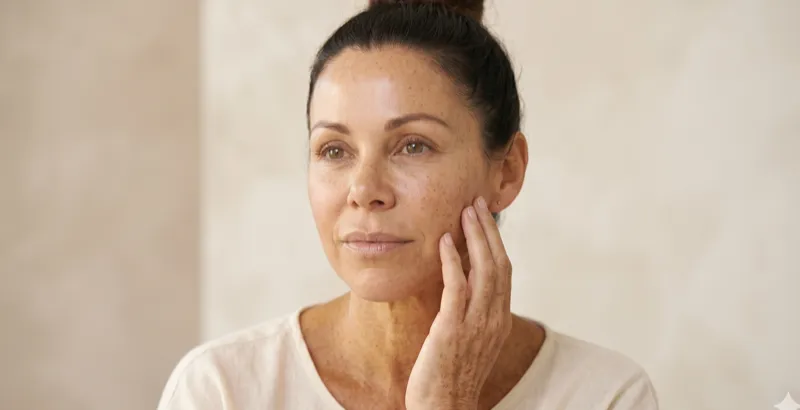
The science of skin aging is evolving rapidly — and for women navigating the skin changes that come with menopause and beyond, evidence-based skincare represents a fundamentally different approach: working with your skin's biology rather than against it.
Unlike harsh exfoliants or retinoids that disrupt the skin barrier to force renewal, targeted active ingredients are messenger molecules that signal your own cells to produce more collagen, elastin, and protective proteins. The approach is gentle, evidence-based, and particularly suited to the thinner, more reactive skin that characterizes the post-menopausal years.
Why UV Protection Anchors Every Pigmentation Plan
Sunscreen is the single most critical component of any hyperpigmentation management strategy — more important than any active depigmenting ingredient — because ongoing UV exposure continuously restimulates the very melanocytes that treatment is attempting to suppress. Every topical brightening agent (vitamin C, hydroquinone, azelaic acid, tranexamic acid, niacinamide) works by reducing melanin production or distribution, but UV radiation is the most potent melanin stimulant in the environment, capable of activating melanocytes through at least five independent pathways: direct DNA damage triggering p53-mediated melanogenesis, UVA-generated ROS activating the MC1R cascade, keratinocyte inflammatory signaling via IL-1 and TNF-α, prostaglandin E2 synthesis through arachidonic acid release, and endothelin-1 secretion from UV-damaged keratinocytes. A single significant UV exposure can undo weeks of topical depigmentation progress. A 2020 study in the Journal of the American Academy of Dermatology demonstrated that the addition of strict daily sunscreen to a topical depigmenting regimen improved melasma outcomes by 40-60% compared to identical depigmenting treatment without consistent sunscreen — confirming that UV protection amplifies the efficacy of every depigmenting agent.[1]
For hyperpigmentation prevention and management, sunscreen specifications must go beyond standard SPF recommendations. UV-A radiation (315-400nm) is the primary wavelength driving pigmentary responses — it penetrates deeper than UV-B, reaches melanocytes in the basal layer of the epidermis, and activates persistent pigment darkening (PPD) that can last weeks to months. Standard SPF measures only UV-B protection and tells nothing about UV-A coverage. Women with hyperpigmentation should select sunscreens with the highest available UV-A protection: PA++++ (Japanese rating), PPD 16+ (European rating), or broad-spectrum zinc oxide ≥15% (which provides inherent UV-A coverage across the full spectrum). Visible light (400-700nm) is an increasingly recognized contributor to pigmentation, particularly in women with Fitzpatrick skin types III-VI — a 2014 study in the Journal of Investigative Dermatology demonstrated that visible light induced pigmentation in darker skin types that lasted over 2 weeks, comparable to UV-induced pigmentation. Tinted sunscreens containing iron oxides are the only commercially available protection against visible light-induced pigmentation.
Clinical research confirms that the concept of 'photoprotection beyond sunscreen' is essential for women with treatment-resistant hyperpigmentation. Even the best sunscreens allow 2-3% of UV radiation to reach the skin (no sunscreen blocks 100%), and this residual UV exposure accumulates over months and years, providing sufficient melanocyte stimulation to maintain hyperpigmentation in susceptible individuals. Physical photoprotection — wide-brimmed hats (minimum 3-inch brim), UV-protective clothing (UPF 50+), and seeking shade during peak UV hours (10am-4pm) — eliminates UV exposure more completely than sunscreen alone. For melasma-prone women, heat exposure (separate from UV) can trigger pigmentation through TRPV1 receptor activation on melanocytes, meaning that sunscreen alone is insufficient protection during activities involving radiant heat (cooking, sauna, hot yoga) even in the absence of UV exposure. A 2017 pilot study in the Journal of Cosmetic Dermatology found that women with melasma who adopted comprehensive photoprotection (sunscreen + hat + shade-seeking + heat avoidance) showed 52% better maintenance of depigmentation treatment results compared to women using sunscreen alone.
Sunscreen application technique and reapplication specifically for hyperpigmentation management requires greater rigor than general photoprotection. Apply the full recommended amount (1/4 teaspoon for face) of tinted mineral sunscreen (zinc oxide 15-20% + iron oxides) every morning, regardless of indoor/outdoor plans — UV-A penetrates windows and clouds, and these wavelengths drive pigmentation without causing sunburn that would signal the need for protection. Reapply every 2 hours during outdoor exposure, and at midday even during office work if seated near windows. After swimming, sweating, or towel-drying the face, reapply immediately rather than waiting for the next scheduled interval. For women with active melasma or treatment-phase hyperpigmentation, morning sunscreen application should be the very last skincare step — applied after all serums and moisturizers — to ensure an uninterrupted, uniform UV-filtering film on the skin surface. The return on investment of rigorous sunscreen use for hyperpigmentation is extraordinary: a 2019 cost-effectiveness analysis found that consistent daily sunscreen use prevented $3-8 of depigmenting treatment costs for every $1 spent on sunscreen — the most cost-effective intervention in the entire hyperpigmentation treatment arsenal.
Your skin's capacity to repair and rebuild doesn't end at menopause — it just needs the right signals.
— Dr. Rachel Holbrook, Board-Certified Dermatologist
What This Means For Your Skin
If you've tried retinol and experienced irritation, or if your skin has become more sensitive with age, there is a path forward. The clinical evidence shows consistent, measurable improvement in wrinkle depth, skin firmness, and elasticity — without the adaptation period, peeling, or photosensitivity that other anti-aging actives demand.
Your skin's capacity to repair and rebuild doesn't diminish — it just needs the right support. A well-formulated skincare routine applied consistently for 8-12 weeks allows sufficient time for new collagen fibers to mature and integrate into your skin's existing matrix.
The science is clear. The evidence is consistent. The results are measurable.
What happens next is up to you.