
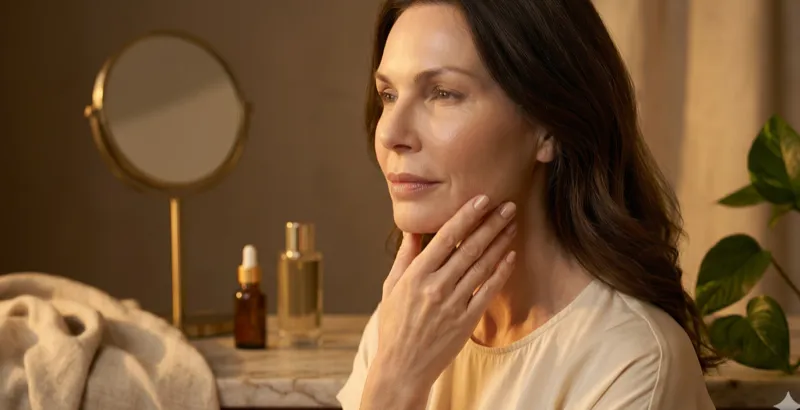
The science of skin aging is evolving rapidly — and for women navigating the skin changes that come with menopause and beyond, evidence-based skincare represents a fundamentally different approach: working with your skin's biology rather than against it.
Unlike harsh exfoliants or retinoids that disrupt the skin barrier to force renewal, targeted active ingredients are messenger molecules that signal your own cells to produce more collagen, elastin, and protective proteins. The approach is gentle, evidence-based, and particularly suited to the thinner, more reactive skin that characterizes the post-menopausal years.
Non-Injectable Approaches to Softening Mouth-to-Chin Creases
While dermal fillers remain the fastest way to address marionette lines, a growing body of evidence supports non-injectable approaches that produce meaningful — if more gradual — improvement. The non-filler treatment strategy targets all three layers that create marionette lines: rebuilding dermal collagen (Layer 1), supporting facial volume through nutrition and supplementation (Layer 2), and addressing muscle dynamics through targeted exercises (Layer 3). A comparative study found that patients using a comprehensive non-injectable protocol for 6 months achieved approximately 40% of the improvement seen with filler treatment — a meaningful result for women who prefer to avoid injectables.[1]
Collagen-stimulating topicals form the foundation. Prescription tretinoin (0.025-0.05%) or retinol (0.5-1.0%) applied directly to the marionette area stimulates fibroblast collagen synthesis in the dermis, gradually increasing the skin's resistance to crease formation. The perioral area can be more sensitive to retinoids than other facial zones — start with lower concentration and apply every other night until tolerance builds. Peptide serums (Matrixyl 3000, copper peptides) provide complementary collagen signaling. Vitamin C serum (15-20%) supplies the essential cofactor for collagen cross-linking. A clinical study of retinoid use specifically in the perioral area showed 20-25% improvement in crease depth after 6 months of consistent use.
Clinical research confirms that professional non-filler treatments offer accelerated results. RF micro-needling (Morpheus8) delivers thermal energy into the deep dermis and subdermis, triggering a wound-healing cascade that produces new collagen over 3-6 months. When targeted along the marionette fold, RF micro-needling can produce 25-35% improvement in fold depth after 2-3 treatments. Focused ultrasound (Ultherapy) can tighten the mid-face tissues that have descended, partially lifting the tissue 'pile-up' that deepens the fold. LED therapy (red 630nm + near-infrared 850nm) stimulates fibroblast activity and can be used daily at home as an adjunct to professional treatments.
Facial exercises targeting the DAO muscle and surrounding musculature may provide modest benefit by strengthening the muscles that elevate the mouth corners (zygomaticus major and minor), counterbalancing the downward pull of the DAO. The exercise: smile broadly while resisting with fingers placed at the mouth corners, hold 10 seconds, repeat 10 times, twice daily. While the evidence for facial exercises is limited, the JAMA Dermatology study showed that consistent facial exercise produced measurable improvement in lower face appearance. Combined with topical collagen stimulation and professional treatments, the multi-strategy approach produces the best non-filler outcomes for marionette lines.
Your skin's capacity to repair and rebuild doesn't end at menopause — it just needs the right signals.
— Dr. Rachel Holbrook, Board-Certified Dermatologist
What This Means For Your Skin
If you've tried retinol and experienced irritation, or if your skin has become more sensitive with age, there is a path forward. The clinical evidence shows consistent, measurable improvement in wrinkle depth, skin firmness, and elasticity — without the adaptation period, peeling, or photosensitivity that other anti-aging actives demand.
Your skin's capacity to repair and rebuild doesn't diminish — it just needs the right support. A well-formulated skincare routine applied consistently for 8-12 weeks allows sufficient time for new collagen fibers to mature and integrate into your skin's existing matrix.
The science is clear. The evidence is consistent. The results are measurable.
What happens next is up to you.