
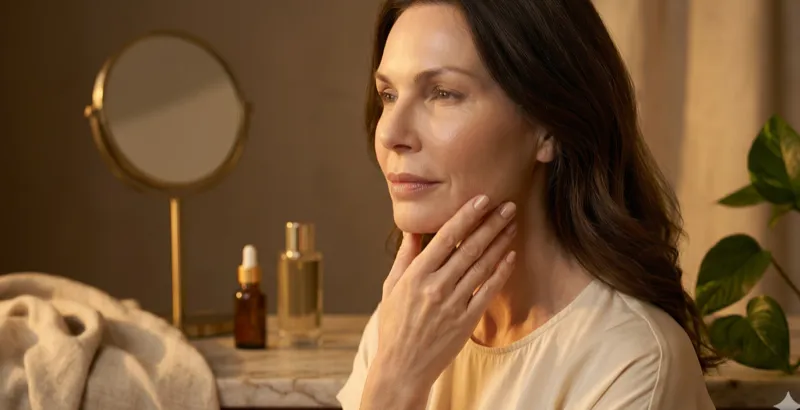
The science of skin aging is evolving rapidly — and for women navigating the skin changes that come with menopause and beyond, evidence-based skincare represents a fundamentally different approach: working with your skin's biology rather than against it.
Unlike harsh exfoliants or retinoids that disrupt the skin barrier to force renewal, targeted active ingredients are messenger molecules that signal your own cells to produce more collagen, elastin, and protective proteins. The approach is gentle, evidence-based, and particularly suited to the thinner, more reactive skin that characterizes the post-menopausal years.
Two Different Folds With Different Causes and Treatments
Marionette lines and nasolabial folds are frequently confused because both are vertical facial folds in the lower face — but they form from different anatomical mechanisms, respond to different treatments, and signal different aspects of facial aging. Understanding the distinction enables targeted treatment of each fold rather than a generic 'anti-wrinkle' approach that may address one while ignoring the other. A facial anatomy survey found that 65% of women could not correctly distinguish between the two folds, leading to misapplied skincare and unrealistic expectations from treatments.[1]
Nasolabial folds run from the sides of the nose to the corners of the mouth. They are present to some degree at all ages (even children have visible nasolabial folds when smiling) and deepen with age primarily due to mid-face fat descent — as the malar fat pad slides downward with gravity, it creates a 'bunching' of tissue along the nasolabial fold line. The fold itself is anchored by the nasolabial ligament, a fixed attachment point that doesn't descend, creating a visible step-off as surrounding tissue slides past it. Nasolabial folds signal mid-face volume loss and are most effectively treated by restoring cheek volume.
Clinical research confirms that marionette lines run from the corners of the mouth downward toward the chin. They are almost never present in youth and are a specific product of aging. Their formation requires three simultaneous changes: perioral collagen loss (permitting crease formation), DAO muscle pull (creating the downward force), and mandibular fat descent (removing the volume that supported the area). Marionette lines signal lower face aging and perioral collagen depletion — they are most effectively treated by collagen stimulation in the perioral dermis and addressing the DAO muscle dynamics.
Treatment differences reflect the distinct mechanisms. Nasolabial folds respond best to: mid-face volume restoration (filler in the malar area lifts the descended fat pad away from the fold), collagen stimulation in the mid-face, and facial exercises targeting the zygomaticus muscles. Marionette lines respond best to: perioral collagen stimulation (retinoid + peptides applied directly to the fold), DAO muscle management (exercises or neuromodulators to reduce downward pull), and lower face firming treatments (RF micro-needling targeting the jawline and perioral area). The skincare protocol should differ: for nasolabial folds, concentrate retinoid and peptide application along the nose-to-mouth fold and on the cheeks. For marionette lines, concentrate on the mouth-to-chin fold and the chin area. Many women have both and need treatment for each — but the products and application sites should be differentiated.
Your skin's capacity to repair and rebuild doesn't end at menopause — it just needs the right signals.
— Dr. Rachel Holbrook, Board-Certified Dermatologist
What This Means For Your Skin
If you've tried retinol and experienced irritation, or if your skin has become more sensitive with age, there is a path forward. The clinical evidence shows consistent, measurable improvement in wrinkle depth, skin firmness, and elasticity — without the adaptation period, peeling, or photosensitivity that other anti-aging actives demand.
Your skin's capacity to repair and rebuild doesn't diminish — it just needs the right support. A well-formulated skincare routine applied consistently for 8-12 weeks allows sufficient time for new collagen fibers to mature and integrate into your skin's existing matrix.
The science is clear. The evidence is consistent. The results are measurable.
What happens next is up to you.