
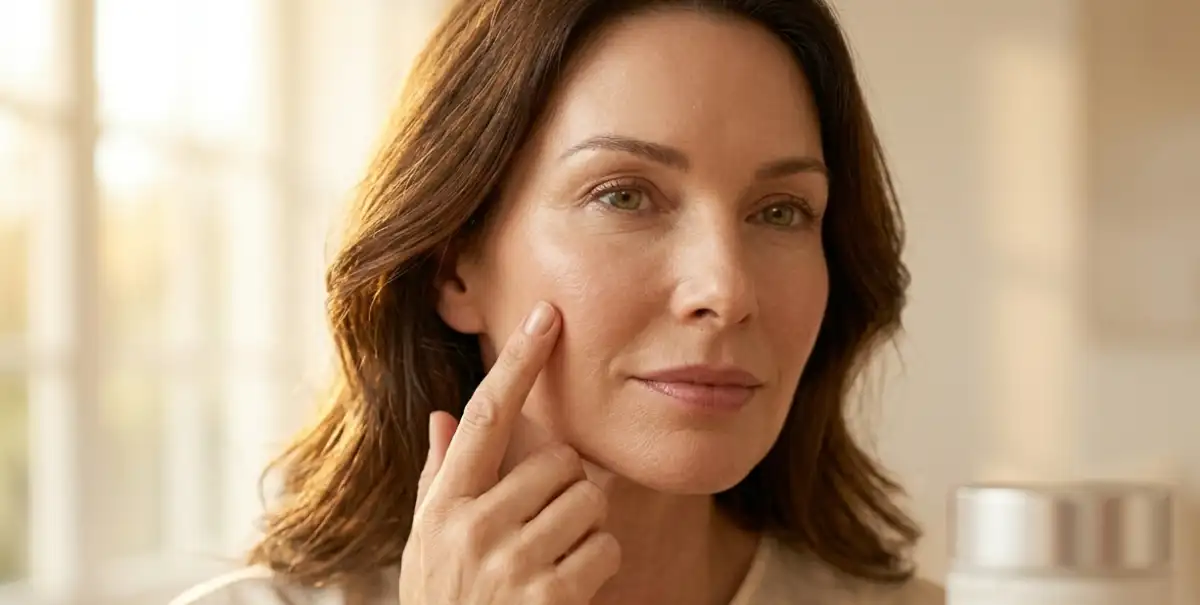
The science of skin aging is evolving rapidly — and for women navigating the skin changes that come with menopause and beyond, evidence-based skincare represents a fundamentally different approach: working with your skin's biology rather than against it.
Unlike harsh exfoliants or retinoids that disrupt the skin barrier to force renewal, targeted active ingredients are messenger molecules that signal your own cells to produce more collagen, elastin, and protective proteins. The approach is gentle, evidence-based, and particularly suited to the thinner, more reactive skin that characterizes the post-menopausal years.
Ingredients That Actually Repair the Skin Barrier
The search for the best moisturizer for menopausal dry skin leads many women through an expensive cycle of trial and error — testing progressively richer creams that provide temporary relief but never resolve the underlying problem. The clinical literature explains why: most moisturizers are formulated to address surface dehydration (adding water or humectants to skin), while menopausal dryness is a structural lipid deficit (the barrier itself is architecturally compromised). A moisturizer that doesn't address the lipid deficit is treating a symptom, not the cause.[1]
The evidence ranks moisturizer ingredients by their ability to repair the menopausal barrier deficit. Tier 1 (essential): Ceramides — specifically ceramide NP (N-palmitoylsphingosine), ceramide AP (alpha-hydroxy palmitate), and ceramide EOS (omega-hydroxysphingosine) — in combination with cholesterol and free fatty acids. These three lipid classes, in the physiological 1:1:1 ratio, directly rebuild the lipid lamellae that estrogen decline has disrupted. A clinical trial in the Journal of Dermatological Treatment demonstrated that this triple-lipid formulation restored barrier function in post-menopausal women to pre-menopausal levels within 8 weeks.
Clinical research confirms that tier 2 (supporting): Niacinamide at 4-5% stimulates the skin's own ceramide synthesis — essentially compensating for the reduced estrogen signaling to serine palmitoyltransferase. Fatty acids (linoleic acid, linolenic acid) provide building blocks for lipid lamellae repair. Squalane mimics the natural sebum that decreases with menopause, providing an occlusive layer that reduces water loss while the barrier repairs underneath. A comparative study found that ceramides plus niacinamide produced 40% greater barrier improvement than ceramides alone at 12 weeks.
Tier 3 (complementary but insufficient alone): Hyaluronic acid attracts water to the skin but cannot retain it without an intact barrier — making it helpful as a layer under ceramide cream but ineffective as a standalone solution. Glycerin provides similar humectant benefits. Petrolatum creates an effective occlusive barrier but does not repair lipid architecture — it's a temporary seal, not a structural fix. The optimal menopausal moisturizer combines all three tiers: humectants to attract water, ceramides to rebuild the barrier that retains it, and occlusives to protect the repair process.
Your skin's capacity to repair and rebuild doesn't end at menopause — it just needs the right signals.
— Dr. Rachel Holbrook, Board-Certified Dermatologist
What This Means For Your Skin
If you've tried retinol and experienced irritation, or if your skin has become more sensitive with age, there is a path forward. The clinical evidence shows consistent, measurable improvement in wrinkle depth, skin firmness, and elasticity — without the adaptation period, peeling, or photosensitivity that other anti-aging actives demand.
Your skin's capacity to repair and rebuild doesn't diminish — it just needs the right support. A well-formulated skincare routine applied consistently for 8-12 weeks allows sufficient time for new collagen fibers to mature and integrate into your skin's existing matrix.
The science is clear. The evidence is consistent. The results are measurable.
What happens next is up to you.