
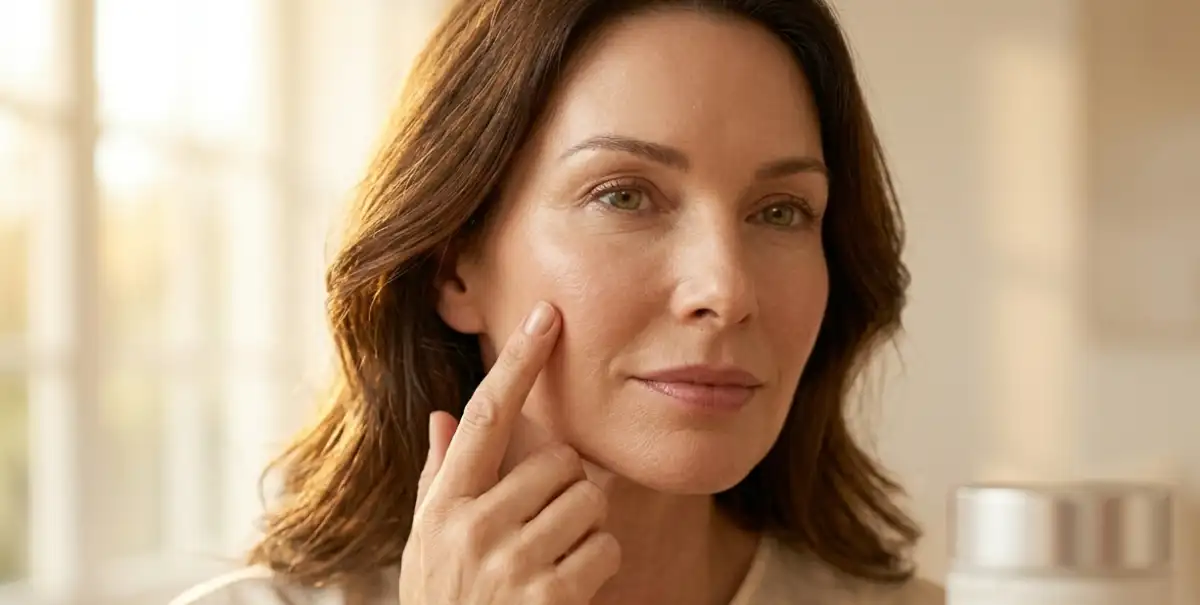
The science of skin aging is evolving rapidly — and for women navigating the skin changes that come with menopause and beyond, evidence-based skincare represents a fundamentally different approach: working with your skin's biology rather than against it.
Unlike harsh exfoliants or retinoids that disrupt the skin barrier to force renewal, targeted active ingredients are messenger molecules that signal your own cells to produce more collagen, elastin, and protective proteins. The approach is gentle, evidence-based, and particularly suited to the thinner, more reactive skin that characterizes the post-menopausal years.
The Estrogen-Ceramide Connection Behind Post-Menopausal Dryness
Dry skin during menopause is the most frequently reported dermatological symptom, affecting 64% of menopausal women according to a large-scale survey published in Menopause. Yet the dryness women experience after menopause is fundamentally different from the dryness they may have encountered in younger years. Pre-menopausal dryness is typically a surface hydration issue — environmental factors stripping moisture from otherwise intact skin. Menopausal dryness is a structural barrier deficit — the skin's lipid architecture is compromised because the hormonal signals that maintained it have permanently declined.[1]
The mechanism centers on estrogen's role in ceramide biosynthesis. Estrogen stimulates the enzyme serine palmitoyltransferase, which catalyzes the rate-limiting step in ceramide production. Ceramides constitute 50% of the stratum corneum lipid matrix — the mortar between the brick-like corneocytes that forms the skin's waterproof barrier. When estrogen declines permanently at menopause, ceramide production decreases by 20-30%, creating structural gaps in the lipid matrix through which water escapes uncontrollably. A study in the British Journal of Dermatology measured transepidermal water loss (TEWL) in post-menopausal women and found values 30-40% higher than in age-matched pre-menopausal controls.
Clinical research confirms that the decline extends beyond ceramides to affect all three lipid classes that constitute the barrier. Cholesterol synthesis decreases, free fatty acid production slows, and the precise 1:1:1 ratio of ceramides:cholesterol:fatty acids — critical for proper lipid lamellae organization — becomes imbalanced. Research using electron microscopy revealed that post-menopausal stratum corneum lipid lamellae show disorganized, discontinuous structures compared to the orderly parallel bilayers seen in pre-menopausal skin. This architectural disruption explains why humectant-only moisturizers (hyaluronic acid, glycerin) fail to resolve menopausal dryness — they attract water to a barrier that cannot retain it.
The clinical implication is that menopausal dry skin requires lipid replacement therapy, not simply hydration. Products containing physiological lipids — ceramides NP, AP, and EOS in combination with cholesterol and free fatty acids at the 1:1:1 ratio — directly replace what estrogen decline has removed. A randomized controlled trial found that twice-daily application of a physiological lipid mixture restored TEWL values to pre-menopausal baseline within 8 weeks, eliminated the cyclical dryness pattern, and reduced sensitivity reports by 40%. The evidence is clear: treat the barrier deficit, not the surface dryness.
Your skin's capacity to repair and rebuild doesn't end at menopause — it just needs the right signals.
— Dr. Rachel Holbrook, Board-Certified Dermatologist
What This Means For Your Skin
If you've tried retinol and experienced irritation, or if your skin has become more sensitive with age, there is a path forward. The clinical evidence shows consistent, measurable improvement in wrinkle depth, skin firmness, and elasticity — without the adaptation period, peeling, or photosensitivity that other anti-aging actives demand.
Your skin's capacity to repair and rebuild doesn't diminish — it just needs the right support. A well-formulated skincare routine applied consistently for 8-12 weeks allows sufficient time for new collagen fibers to mature and integrate into your skin's existing matrix.
The science is clear. The evidence is consistent. The results are measurable.
What happens next is up to you.