
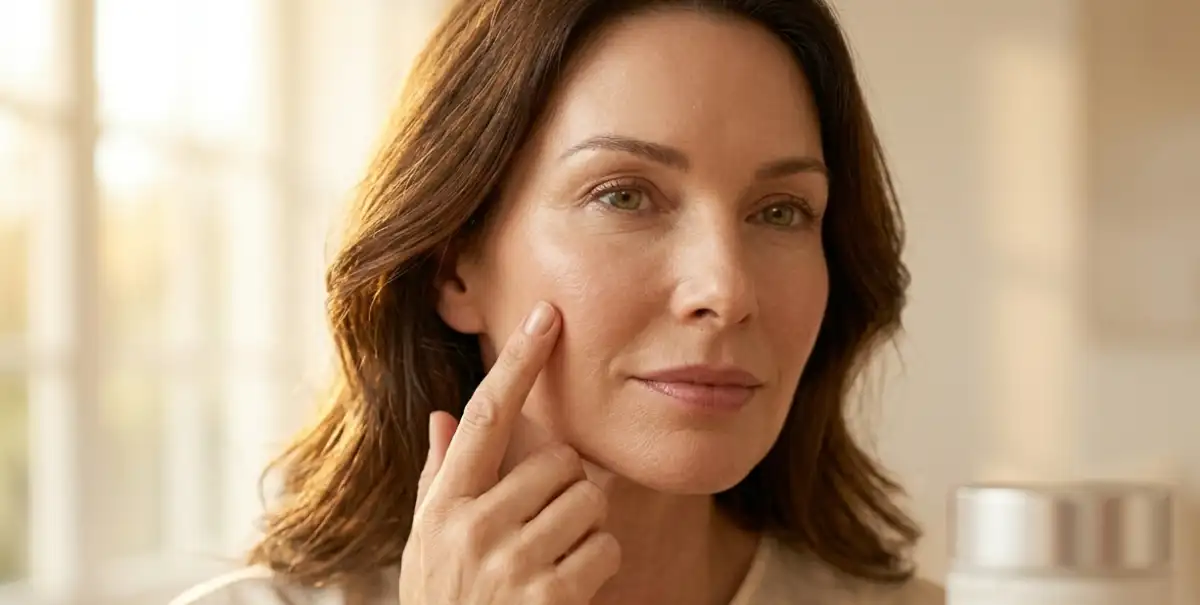
The science of skin aging is evolving rapidly — and for women navigating the skin changes that come with menopause and beyond, evidence-based skincare represents a fundamentally different approach: working with your skin's biology rather than against it.
Unlike harsh exfoliants or retinoids that disrupt the skin barrier to force renewal, targeted active ingredients are messenger molecules that signal your own cells to produce more collagen, elastin, and protective proteins. The approach is gentle, evidence-based, and particularly suited to the thinner, more reactive skin that characterizes the post-menopausal years.
From Declining Estrogen to Barrier Collapse
The connection between estrogen loss and dry skin is not correlation — it is direct causation through three independently documented biological pathways. The first and most impactful pathway is ceramide biosynthesis: estrogen activates the promoter region of the SPTLC1 gene, which encodes serine palmitoyltransferase — the enzyme that catalyzes the first and rate-limiting step in ceramide production. When estrogen levels fall below approximately 30 pg/mL (the typical post-menopausal range), SPTLC1 transcription decreases by 25-40%, directly reducing the skin's capacity to produce the lipid barriers that prevent water loss.[1]
The second pathway involves sebaceous gland suppression. Estrogen maintains sebaceous gland size and activity through ER-beta receptors on sebocytes. Post-menopausal sebum production decreases by 30-40% across all body sites, with facial skin showing the most dramatic reduction because it has the highest baseline sebocyte density. This sebum decline removes the natural lipid film that pre-menopausal skin uses as a first-line moisture barrier. A study tracking sebum output across the menopausal transition found that the decline begins during perimenopause and reaches its nadir approximately 3 years post-menopause.
Clinical research confirms that the third pathway is glycosaminoglycan (GAG) depletion. Estrogen stimulates hyaluronic acid synthase in dermal fibroblasts, maintaining the dermal GAG content that binds water within the dermis. Post-menopausal skin shows 20-30% lower GAG content compared to pre-menopausal skin, reducing the dermis's capacity to hold water internally. This manifests not as surface dryness (which is a barrier issue) but as loss of plumpness and turgor — the 'deflated' quality that menopausal women describe. Combined with barrier compromise, GAG depletion means the skin both loses water faster through the surface and holds less water internally.
Understanding these three pathways transforms treatment from guesswork into targeted intervention. Ceramide replacement addresses pathway one. Squalane or rosehip oil replaces the missing sebum in pathway two. Hyaluronic acid (topical, at multiple molecular weights) partially compensates for pathway three. The clinical evidence shows that addressing all three pathways simultaneously produces dramatically better outcomes than addressing any single pathway alone — a study comparing single-pathway versus triple-pathway treatment found 2.5 times greater improvement in skin hydration scores at 12 weeks.
Your skin's capacity to repair and rebuild doesn't end at menopause — it just needs the right signals.
— Dr. Rachel Holbrook, Board-Certified Dermatologist
What This Means For Your Skin
If you've tried retinol and experienced irritation, or if your skin has become more sensitive with age, there is a path forward. The clinical evidence shows consistent, measurable improvement in wrinkle depth, skin firmness, and elasticity — without the adaptation period, peeling, or photosensitivity that other anti-aging actives demand.
Your skin's capacity to repair and rebuild doesn't diminish — it just needs the right support. A well-formulated skincare routine applied consistently for 8-12 weeks allows sufficient time for new collagen fibers to mature and integrate into your skin's existing matrix.
The science is clear. The evidence is consistent. The results are measurable.
What happens next is up to you.