
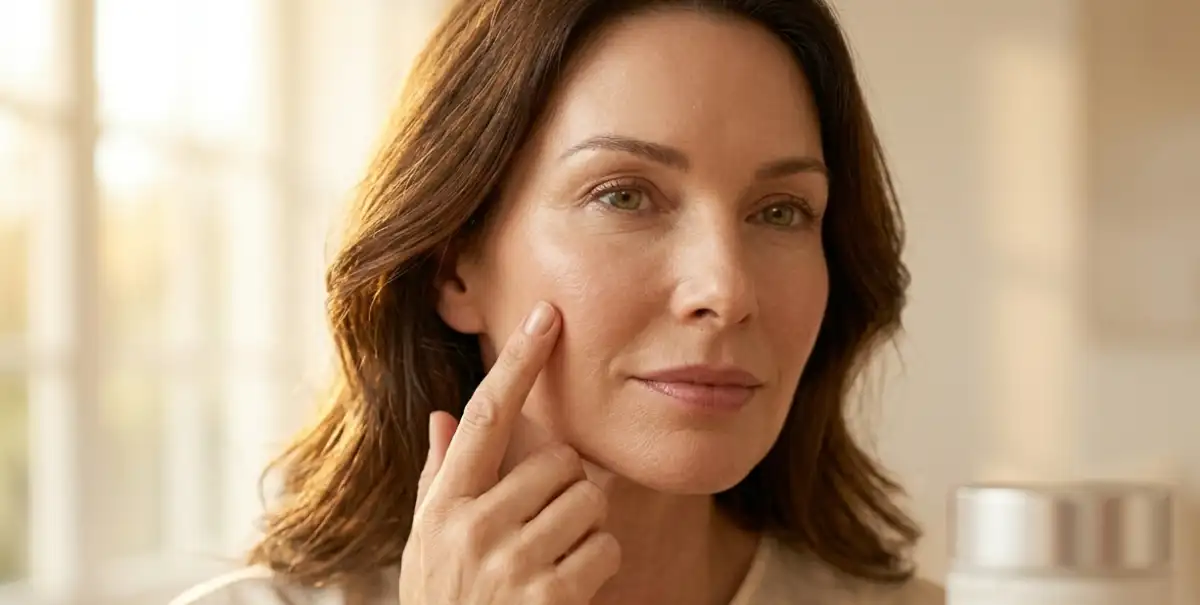
The science of skin aging is evolving rapidly — and for women navigating the skin changes that come with menopause and beyond, evidence-based skincare represents a fundamentally different approach: working with your skin's biology rather than against it.
Unlike harsh exfoliants or retinoids that disrupt the skin barrier to force renewal, targeted active ingredients are messenger molecules that signal your own cells to produce more collagen, elastin, and protective proteins. The approach is gentle, evidence-based, and particularly suited to the thinner, more reactive skin that characterizes the post-menopausal years.
Why Overnight Barrier Repair Produces the Best Clinical Results
Nighttime is the optimal window for menopausal skin barrier repair, and the clinical evidence explains why. TEWL follows a circadian rhythm — peaking between 11 PM and 2 AM when the skin is most permeable and metabolically active. A chronobiology study published in the Journal of Investigative Dermatology documented that nocturnal TEWL was 20-30% higher than daytime values, indicating that the barrier is most 'open' at night. For menopausal skin with an already-compromised barrier, this nocturnal permeability increase creates both a vulnerability (more water loss during sleep) and an opportunity (better absorption of repair ingredients).[1]
The cellular biology supports nocturnal treatment. Skin cell division peaks between 11 PM and 4 AM — the period when keratinocyte proliferation is 30 times higher than during daytime. DNA repair activity peaks overnight. Growth hormone, which stimulates fibroblast activity and collagen synthesis, is released primarily during deep sleep. These circadian processes mean that repair-focused ingredients applied at night encounter skin that is biologically primed for renovation. A comparative study found that identical ceramide formulations applied at night produced 15% greater barrier improvement than the same formulation applied in the morning.
Clinical research confirms that the optimal night cream for menopausal skin differs from a daytime moisturizer in three ways. First, higher ceramide concentration — without the constraint of cosmetic elegance or SPF compatibility, night formulations can carry 3-5% total ceramide content versus the 1-2% typical of daytime products. Second, occlusive elements — petrolatum, shea butter, or squalane at higher concentrations create a physical barrier that prevents nocturnal TEWL during the 7-8 hours of sleep. Third, active repair ingredients — retinol and peptides that are photosensitive or cosmetically incompatible with daytime use can be incorporated into night formulations.
The application technique matters as much as the product. Apply night cream to slightly damp skin (immediately after cleansing) to trap water in the stratum corneum before sealing with lipids. Use enough product to create a visible film — nighttime is not the time for lightweight application. For severely dry menopausal skin, the 'slugging' technique (applying a thin layer of petrolatum over the night cream) reduces overnight TEWL by up to 98%, allowing the ceramide ingredients to repair the barrier in a moisture-saturated environment. A study of slugging in post-menopausal women found that 4 weeks of nightly petrolatum occlusion improved hydration scores equivalent to 12 weeks of moisturizer alone.
Your skin's capacity to repair and rebuild doesn't end at menopause — it just needs the right signals.
— Dr. Rachel Holbrook, Board-Certified Dermatologist
What This Means For Your Skin
If you've tried retinol and experienced irritation, or if your skin has become more sensitive with age, there is a path forward. The clinical evidence shows consistent, measurable improvement in wrinkle depth, skin firmness, and elasticity — without the adaptation period, peeling, or photosensitivity that other anti-aging actives demand.
Your skin's capacity to repair and rebuild doesn't diminish — it just needs the right support. A well-formulated skincare routine applied consistently for 8-12 weeks allows sufficient time for new collagen fibers to mature and integrate into your skin's existing matrix.
The science is clear. The evidence is consistent. The results are measurable.
What happens next is up to you.