
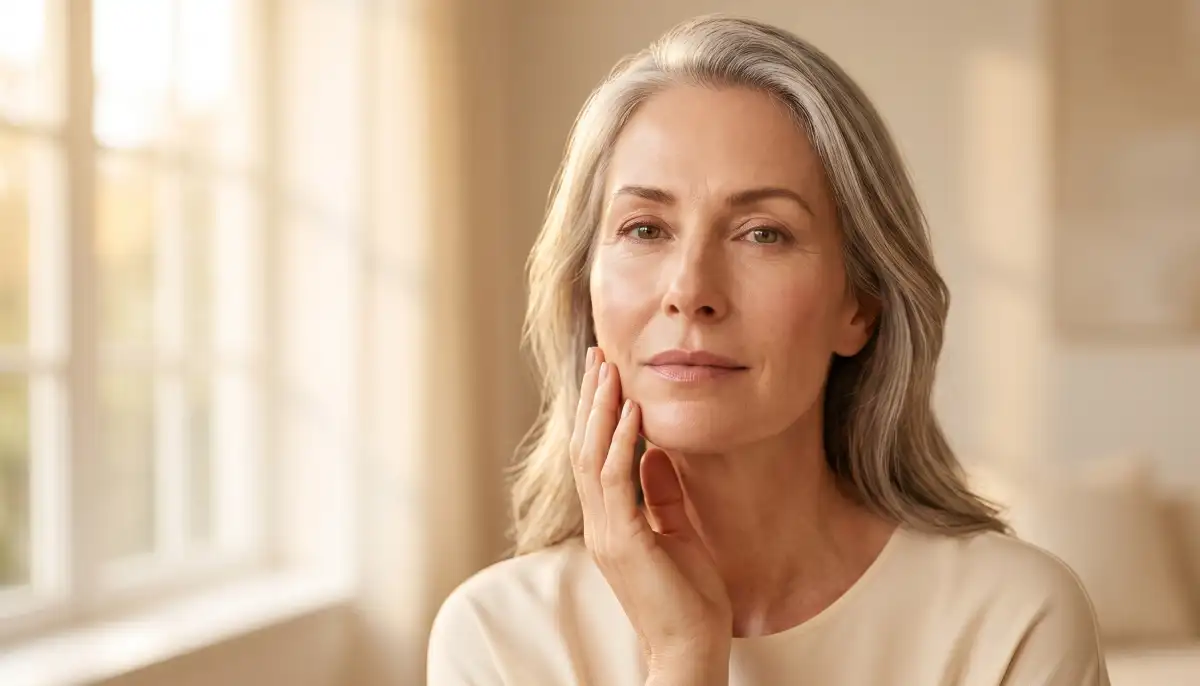
The science of skin aging is evolving rapidly — and for women navigating the skin changes that come with menopause and beyond, evidence-based skincare represents a fundamentally different approach: working with your skin's biology rather than against it.
Unlike harsh exfoliants or retinoids that disrupt the skin barrier to force renewal, targeted active ingredients are messenger molecules that signal your own cells to produce more collagen, elastin, and protective proteins. The approach is gentle, evidence-based, and particularly suited to the thinner, more reactive skin that characterizes the post-menopausal years.
The Estrogen-Collagen Link That Changes Skin
Menopause triggers a cascade of dermatological changes that go far beyond surface dryness. Within the first five years of menopause, women lose approximately 30% of their dermal collagen — a statistic documented across multiple longitudinal studies, including a landmark investigation published in the American Journal of Clinical Dermatology. This collagen decline occurs at a rate of roughly 2.1% per year, with the most dramatic losses concentrated in the early post-menopausal period when estrogen levels drop most precipitously.[1]
The mechanism is direct: estrogen receptors (ER-alpha and ER-beta) are densely distributed throughout dermal fibroblasts — the cells responsible for collagen and elastin synthesis. When circulating estrogen falls below a critical threshold, fibroblast activity decreases by 30-50%, simultaneously reducing new collagen production and accelerating the enzymatic breakdown of existing collagen through upregulated matrix metalloproteinases (MMPs). A 2019 study in Dermato-Endocrinology confirmed that post-menopausal women show significantly elevated MMP-1 and MMP-3 levels compared to pre-menopausal controls.
Clinical research confirms that beyond collagen, estrogen withdrawal affects virtually every layer of skin architecture. The epidermis thins by approximately 1.13% per year after menopause. Sebaceous gland output decreases, leading to the characteristic dryness that 64% of menopausal women report. Glycosaminoglycan content — particularly hyaluronic acid, which holds 1,000 times its weight in water — declines measurably. Melanocyte behavior becomes erratic, explaining the sudden appearance of age spots and hyperpigmentation that many women notice during perimenopause.
Understanding these mechanisms transforms skincare from guesswork into targeted intervention. The clinical literature consistently identifies three priority pathways for menopausal skin: stimulating residual fibroblast activity through peptide signaling, reinforcing the compromised lipid barrier with ceramides and essential fatty acids, and providing external antioxidant protection against the oxidative stress that compounds hormonal damage. Each pathway has robust clinical evidence — and each becomes more critical, not less, as estrogen continues to decline.
Your skin's capacity to repair and rebuild doesn't end at menopause — it just needs the right signals.
— Dr. Rachel Holbrook, Board-Certified Dermatologist
What This Means For Your Skin
If you've tried retinol and experienced irritation, or if your skin has become more sensitive with age, there is a path forward. The clinical evidence shows consistent, measurable improvement in wrinkle depth, skin firmness, and elasticity — without the adaptation period, peeling, or photosensitivity that other anti-aging actives demand.
Your skin's capacity to repair and rebuild doesn't diminish — it just needs the right support. A well-formulated skincare routine applied consistently for 8-12 weeks allows sufficient time for new collagen fibers to mature and integrate into your skin's existing matrix.
The science is clear. The evidence is consistent. The results are measurable.
What happens next is up to you.