
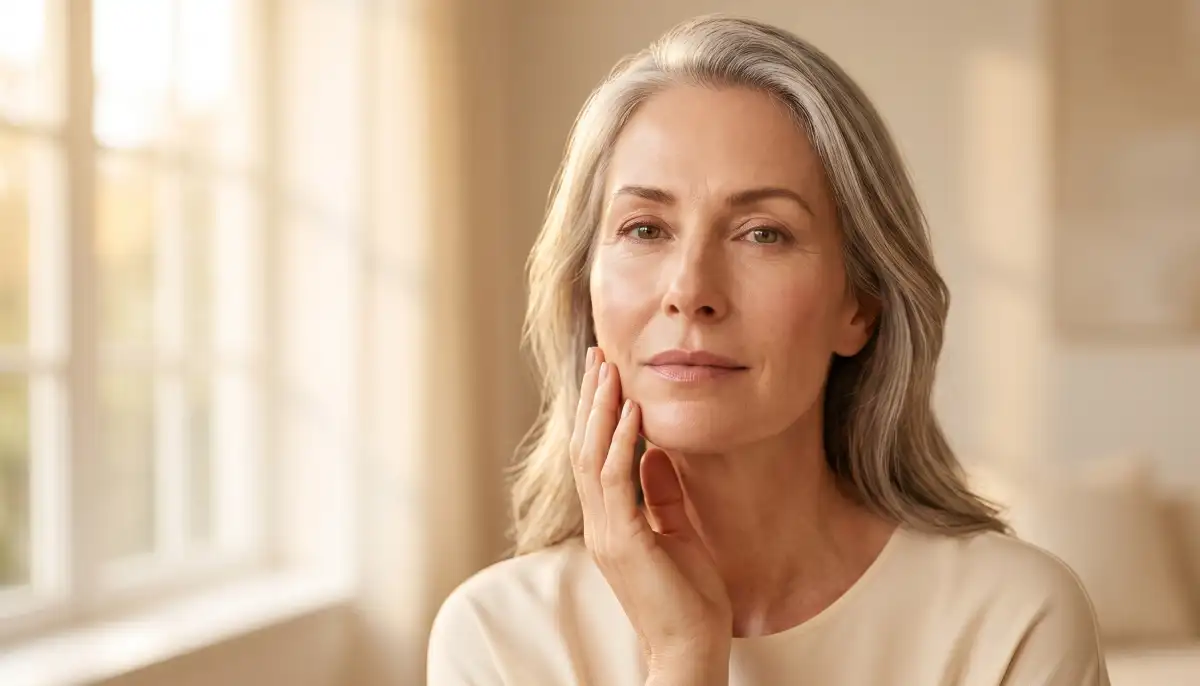
The science of skin aging is evolving rapidly — and for women navigating the skin changes that come with menopause and beyond, evidence-based skincare represents a fundamentally different approach: working with your skin's biology rather than against it.
Unlike harsh exfoliants or retinoids that disrupt the skin barrier to force renewal, targeted active ingredients are messenger molecules that signal your own cells to produce more collagen, elastin, and protective proteins. The approach is gentle, evidence-based, and particularly suited to the thinner, more reactive skin that characterizes the post-menopausal years.
Why Your Skin Transforms in Your 40s and 50s — The Science
The skin changes women experience during menopause are not gradual — they are accelerated. Research from the University of Michigan published in the Archives of Dermatology demonstrated that skin collagen content decreases by 2.1% per post-menopausal year, with the steepest decline occurring in the first five years. This translates to a loss of approximately 30% of total dermal collagen by year five — equivalent to roughly 15 years of chronological aging compressed into half a decade.[1]
This acceleration explains why many women describe a sudden transformation in their skin between ages 45 and 55. The changes are not imagined. Clinical measurements confirm that skin thickness decreases by an average of 1.13% per year, skin elasticity drops by 0.55% per year, and transepidermal water loss increases significantly. A 2020 meta-analysis in the International Journal of Women's Dermatology found that these changes correlate more strongly with years since menopause than with chronological age — meaning two women of identical age can have dramatically different skin based on their hormonal timeline.
Clinical research confirms that the molecular basis is increasingly well understood. Estrogen receptors in skin fibroblasts regulate the production of Type I and Type III collagen, elastin, glycosaminoglycans, and vascular endothelial growth factor. When estrogen signaling diminishes, each of these outputs decreases. Simultaneously, matrix metalloproteinase activity increases — meaning the skin both produces less structural protein and breaks down existing protein faster. This dual mechanism creates the characteristic rapid-onset changes: deeper wrinkles, thinner texture, reduced elasticity, and compromised barrier function.
The clinical significance of this understanding is practical. Because the changes are mechanism-specific rather than inevitable aging, they respond to targeted intervention. Topical retinoids have been shown to partially restore collagen synthesis even in post-menopausal skin. Peptide formulations activate fibroblast pathways through estrogen-independent mechanisms. And barrier-repair formulations with ceramides, cholesterol, and fatty acids in physiological ratios can compensate for the lipid deficit that estrogen withdrawal creates.
Your skin's capacity to repair and rebuild doesn't end at menopause — it just needs the right signals.
— Dr. Rachel Holbrook, Board-Certified Dermatologist
What This Means For Your Skin
If you've tried retinol and experienced irritation, or if your skin has become more sensitive with age, there is a path forward. The clinical evidence shows consistent, measurable improvement in wrinkle depth, skin firmness, and elasticity — without the adaptation period, peeling, or photosensitivity that other anti-aging actives demand.
Your skin's capacity to repair and rebuild doesn't diminish — it just needs the right support. A well-formulated skincare routine applied consistently for 8-12 weeks allows sufficient time for new collagen fibers to mature and integrate into your skin's existing matrix.
The science is clear. The evidence is consistent. The results are measurable.
What happens next is up to you.