
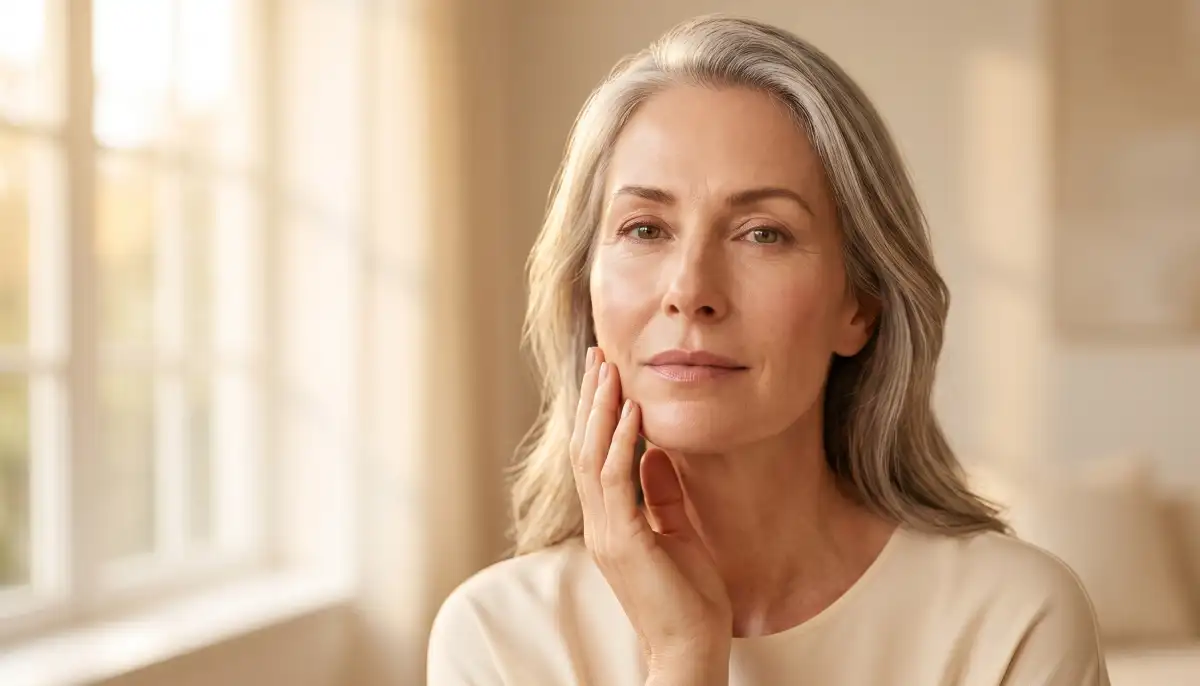
The science of skin aging is evolving rapidly — and for women navigating the skin changes that come with menopause and beyond, evidence-based skincare represents a fundamentally different approach: working with your skin's biology rather than against it.
Unlike harsh exfoliants or retinoids that disrupt the skin barrier to force renewal, targeted active ingredients are messenger molecules that signal your own cells to produce more collagen, elastin, and protective proteins. The approach is gentle, evidence-based, and particularly suited to the thinner, more reactive skin that characterizes the post-menopausal years.
The Molecular Pathway From Hormone Loss to Visible Change
Estrogen's influence on skin is mediated through two receptor types — ER-alpha and ER-beta — distributed throughout the epidermis, dermis, hair follicles, and sebaceous glands. When estrogen binds these receptors, it activates a cascade of gene expression that maintains virtually every aspect of skin health: collagen synthesis, elastin production, hyaluronic acid secretion, sebum output, melanocyte regulation, wound healing, and inflammatory modulation. A comprehensive mapping study published in the Journal of Investigative Dermatology identified over 3,000 estrogen-responsive genes in human skin fibroblasts.[1]
The decline pathway follows a predictable molecular sequence. As circulating estradiol drops below approximately 30 pg/mL (the typical post-menopausal range), ER activation decreases proportionally. Within fibroblasts, this reduces transcription of COL1A1 (collagen I), COL3A1 (collagen III), ELN (elastin), and HAS2 (hyaluronic acid synthase 2). Simultaneously, reduced ER activation removes the normal suppression of MMP1, MMP3, and MMP9 genes, allowing these collagen-degrading enzymes to increase expression 2-4 fold. The net effect is a shift from anabolic (building) to catabolic (breaking down) in the dermal extracellular matrix.
Clinical research confirms that in the epidermis, reduced ER-beta signaling slows keratinocyte proliferation and impairs differentiation — the process by which cells produce the structural proteins (keratin, filaggrin, involucrin) and lipids (ceramides) that constitute the barrier. This is why menopausal skin develops barrier dysfunction: it is not producing the structural components at pre-menopausal rates. A controlled study measuring ceramide levels across the menopausal transition found a 33% decrease in total epidermal ceramides within four years of menopause.
Understanding this molecular pathway identifies the intervention points. Retinoids can partially compensate for reduced ER-alpha signaling by activating retinoic acid receptors (RARs) on the same fibroblasts, stimulating collagen production through an estrogen-independent pathway. Peptides can activate membrane receptors that trigger similar downstream effects. And phytoestrogens — plant compounds like genistein and daidzein — can weakly activate ERs, providing a fraction of estrogen's signaling without hormonal replacement. Each approach targets a different point in the pathway, which is why combination therapy consistently outperforms single-ingredient strategies.
Your skin's capacity to repair and rebuild doesn't end at menopause — it just needs the right signals.
— Dr. Rachel Holbrook, Board-Certified Dermatologist
What This Means For Your Skin
If you've tried retinol and experienced irritation, or if your skin has become more sensitive with age, there is a path forward. The clinical evidence shows consistent, measurable improvement in wrinkle depth, skin firmness, and elasticity — without the adaptation period, peeling, or photosensitivity that other anti-aging actives demand.
Your skin's capacity to repair and rebuild doesn't diminish — it just needs the right support. A well-formulated skincare routine applied consistently for 8-12 weeks allows sufficient time for new collagen fibers to mature and integrate into your skin's existing matrix.
The science is clear. The evidence is consistent. The results are measurable.
What happens next is up to you.