
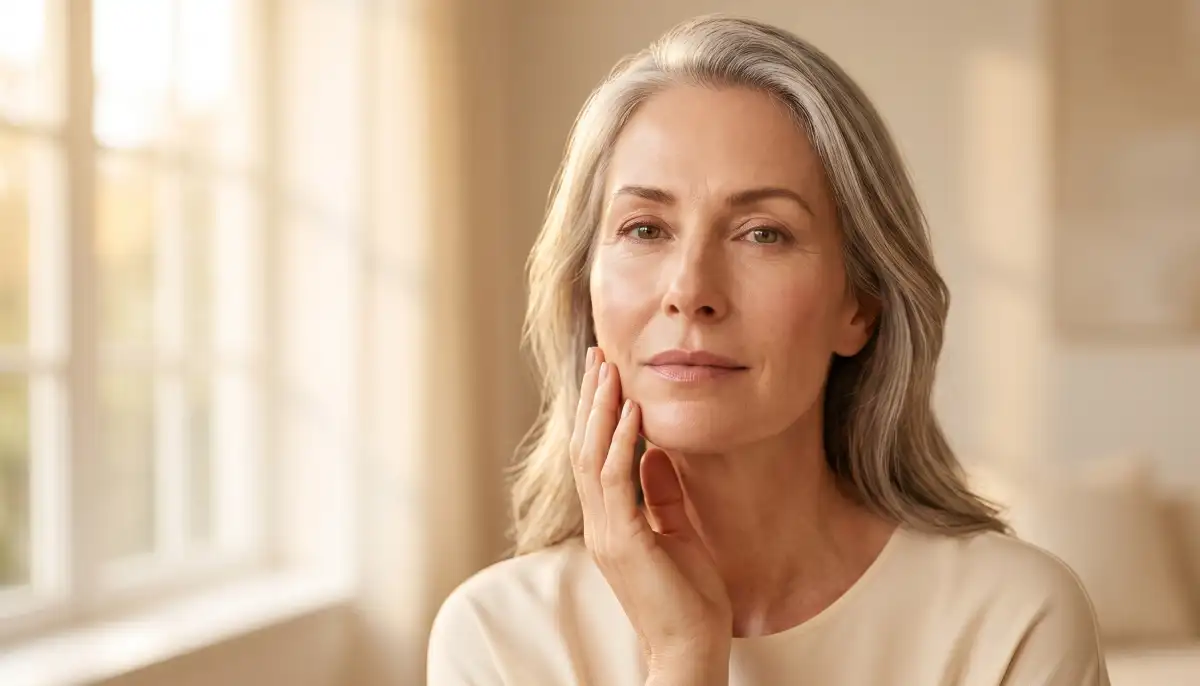
The science of skin aging is evolving rapidly — and for women navigating the skin changes that come with menopause and beyond, evidence-based skincare represents a fundamentally different approach: working with your skin's biology rather than against it.
Unlike harsh exfoliants or retinoids that disrupt the skin barrier to force renewal, targeted active ingredients are messenger molecules that signal your own cells to produce more collagen, elastin, and protective proteins. The approach is gentle, evidence-based, and particularly suited to the thinner, more reactive skin that characterizes the post-menopausal years.
Less Collagen Built, More Collagen Destroyed
Skin ages faster after menopause because of a double mechanism that no other life stage produces: collagen synthesis decreases while collagen destruction simultaneously increases. This dual hit — documented in a groundbreaking study by Brincat et al. in the British Journal of Obstetrics and Gynaecology — explains why five years of post-menopausal aging can produce changes equivalent to 15 years of chronological aging. The body is not simply making less collagen; it is actively dismantling the collagen it already has.[1]
The synthesis side is driven by estrogen receptor loss in dermal fibroblasts. Estrogen directly activates the promoter regions of COL1A1 and COL3A1 genes — the blueprints for Type I and Type III collagen. Without estrogen signaling, transcription of these genes decreases by 30-50%. Fibroblasts remain alive and functional, but their output drops dramatically. A 2013 study in Dermato-Endocrinology demonstrated that estrogen replacement therapy could restore collagen production to near pre-menopausal levels, proving that the fibroblasts themselves are not damaged — they are simply under-stimulated.
Clinical research confirms that the destruction side involves matrix metalloproteinases (MMPs) — enzymes that cleave collagen and elastin fibers. Estrogen normally suppresses MMP expression through its anti-inflammatory effects. When estrogen declines, MMP activity increases by 2-4 fold, creating a catabolic environment in the dermis. Compounding this, the natural tissue inhibitors of metalloproteinases (TIMPs) also decrease, removing the braking mechanism that normally limits collagen degradation. The net result is a dermal environment that both produces less and destroys more — the biochemical definition of accelerated aging.
This understanding reveals why targeted skincare — not just any skincare — matters after menopause. Products that stimulate fibroblast activity (peptides, retinoids) address the synthesis deficit. Products that inhibit MMP activity (green tea polyphenols, vitamin C, certain peptides) address the destruction surplus. And products that protect existing collagen from oxidative stress (antioxidant combinations) prevent the environmental damage that compounds the hormonal deficit. A complete post-menopausal skincare approach addresses all three mechanisms simultaneously.
Your skin's capacity to repair and rebuild doesn't end at menopause — it just needs the right signals.
— Dr. Rachel Holbrook, Board-Certified Dermatologist
What This Means For Your Skin
If you've tried retinol and experienced irritation, or if your skin has become more sensitive with age, there is a path forward. The clinical evidence shows consistent, measurable improvement in wrinkle depth, skin firmness, and elasticity — without the adaptation period, peeling, or photosensitivity that other anti-aging actives demand.
Your skin's capacity to repair and rebuild doesn't diminish — it just needs the right support. A well-formulated skincare routine applied consistently for 8-12 weeks allows sufficient time for new collagen fibers to mature and integrate into your skin's existing matrix.
The science is clear. The evidence is consistent. The results are measurable.
What happens next is up to you.