
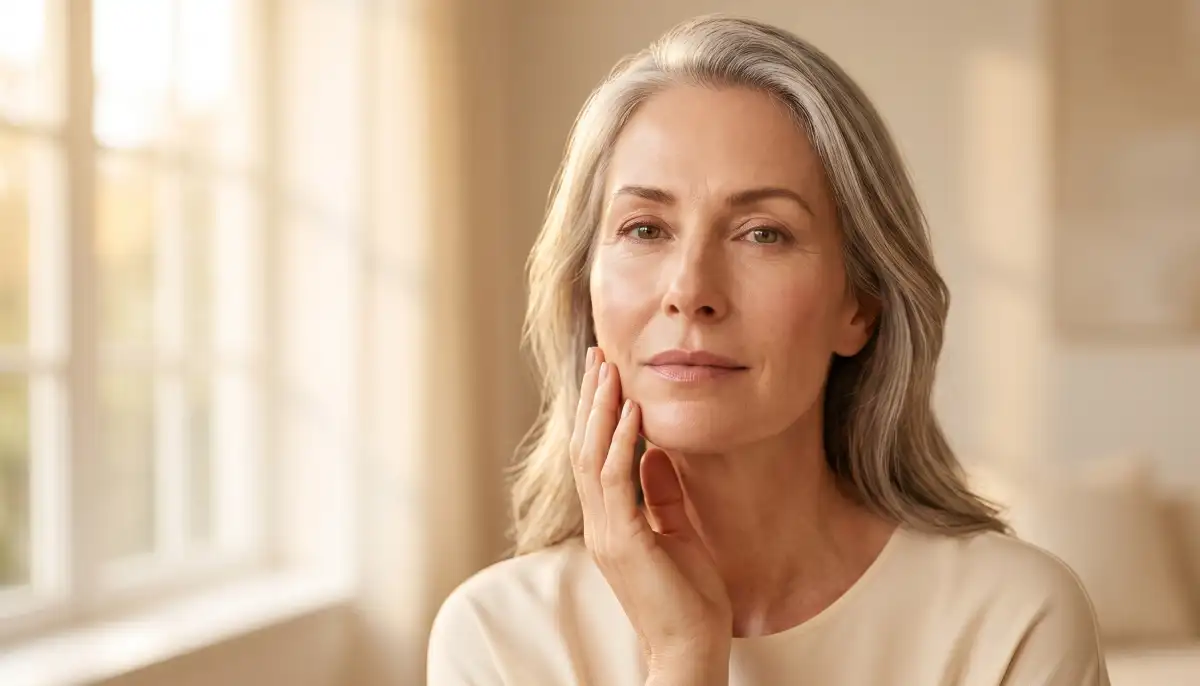
The science of skin aging is evolving rapidly — and for women navigating the skin changes that come with menopause and beyond, evidence-based skincare represents a fundamentally different approach: working with your skin's biology rather than against it.
Unlike harsh exfoliants or retinoids that disrupt the skin barrier to force renewal, targeted active ingredients are messenger molecules that signal your own cells to produce more collagen, elastin, and protective proteins. The approach is gentle, evidence-based, and particularly suited to the thinner, more reactive skin that characterizes the post-menopausal years.
Evidence-Based Strategies to Slow the 30% Decline
Preventing collagen loss during menopause requires a multi-pronged approach because the loss occurs through multiple mechanisms simultaneously. The 30% figure — first documented by Brincat and colleagues and since replicated across multiple populations — is not inevitable at full magnitude. A longitudinal study published in Maturitas followed women who began preventive skincare interventions during perimenopause and found that consistent retinoid use reduced the rate of collagen decline by approximately 40% compared to untreated controls.[1]
Retinoids remain the gold standard for collagen preservation. Tretinoin (prescription) and retinol (over-the-counter) activate retinoic acid receptors in fibroblasts, directly stimulating COL1A1 gene expression and new procollagen production. A randomized controlled trial in the Journal of Investigative Dermatology demonstrated that 0.025% tretinoin applied three times weekly for 48 weeks increased dermal collagen by 80% in sun-damaged post-menopausal skin. Over-the-counter retinol at 0.5-1% produces comparable but slower results over 24-48 weeks.
Clinical research confirms that vitamin C serves a dual role in collagen preservation: it is a required cofactor for prolyl and lysyl hydroxylase — the enzymes that stabilize collagen's triple-helix structure — and it inhibits MMP-1 expression, reducing collagen degradation. A study in the American Journal of Clinical Nutrition found that women with higher vitamin C intake had measurably better skin appearance scores. Topically, L-ascorbic acid at 10-15% concentration penetrates the dermis and provides both effects. The combination of retinoid + vitamin C addresses both sides of the synthesis/destruction equation.
Peptide formulations offer a third pathway, particularly valuable for women who cannot tolerate retinoids. Signal peptides like palmitoyl pentapeptide-4 (Matrixyl) mimic collagen fragment sequences that trigger fibroblast repair responses. Copper peptides (GHK-Cu) activate over 4,000 genes involved in tissue remodeling. These mechanisms are estrogen-independent — they work regardless of hormonal status. Clinical trials show peptide-based interventions improve collagen density by 12-18% over 12 weeks, making them a meaningful complement to retinoid therapy or a standalone alternative for sensitive skin.
Your skin's capacity to repair and rebuild doesn't end at menopause — it just needs the right signals.
— Dr. Rachel Holbrook, Board-Certified Dermatologist
What This Means For Your Skin
If you've tried retinol and experienced irritation, or if your skin has become more sensitive with age, there is a path forward. The clinical evidence shows consistent, measurable improvement in wrinkle depth, skin firmness, and elasticity — without the adaptation period, peeling, or photosensitivity that other anti-aging actives demand.
Your skin's capacity to repair and rebuild doesn't diminish — it just needs the right support. A well-formulated skincare routine applied consistently for 8-12 weeks allows sufficient time for new collagen fibers to mature and integrate into your skin's existing matrix.
The science is clear. The evidence is consistent. The results are measurable.
What happens next is up to you.