
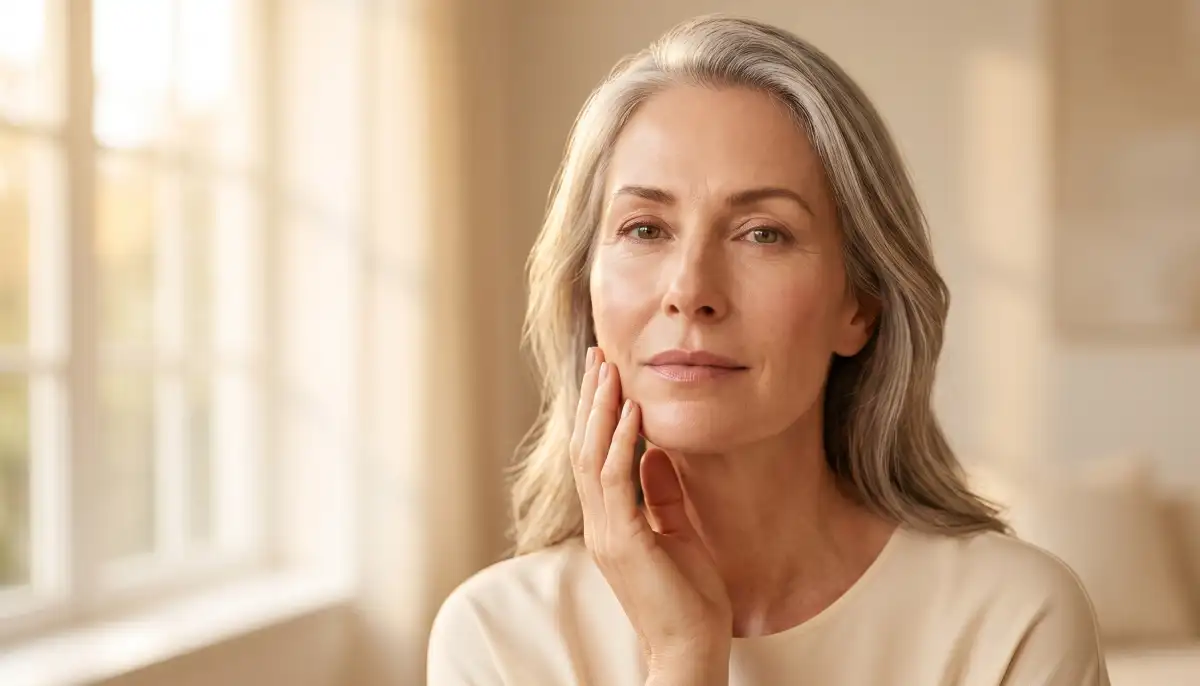
The science of skin aging is evolving rapidly — and for women navigating the skin changes that come with menopause and beyond, evidence-based skincare represents a fundamentally different approach: working with your skin's biology rather than against it.
Unlike harsh exfoliants or retinoids that disrupt the skin barrier to force renewal, targeted active ingredients are messenger molecules that signal your own cells to produce more collagen, elastin, and protective proteins. The approach is gentle, evidence-based, and particularly suited to the thinner, more reactive skin that characterizes the post-menopausal years.
Can Plant Estrogens Slow Hormone-Driven Skin Aging?
Phytoestrogens — plant-derived compounds that weakly activate human estrogen receptors — have emerged as a promising topical strategy for menopausal skin. The most studied phytoestrogens in dermatology are soy isoflavones (genistein and daidzein), resveratrol (from grape skin and Japanese knotweed), and bakuchiol (from Psoralea corylifolia). Each interacts with skin estrogen receptors at different potencies and through different mechanisms, creating opportunities for targeted intervention without systemic hormonal effects.[1]
Genistein, the primary soy isoflavone, has the strongest dermatological evidence. A randomized, double-blind study published in the European Journal of Pharmaceutics and Biopharmaceutics found that topical genistein at 4% concentration increased dermal collagen and hyaluronic acid content in post-menopausal women over 24 weeks. A separate study in Phytomedicine demonstrated that genistein activated ER-beta in skin fibroblasts at approximately 1/1,000th the potency of 17-beta-estradiol — weak enough to avoid systemic effects but sufficient to measurably stimulate collagen synthesis at the application site.
Clinical research confirms that bakuchiol has generated significant clinical interest because it produces retinol-like effects through a mechanism that includes phytoestrogenic activity. A landmark 2019 study in the British Journal of Dermatology compared 0.5% bakuchiol with 0.5% retinol over 12 weeks and found comparable improvements in wrinkles and pigmentation — with significantly less scaling and stinging in the bakuchiol group. While bakuchiol is not exclusively a phytoestrogen (it also activates retinoid pathways and NF-E2-related factor 2), its ER-beta agonist activity contributes to its collagen-stimulating effects.
Resveratrol acts primarily as an antioxidant and sirtuin activator rather than a direct ER agonist, but its dermatological benefits complement phytoestrogenic approaches. A 2015 study in Clinical, Cosmetic and Investigational Dermatology found that topical resveratrol reduced oxidative stress markers and improved skin hydration and elasticity in post-menopausal women. When combined with direct phytoestrogens like genistein, resveratrol addresses the oxidative damage component while genistein addresses the receptor-mediated collagen decline — a complementary dual mechanism.
Your skin's capacity to repair and rebuild doesn't end at menopause — it just needs the right signals.
— Dr. Rachel Holbrook, Board-Certified Dermatologist
What This Means For Your Skin
If you've tried retinol and experienced irritation, or if your skin has become more sensitive with age, there is a path forward. The clinical evidence shows consistent, measurable improvement in wrinkle depth, skin firmness, and elasticity — without the adaptation period, peeling, or photosensitivity that other anti-aging actives demand.
Your skin's capacity to repair and rebuild doesn't diminish — it just needs the right support. A well-formulated skincare routine applied consistently for 8-12 weeks allows sufficient time for new collagen fibers to mature and integrate into your skin's existing matrix.
The science is clear. The evidence is consistent. The results are measurable.
What happens next is up to you.