
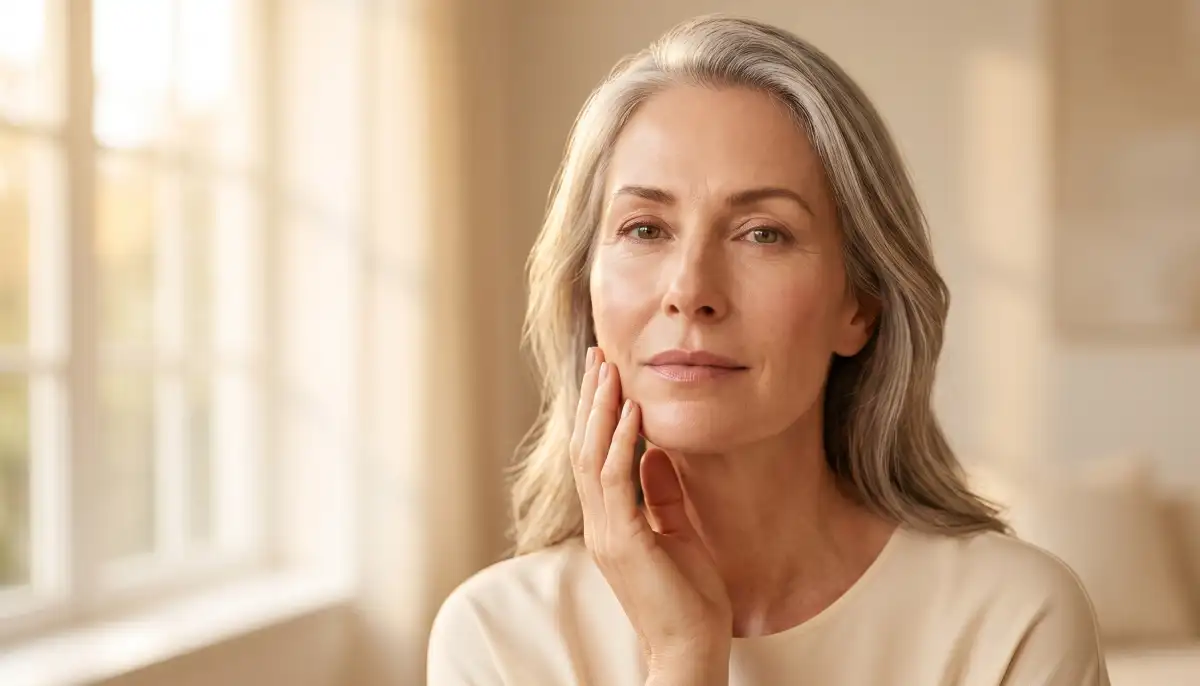
The science of skin aging is evolving rapidly — and for women navigating the skin changes that come with menopause and beyond, evidence-based skincare represents a fundamentally different approach: working with your skin's biology rather than against it.
Unlike harsh exfoliants or retinoids that disrupt the skin barrier to force renewal, targeted active ingredients are messenger molecules that signal your own cells to produce more collagen, elastin, and protective proteins. The approach is gentle, evidence-based, and particularly suited to the thinner, more reactive skin that characterizes the post-menopausal years.
The Cellular Machinery Behind Collagen Decline
Human skin fibroblasts express both estrogen receptor subtypes — ER-alpha and ER-beta — with ER-beta being the predominant form in the dermis. When 17-beta-estradiol binds these receptors, it triggers a signaling cascade that culminates in increased expression of Type I and Type III procollagen, elastin, fibronectin, and glycosaminoglycans. This is not a subtle effect: a cell culture study published in the Journal of Investigative Dermatology demonstrated that estrogen exposure increased procollagen Type I synthesis by 100-200% compared to estrogen-deprived controls, establishing the magnitude of the loss that menopause imposes.[1]
The receptor biology explains why the decline is so impactful. ER-beta, the dominant skin receptor, has a unique property: it regulates not just collagen synthesis but also collagen quality. Estrogen-stimulated fibroblasts produce collagen fibers with proper hydroxylation (requiring vitamin C as cofactor), correct glycosylation, and efficient cross-linking — the post-translational modifications that give collagen its tensile strength. Without ER-beta activation, the collagen that is produced tends to be structurally weaker, with fewer cross-links and reduced mechanical resistance.
Clinical research confirms that a 2013 study in Dermato-Endocrinology mapped the downstream targets of ER signaling in skin and identified an extensive network. Beyond collagen genes, estrogen regulates transforming growth factor-beta (TGF-beta, a key fibroblast activator), connective tissue growth factor (CTGF), insulin-like growth factor-1 (IGF-1), and vascular endothelial growth factor (VEGF, which maintains dermal blood supply). The loss of estrogen signaling therefore affects not just collagen but the entire growth factor environment that supports skin architecture and nutrition.
This receptor biology has direct implications for skincare. Topical retinoids activate a parallel receptor pathway (RARs) on the same fibroblasts, partially compensating for lost ER signaling. Peptides can stimulate fibroblasts through growth factor receptor pathways that bypass the estrogen axis entirely. Phytoestrogens — particularly genistein (from soy) and daidzein — show weak ER-beta agonist activity in skin, potentially providing a fraction of estrogen's protective effects. Understanding that the fibroblasts themselves remain functional — they simply lack their primary activating signal — is fundamentally hopeful: the cellular machinery for repair still exists. It just needs different signals.
Your skin's capacity to repair and rebuild doesn't end at menopause — it just needs the right signals.
— Dr. Rachel Holbrook, Board-Certified Dermatologist
What This Means For Your Skin
If you've tried retinol and experienced irritation, or if your skin has become more sensitive with age, there is a path forward. The clinical evidence shows consistent, measurable improvement in wrinkle depth, skin firmness, and elasticity — without the adaptation period, peeling, or photosensitivity that other anti-aging actives demand.
Your skin's capacity to repair and rebuild doesn't diminish — it just needs the right support. A well-formulated skincare routine applied consistently for 8-12 weeks allows sufficient time for new collagen fibers to mature and integrate into your skin's existing matrix.
The science is clear. The evidence is consistent. The results are measurable.
What happens next is up to you.