
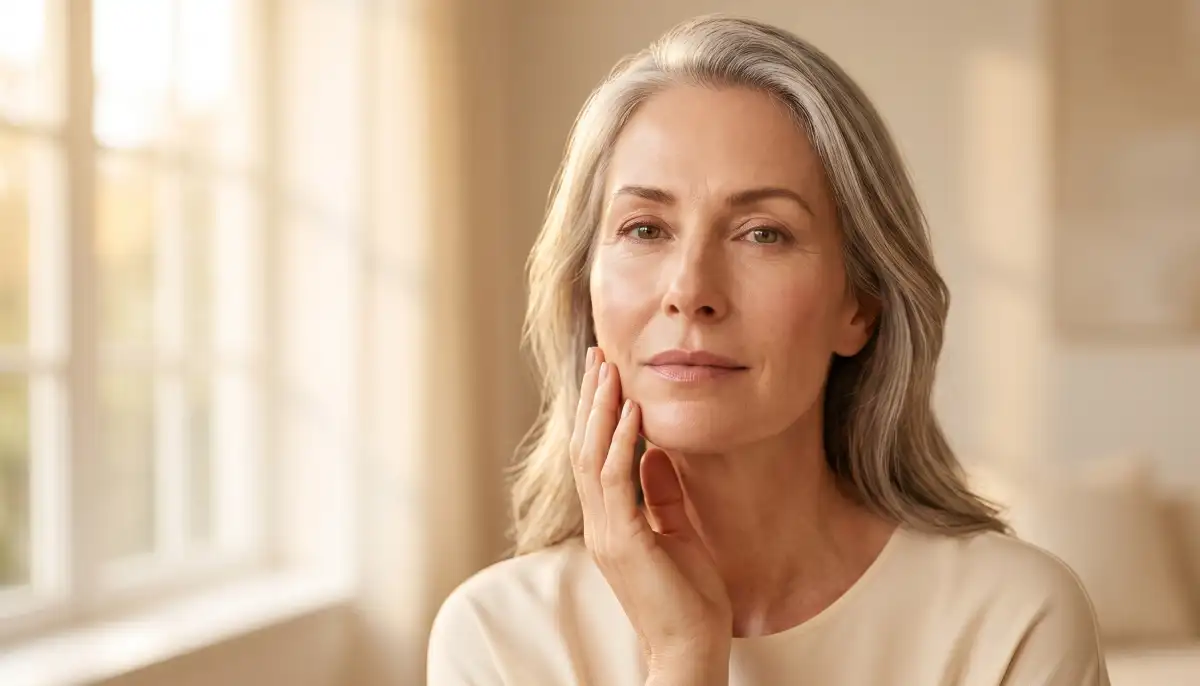
The science of skin aging is evolving rapidly — and for women navigating the skin changes that come with menopause and beyond, evidence-based skincare represents a fundamentally different approach: working with your skin's biology rather than against it.
Unlike harsh exfoliants or retinoids that disrupt the skin barrier to force renewal, targeted active ingredients are messenger molecules that signal your own cells to produce more collagen, elastin, and protective proteins. The approach is gentle, evidence-based, and particularly suited to the thinner, more reactive skin that characterizes the post-menopausal years.
The Biological Timeline From Perimenopause to Post-Menopause
Skin changes during menopause follow a biological timeline that begins years before the last menstrual period. During perimenopause — typically starting between ages 38 and 44 — estrogen levels begin fluctuating unpredictably. These fluctuations, documented in a longitudinal study published in the Journal of Clinical Endocrinology & Metabolism, produce the first skin symptoms: intermittent dryness, occasional sensitivity flares, and subtle changes in skin texture that most women initially dismiss.[1]
The most dramatic changes occur during the menopausal transition itself — the 1-3 year window surrounding the final menstrual period. During this phase, estrogen drops by approximately 60-80%, triggering the rapid collagen decline that characterizes early menopause. A prospective study following 114 women through menopause found that skin collagen content decreased most steeply between years -1 and +3 relative to the final period, with losses of 2.1-2.3% per year during this window compared to 0.5-0.7% in the years prior.
Clinical research confirms that post-menopause stabilizes the hormonal environment — but at a permanently lower baseline. By five years post-menopause, the average woman has lost 30% of her dermal collagen. Skin thickness continues to decline at approximately 1.13% per year. However, the rate of loss decelerates: the most aggressive changes are concentrated in years 1-5, after which the skin reaches a new equilibrium. A 60-year-old who entered menopause at 50 shows relatively stable skin metrics, while a 55-year-old who entered at 52 may still be in active decline.
This timeline has practical implications for skincare strategy. During perimenopause, preventive intervention — barrier support with ceramides, antioxidant protection with vitamin C, and collagen stimulation with retinol or peptides — can slow the trajectory before acceleration begins. During the menopausal transition, more aggressive intervention becomes appropriate: higher-concentration retinoids, multi-peptide formulations, and dedicated barrier-repair protocols. Post-menopause, the focus shifts to maintenance and protection of remaining dermal architecture.
Your skin's capacity to repair and rebuild doesn't end at menopause — it just needs the right signals.
— Dr. Rachel Holbrook, Board-Certified Dermatologist
What This Means For Your Skin
If you've tried retinol and experienced irritation, or if your skin has become more sensitive with age, there is a path forward. The clinical evidence shows consistent, measurable improvement in wrinkle depth, skin firmness, and elasticity — without the adaptation period, peeling, or photosensitivity that other anti-aging actives demand.
Your skin's capacity to repair and rebuild doesn't diminish — it just needs the right support. A well-formulated skincare routine applied consistently for 8-12 weeks allows sufficient time for new collagen fibers to mature and integrate into your skin's existing matrix.
The science is clear. The evidence is consistent. The results are measurable.
What happens next is up to you.