
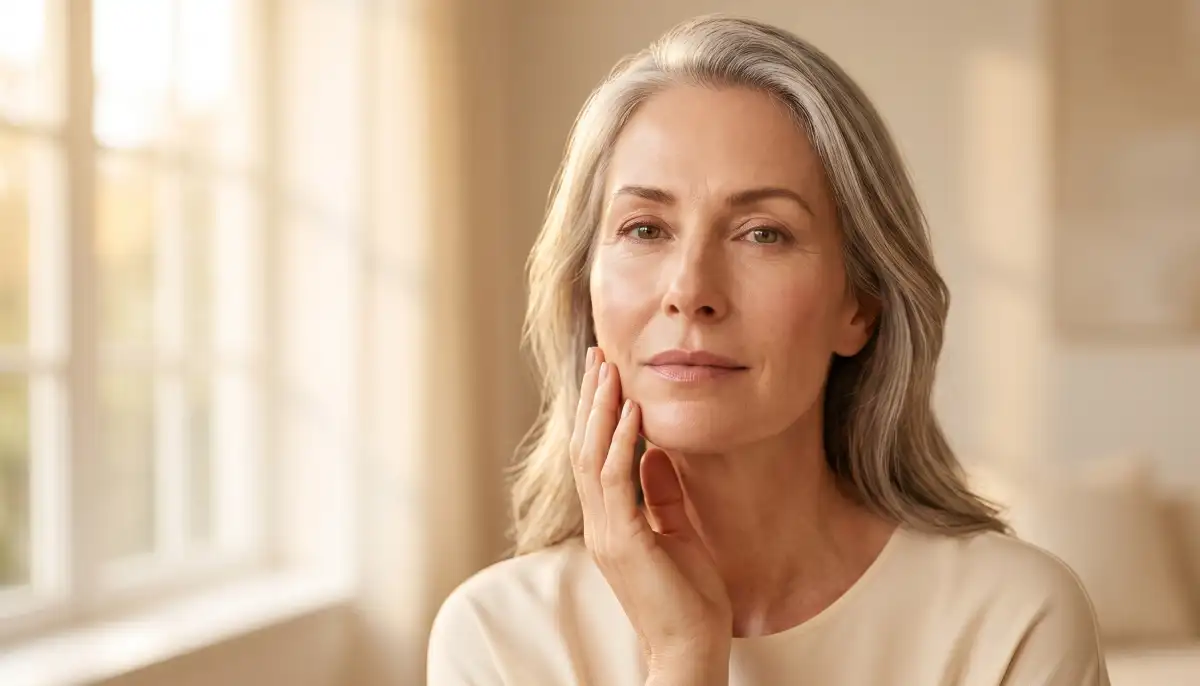
The science of skin aging is evolving rapidly — and for women navigating the skin changes that come with menopause and beyond, evidence-based skincare represents a fundamentally different approach: working with your skin's biology rather than against it.
Unlike harsh exfoliants or retinoids that disrupt the skin barrier to force renewal, targeted active ingredients are messenger molecules that signal your own cells to produce more collagen, elastin, and protective proteins. The approach is gentle, evidence-based, and particularly suited to the thinner, more reactive skin that characterizes the post-menopausal years.
Why Skin Becomes Rough and How to Restore Smoothness
Skin texture changes during menopause are among the earliest visible signs — often preceding wrinkle deepening by 1-2 years. The mechanism is straightforward: as estrogen declines, epidermal cell turnover slows from approximately 28 days to 45-60 days. This means dead keratinocytes accumulate on the skin surface for twice as long as they did pre-menopause, creating a layer of compacted, dull, rough-feeling cells that disrupts light reflection and gives skin the characteristic 'crepe-like' texture many women describe.[1]
Objectively, skin surface roughness is measurable using optical profilometry — a technique that maps the micro-topography of the skin surface. Studies using this method have documented a 15-25% increase in surface roughness parameters within three years of menopause. The roughness correlates with both decreased ceramide content (which affects the orderly arrangement of corneocytes) and reduced natural moisturizing factor (NMF) production, which depends on filaggrin — a protein whose expression is partially estrogen-regulated.
Clinical research confirms that the textural changes extend beyond surface roughness. Many women notice increased visibility of pores, a 'bumpy' or 'gritty' texture particularly on the cheeks and forehead, and keratosis pilaris-like roughness on the upper arms and thighs. These changes reflect the same underlying mechanism: slowed desquamation and altered keratinization. Additionally, decreased glycosaminoglycan content in the dermis — particularly hyaluronic acid — reduces the 'plumpness' that normally smooths the skin surface from below.
Restoring texture requires addressing both the surface accumulation and the underlying production deficit. Chemical exfoliation with alpha-hydroxy acids (lactic acid at 5-10% is preferred for menopausal skin due to its hydrating properties) accelerates desquamation and reveals fresher cells. Retinoids normalize the entire keratinization process over 8-12 weeks, restoring a more youthful cell turnover rate. Hyaluronic acid serums provide temporary surface plumping, while peptide and retinoid combinations stimulate the dermal production of endogenous hyaluronic acid for sustained improvement.
Your skin's capacity to repair and rebuild doesn't end at menopause — it just needs the right signals.
— Dr. Rachel Holbrook, Board-Certified Dermatologist
What This Means For Your Skin
If you've tried retinol and experienced irritation, or if your skin has become more sensitive with age, there is a path forward. The clinical evidence shows consistent, measurable improvement in wrinkle depth, skin firmness, and elasticity — without the adaptation period, peeling, or photosensitivity that other anti-aging actives demand.
Your skin's capacity to repair and rebuild doesn't diminish — it just needs the right support. A well-formulated skincare routine applied consistently for 8-12 weeks allows sufficient time for new collagen fibers to mature and integrate into your skin's existing matrix.
The science is clear. The evidence is consistent. The results are measurable.
What happens next is up to you.