
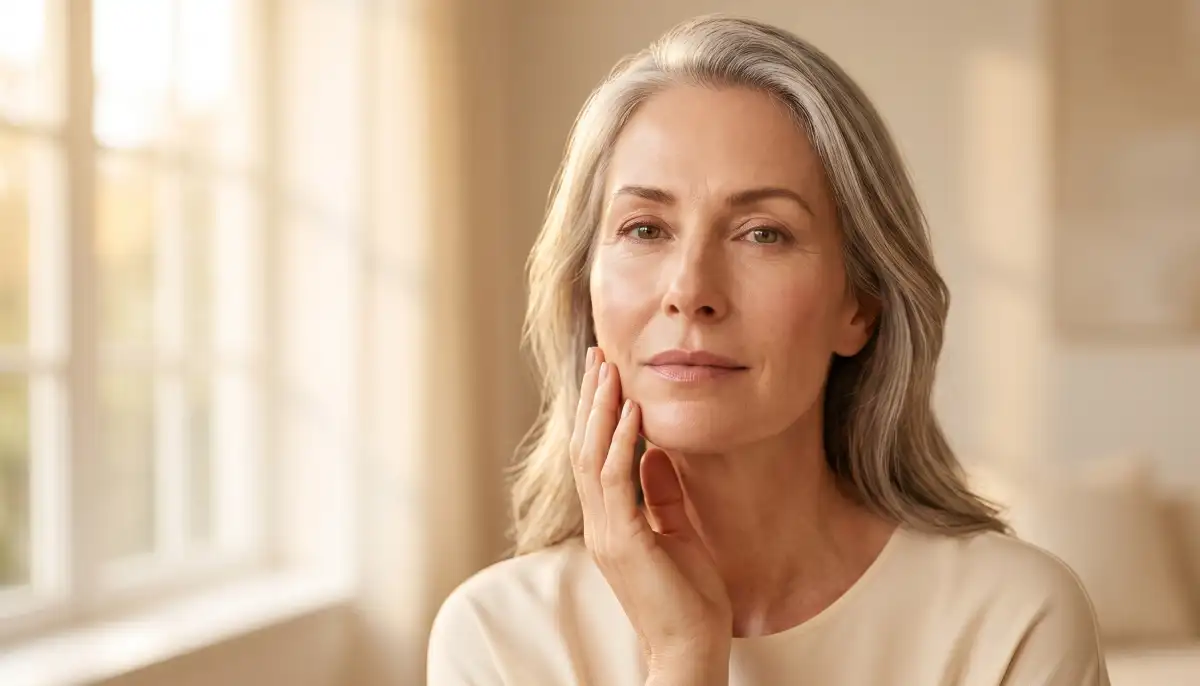
The science of skin aging is evolving rapidly — and for women navigating the skin changes that come with menopause and beyond, evidence-based skincare represents a fundamentally different approach: working with your skin's biology rather than against it.
Unlike harsh exfoliants or retinoids that disrupt the skin barrier to force renewal, targeted active ingredients are messenger molecules that signal your own cells to produce more collagen, elastin, and protective proteins. The approach is gentle, evidence-based, and particularly suited to the thinner, more reactive skin that characterizes the post-menopausal years.
Clinical Approaches to Volume Loss, Sagging, and Texture Changes
Menopause produces three categories of facial changes — volume loss, gravitational descent (sagging), and surface texture deterioration — each requiring different treatment strategies. A prospective study published in Plastic and Reconstructive Surgery tracked facial changes in 150 women across menopause and found that volume loss preceded sagging by an average of 18 months, suggesting a window of early intervention where volumizing treatments could delay the cascade of visible aging.[1]
Volume loss concentrates in specific facial compartments: the temporal hollows, the malar (cheekbone) region, the periorbital area, and the perioral region. This creates the characteristic 'deflated' appearance that distinguishes menopausal aging from photoaging. Topical approaches include hyaluronic acid-based serums that provide temporary plumping, peptide complexes that stimulate fibroblast production of endogenous hyaluronic acid, and ceramide-rich moisturizers that improve surface hydration and light reflection. Clinical trials show that multi-peptide formulations can improve facial volume measurements by 8-15% over 12 weeks.
Clinical research confirms that gravitational descent — the downward migration of facial tissues — follows volume loss. As the structural support of collagen, elastin, and fat diminishes, gravity pulls tissues downward. This manifests as jowling, nasolabial fold deepening, and marionette lines. Topical interventions include retinoids that stimulate collagen Type I production in the deep dermis, DMAE (dimethylaminoethanol) that has short-term firming effects through improved muscle tone, and niacinamide at 4-5% concentration that improves skin elasticity measurably over 12 weeks.
Surface texture changes — roughness, enlarged pores, dullness, and uneven tone — reflect the slowed epidermal turnover and barrier compromise discussed previously. These changes respond most rapidly to treatment: gentle chemical exfoliation with alpha-hydroxy acids (lactic acid is preferred for sensitive menopausal skin), consistent retinoid use to normalize keratinocyte cycling, and vitamin C application to brighten tone and stimulate collagen in the papillary dermis. Most women see measurable texture improvement within 4-8 weeks of a targeted regimen.
Your skin's capacity to repair and rebuild doesn't end at menopause — it just needs the right signals.
— Dr. Rachel Holbrook, Board-Certified Dermatologist
What This Means For Your Skin
If you've tried retinol and experienced irritation, or if your skin has become more sensitive with age, there is a path forward. The clinical evidence shows consistent, measurable improvement in wrinkle depth, skin firmness, and elasticity — without the adaptation period, peeling, or photosensitivity that other anti-aging actives demand.
Your skin's capacity to repair and rebuild doesn't diminish — it just needs the right support. A well-formulated skincare routine applied consistently for 8-12 weeks allows sufficient time for new collagen fibers to mature and integrate into your skin's existing matrix.
The science is clear. The evidence is consistent. The results are measurable.
What happens next is up to you.