
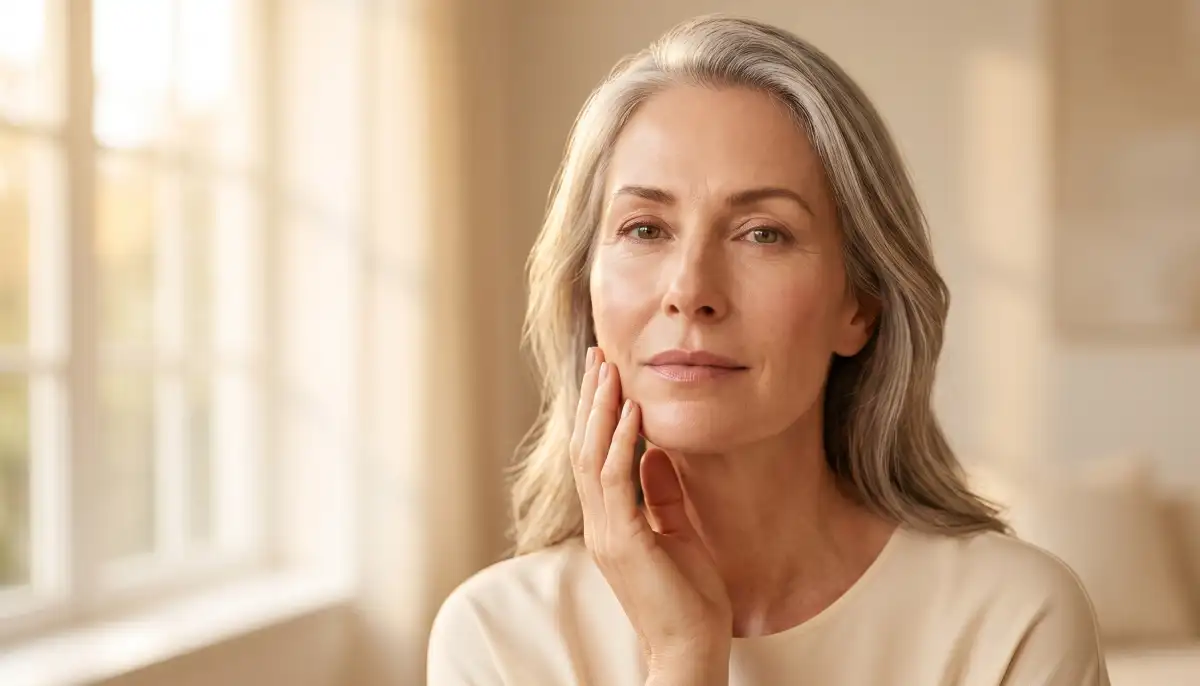
The science of skin aging is evolving rapidly — and for women navigating the skin changes that come with menopause and beyond, evidence-based skincare represents a fundamentally different approach: working with your skin's biology rather than against it.
Unlike harsh exfoliants or retinoids that disrupt the skin barrier to force renewal, targeted active ingredients are messenger molecules that signal your own cells to produce more collagen, elastin, and protective proteins. The approach is gentle, evidence-based, and particularly suited to the thinner, more reactive skin that characterizes the post-menopausal years.
What Clinical Studies Show About Reversible vs. Permanent Changes
The before-and-after trajectory of menopausal skin is not a single downward curve — it is a combination of reversible and irreversible changes that respond differently to intervention. A pivotal study published in the Archives of Dermatology followed women through menopause and found that while total collagen loss was not fully reversible, topical retinoid therapy could restore up to 80% of collagen production capacity in post-menopausal skin, effectively slowing the net loss to near pre-menopausal rates.[1]
Reversible changes include surface dryness (responsive to barrier repair within 2-4 weeks), hyperpigmentation (responsive to tyrosinase inhibitors over 8-12 weeks), and fine lines (responsive to retinoids and peptides over 12-24 weeks). These improvements are consistently documented in controlled trials. A 2017 study in the Journal of Cosmetic Dermatology showed that a combined regimen of 0.025% tretinoin, 5% niacinamide, and ceramide moisturizer produced visible improvement in 89% of post-menopausal participants within 16 weeks.
Clinical research confirms that partially reversible changes include dermal thinning (partially responsive to retinoids that stimulate collagen Type I production), elasticity loss (partially responsive to peptides and vitamin C that support elastin cross-linking), and pore enlargement (partially responsive to retinoids that normalize keratinocyte turnover). These changes show measurable but incomplete improvement — typically 30-50% restoration of pre-menopausal metrics based on available clinical data.
Changes that are currently considered irreversible without procedures include significant volume loss (subcutaneous fat redistribution), deep structural wrinkles (requiring deeper intervention than topical agents can reach), and permanent elastic fiber damage from decades of cumulative UV exposure. However, even these changes can be visually softened: hydration plumps the skin surface, peptides improve texture and firmness, and consistent sun protection prevents further degradation. The clinical evidence supports meaningful improvement — not reversal to age 30, but measurable restoration of skin health and function.
Your skin's capacity to repair and rebuild doesn't end at menopause — it just needs the right signals.
— Dr. Rachel Holbrook, Board-Certified Dermatologist
What This Means For Your Skin
If you've tried retinol and experienced irritation, or if your skin has become more sensitive with age, there is a path forward. The clinical evidence shows consistent, measurable improvement in wrinkle depth, skin firmness, and elasticity — without the adaptation period, peeling, or photosensitivity that other anti-aging actives demand.
Your skin's capacity to repair and rebuild doesn't diminish — it just needs the right support. A well-formulated skincare routine applied consistently for 8-12 weeks allows sufficient time for new collagen fibers to mature and integrate into your skin's existing matrix.
The science is clear. The evidence is consistent. The results are measurable.
What happens next is up to you.