
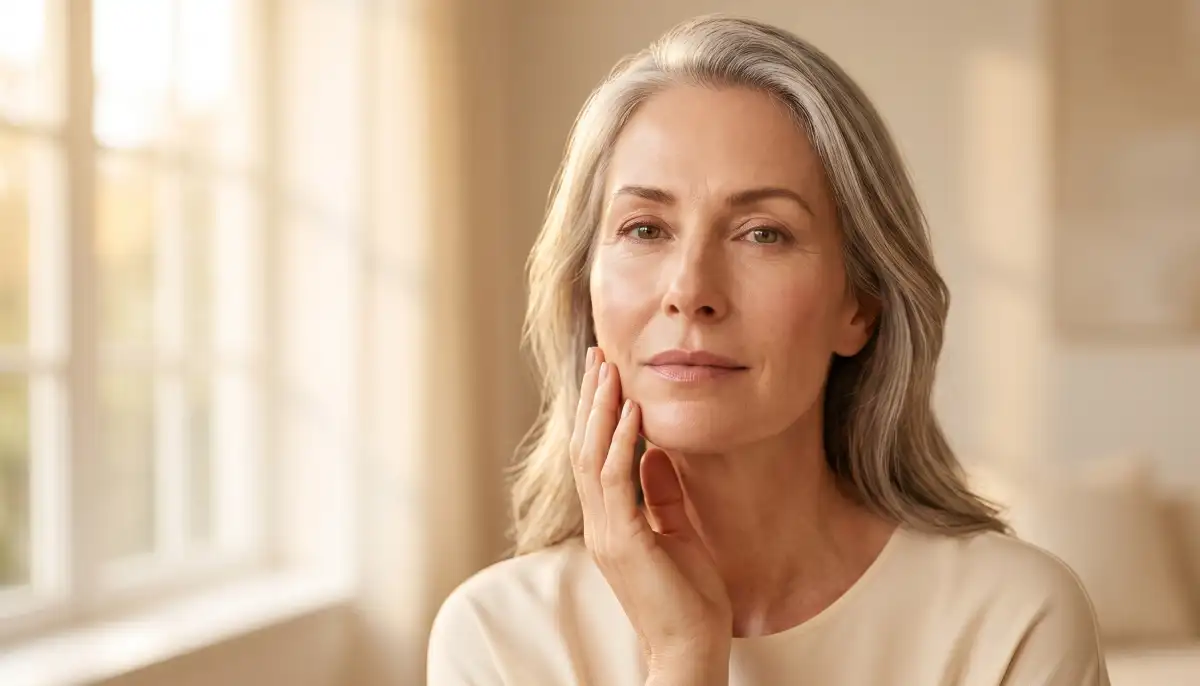
The science of skin aging is evolving rapidly — and for women navigating the skin changes that come with menopause and beyond, evidence-based skincare represents a fundamentally different approach: working with your skin's biology rather than against it.
Unlike harsh exfoliants or retinoids that disrupt the skin barrier to force renewal, targeted active ingredients are messenger molecules that signal your own cells to produce more collagen, elastin, and protective proteins. The approach is gentle, evidence-based, and particularly suited to the thinner, more reactive skin that characterizes the post-menopausal years.
How to Address the 1.13% Annual Thickness Decline
Skin thinning after menopause is a documented clinical phenomenon: ultrasound measurements show a mean decrease of 1.13% in total skin thickness per post-menopausal year. This thinning is not evenly distributed — the dermis accounts for approximately 80% of the total loss, while the epidermis contributes 20%. The result is skin that is more fragile, more transparent (blood vessels become visible), bruises more easily, and heals more slowly. A study in the Journal of the European Academy of Dermatology measured a 22% decrease in total skin thickness over 15 years of menopause.[1]
Retinoids are the most studied treatment for skin thinning. Multiple randomized controlled trials have demonstrated that tretinoin increases epidermal thickness by stimulating keratinocyte proliferation and increases dermal thickness by stimulating new collagen deposition. A landmark 48-week study showed that 0.025% tretinoin applied three times weekly increased epidermal thickness by 15% and dermal procollagen by 80% in post-menopausal women. Over-the-counter retinol produces similar but slower effects — typically requiring 24-48 weeks for measurable thickness improvement.
Clinical research confirms that for women who cannot tolerate retinoids, peptide formulations offer an alternative pathway. Signal peptides like Matrixyl stimulate procollagen synthesis without the irritation, peeling, or photosensitivity associated with retinoids. A 12-week clinical trial demonstrated a 10-15% increase in collagen density with twice-daily peptide application. Growth factor-containing products have also shown promise: a study using topical transforming growth factor-beta (TGF-beta) demonstrated increased dermal thickness in post-menopausal skin over 24 weeks.
Barrier protection is equally important for thin skin. Thinner skin is more vulnerable to environmental damage — UV radiation, pollution, wind, temperature extremes — all of which accelerate further thinning through oxidative stress. Daily broad-spectrum SPF 50, a ceramide-based moisturizer, and antioxidant protection (vitamin C, vitamin E, ferulic acid) form the protective foundation that prevents ongoing damage while active treatments work to rebuild thickness. Without this protective layer, even the best retinoid or peptide regimen is fighting against continued degradation.
Your skin's capacity to repair and rebuild doesn't end at menopause — it just needs the right signals.
— Dr. Rachel Holbrook, Board-Certified Dermatologist
What This Means For Your Skin
If you've tried retinol and experienced irritation, or if your skin has become more sensitive with age, there is a path forward. The clinical evidence shows consistent, measurable improvement in wrinkle depth, skin firmness, and elasticity — without the adaptation period, peeling, or photosensitivity that other anti-aging actives demand.
Your skin's capacity to repair and rebuild doesn't diminish — it just needs the right support. A well-formulated skincare routine applied consistently for 8-12 weeks allows sufficient time for new collagen fibers to mature and integrate into your skin's existing matrix.
The science is clear. The evidence is consistent. The results are measurable.
What happens next is up to you.