
The science of skin aging is evolving rapidly — and for women navigating the skin changes that come with menopause and beyond, evidence-based skincare represents a fundamentally different approach: working with your skin's biology rather than against it.
Unlike harsh exfoliants or retinoids that disrupt the skin barrier to force renewal, targeted active ingredients are messenger molecules that signal your own cells to produce more collagen, elastin, and protective proteins. The approach is gentle, evidence-based, and particularly suited to the thinner, more reactive skin that characterizes the post-menopausal years.
Targeted Muscle Re-Education for a Defined Lower Face
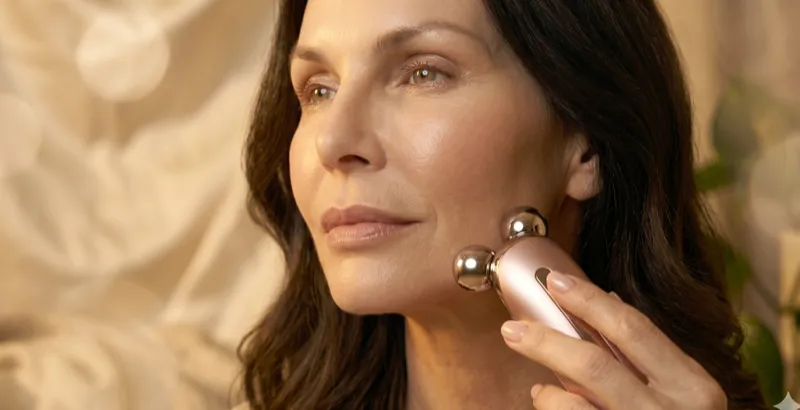
The jawline is the facial area most dramatically improved by microcurrent because it is the area most dependent on muscle tone for its visible definition. The mandibular contour that defines a 'sharp' or 'defined' jawline is created by the interaction between the mandible bone, the overlying fat compartments, and the muscles that drape over and around the jaw. When these muscles lose tone — particularly the platysma (neck/jaw muscle), the masseter (jaw clenching muscle), and the depressor anguli oris (mouth corner depressor) — the tissue sags below the mandible line, creating the softened, jowled appearance that many women first notice in their early 40s.[1]
The microcurrent jawline protocol targets specific muscles in a precise sequence. Step 1 — Platysma lift (2 minutes): Starting at the base of the neck, glide the microcurrent probes upward along the platysma toward the jawline in slow, deliberate strokes. This stimulates the platysma to contract upward rather than pulling downward — effectively training the muscle to support the jawline rather than dragging it down. Step 2 — Jawline definition (3 minutes): Place the probes along the mandible bone from chin to ear, making slow passes along the jaw edge. This targets the muscles directly overlying the jaw, toning them to create a tighter drape over the bone and reducing the soft tissue that blurs the jaw-neck boundary.
Clinical research confirms that step 3 — Jowl lift (2 minutes): Focus the probes on the jowl area specifically — the soft tissue that has descended below the mandible line between the chin and the mid-jaw. Use upward-and-back strokes that encourage the tissue to lift toward the ear. This addresses the marionette area and the pre-jowl sulcus (the indentation that forms between the chin and the jowl). Step 4 — Masseter release (1 minute): For women with jaw tension or clenching habits, gentle microcurrent applied to the masseter muscle promotes relaxation of this overactive muscle, which can contribute to a wider, squarer lower face appearance when hypertrophied.
Results timeline for jawline-specific microcurrent: the jawline typically shows the fastest and most dramatic response to microcurrent because the improvement is primarily muscle-tone-driven (immediate and cumulative) rather than collagen-driven (slower). Week 1-2: improved jawline tension and a subtle feeling of 'tightness' along the jaw. Week 3-4: visible improvement in jawline definition, particularly in morning photographs. Week 6-8: measurable reduction in the tissue below the mandible line — the jowl area appears smaller and the jaw-neck angle is more defined. A clinical study measuring mandibular angle definition found 20% improvement after 8 weeks of daily targeted microcurrent. For best results, combine jawline microcurrent with topical firming products (peptides, caffeine, DMAE) applied immediately after the microcurrent session — the enhanced blood flow from microcurrent improves absorption of topical active ingredients by 20-30%.
Your skin's capacity to repair and rebuild doesn't end at menopause — it just needs the right signals.
— Dr. Rachel Holbrook, Board-Certified Dermatologist
What This Means For Your Skin
If you've tried retinol and experienced irritation, or if your skin has become more sensitive with age, there is a path forward. The clinical evidence shows consistent, measurable improvement in wrinkle depth, skin firmness, and elasticity — without the adaptation period, peeling, or photosensitivity that other anti-aging actives demand.
Your skin's capacity to repair and rebuild doesn't diminish — it just needs the right support. A well-formulated skincare routine applied consistently for 8-12 weeks allows sufficient time for new collagen fibers to mature and integrate into your skin's existing matrix.
The science is clear. The evidence is consistent. The results are measurable.
What happens next is up to you.