
The science of skin aging is evolving rapidly — and for women navigating the skin changes that come with menopause and beyond, evidence-based skincare represents a fundamentally different approach: working with your skin's biology rather than against it.
Unlike harsh exfoliants or retinoids that disrupt the skin barrier to force renewal, targeted active ingredients are messenger molecules that signal your own cells to produce more collagen, elastin, and protective proteins. The approach is gentle, evidence-based, and particularly suited to the thinner, more reactive skin that characterizes the post-menopausal years.
Realistic Expectations at 30, 60, and 90 Days of Daily Use
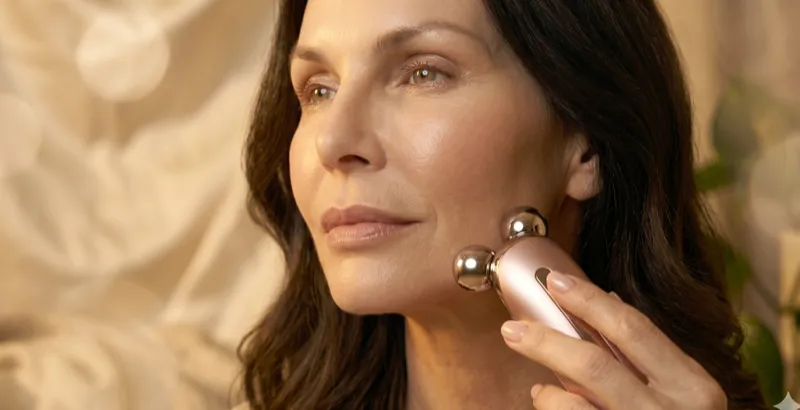
Setting realistic expectations for microcurrent results requires separating clinically documented outcomes from marketing exaggeration. The clinical evidence consistently shows meaningful but gradual improvement — microcurrent is not a substitute for a facelift, but it produces visible changes that independent observers and measurement instruments confirm. Understanding the timeline helps maintain the daily consistency that is essential for results, because many women abandon microcurrent during the first 2-3 weeks before changes become visible.[1]
30-day results — Foundation phase: At one month of daily use, the most consistent change is improved skin texture and 'glow' — the increased ATP production enhances cellular metabolism, improving skin surface quality before structural changes become visible. Mild improvement in facial contour may be apparent, particularly along the jawline and in the cheek area. Clinical measurement at 30 days shows: 10-15% improvement in skin firmness (cutometer), subtle improvement in facial muscle tone, and improved skin hydration (the increased cellular metabolism enhances hyaluronic acid production). Most users report that their skin feels 'tighter' and 'more awake' but may not see dramatic visual differences in photographs yet.
Clinical research confirms that 60-day results — Visible improvement phase: At two months, the collagen-stimulating effects of sustained ATP increase become apparent. The combination of improved muscle tone (from daily neuromuscular stimulation) and increased dermal collagen (from enhanced fibroblast activity) produces changes visible in photographs. Clinical measurement at 60 days shows: 18-23% improvement in facial muscle tone, 15-20% improvement in skin firmness, visible improvement in jawline definition and nasolabial fold depth. The JAMA-referenced facial exercise study found that the 8-week mark was when blinded raters first consistently detected improvement — microcurrent follows a similar timeline.
90-day results — Peak benefit phase: At three months of daily use, results approach their maximum for the current treatment intensity and frequency. Further improvement continues more gradually through 6 months. Clinical measurement at 90 days shows: 20-28% improvement in facial muscle tone, 20-25% improvement in skin firmness, measurable improvement in cheek fullness and jawline contour. After 90 days, the protocol shifts from daily 'building' to 3-5 times weekly 'maintenance' — the muscle tone and collagen gains are maintained at a lower frequency once established. Important reality check: the improvements are real and measurable, but they represent a 20-28% improvement, not a 50-80% transformation. Microcurrent is best understood as a complement to a collagen-stimulating skincare routine (retinoid + peptides), not a replacement for it.
Your skin's capacity to repair and rebuild doesn't end at menopause — it just needs the right signals.
— Dr. Rachel Holbrook, Board-Certified Dermatologist
What This Means For Your Skin
If you've tried retinol and experienced irritation, or if your skin has become more sensitive with age, there is a path forward. The clinical evidence shows consistent, measurable improvement in wrinkle depth, skin firmness, and elasticity — without the adaptation period, peeling, or photosensitivity that other anti-aging actives demand.
Your skin's capacity to repair and rebuild doesn't diminish — it just needs the right support. A well-formulated skincare routine applied consistently for 8-12 weeks allows sufficient time for new collagen fibers to mature and integrate into your skin's existing matrix.
The science is clear. The evidence is consistent. The results are measurable.
What happens next is up to you.