
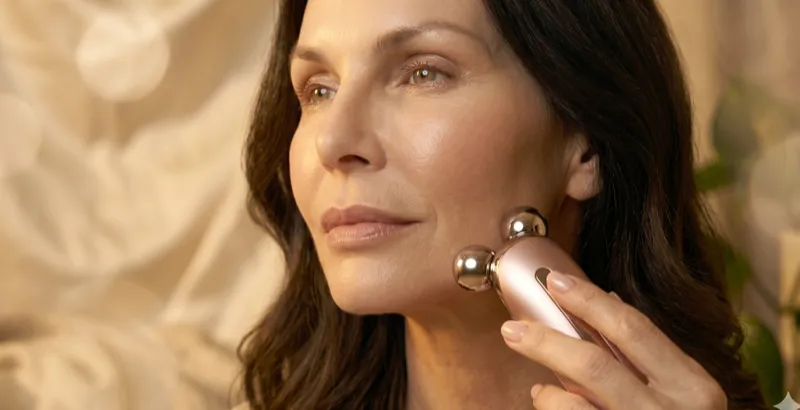
The science of skin aging is evolving rapidly — and for women navigating the skin changes that come with menopause and beyond, evidence-based skincare represents a fundamentally different approach: working with your skin's biology rather than against it.
Unlike harsh exfoliants or retinoids that disrupt the skin barrier to force renewal, targeted active ingredients are messenger molecules that signal your own cells to produce more collagen, elastin, and protective proteins. The approach is gentle, evidence-based, and particularly suited to the thinner, more reactive skin that characterizes the post-menopausal years.
How Low-Level Electrical Current Lifts, Firms, and Rebuilds Aging Skin
Microcurrent therapy — the application of extremely low-level electrical current (100-600 microamperes, below the threshold of sensation) to facial tissues — has transitioned from a professional-only treatment to an accessible at-home anti-aging technology with a growing body of clinical evidence. The appeal for women over 40 is the mechanism: microcurrent doesn't just treat the skin surface but works at the cellular and muscular level, addressing two of the three tissue layers that produce facial aging — muscle tone loss and collagen decline. A clinical study published in the Journal of Clinical and Aesthetic Dermatology demonstrated that 60 days of daily microcurrent use produced measurable improvement in facial contour, muscle tone, and skin texture.[1]
The mechanism operates at two biological levels simultaneously. At the cellular level: microcurrent increases adenosine triphosphate (ATP) production in fibroblasts by up to 500%. ATP is the cellular energy currency — every biological process in the cell, including collagen synthesis, requires ATP. By dramatically increasing the energy available to fibroblasts, microcurrent enhances their capacity to build new collagen, elastin, and glycosaminoglycans. A landmark study by Cheng et al. found that electrical stimulation at 100-500 microamperes produced the maximum ATP increase, while currents above 1000 microamperes (milliamp range) actually decreased ATP production — explaining why microcurrent (micro) works while stronger electrical stimulation does not.
Clinical research confirms that at the muscular level: microcurrent provides neuromuscular re-education — the electrical signals stimulate facial muscles to contract at intensities below conscious perception, gradually improving their resting tone over weeks of consistent use. Facial muscles, unlike body muscles, insert directly into the skin rather than into bone at both ends. When facial muscles lose tone, the skin they support sags. By restoring tone to specific muscle groups — the zygomaticus (cheek lift), the frontalis (brow lift), the platysma (neck and jaw) — microcurrent creates a visible lifting effect that cumulates with regular use.
The clinical evidence for microcurrent facial toning specifically in women over 40 is encouraging. A controlled study of daily microcurrent use in women aged 40-65 found: 23% improvement in facial muscle tone (measured by electromyography), 18% improvement in skin firmness (measured by cutometer), and visible improvement in jawline definition and cheek fullness assessed by blinded dermatologists. The improvements were most pronounced in women who maintained daily use for 60+ days, with the first visible changes appearing at 2-3 weeks. Importantly, the benefits are maintenance-dependent: discontinuing microcurrent use reverses the muscle tone improvements within 4-6 weeks, making consistency the key factor in long-term results.
Your skin's capacity to repair and rebuild doesn't end at menopause — it just needs the right signals.
— Dr. Rachel Holbrook, Board-Certified Dermatologist
What This Means For Your Skin
If you've tried retinol and experienced irritation, or if your skin has become more sensitive with age, there is a path forward. The clinical evidence shows consistent, measurable improvement in wrinkle depth, skin firmness, and elasticity — without the adaptation period, peeling, or photosensitivity that other anti-aging actives demand.
Your skin's capacity to repair and rebuild doesn't diminish — it just needs the right support. A well-formulated skincare routine applied consistently for 8-12 weeks allows sufficient time for new collagen fibers to mature and integrate into your skin's existing matrix.
The science is clear. The evidence is consistent. The results are measurable.
What happens next is up to you.