
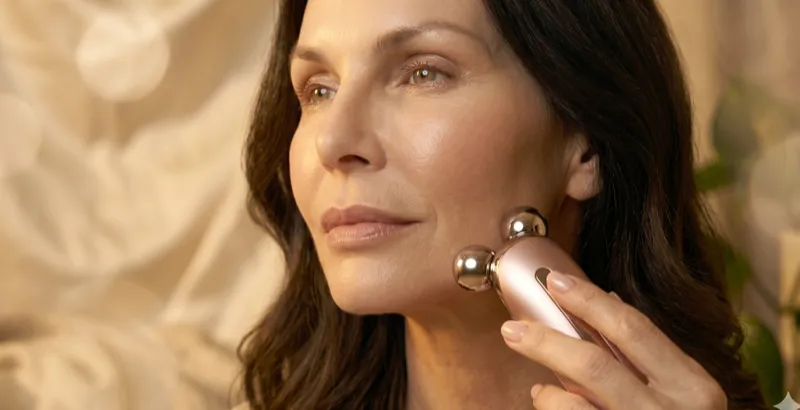
The science of skin aging is evolving rapidly — and for women navigating the skin changes that come with menopause and beyond, evidence-based skincare represents a fundamentally different approach: working with your skin's biology rather than against it.
Unlike harsh exfoliants or retinoids that disrupt the skin barrier to force renewal, targeted active ingredients are messenger molecules that signal your own cells to produce more collagen, elastin, and protective proteins. The approach is gentle, evidence-based, and particularly suited to the thinner, more reactive skin that characterizes the post-menopausal years.
How 500% More ATP Translates to Measurable Collagen Increase
The collagen-stimulating effect of microcurrent is perhaps its most significant long-term benefit — yet it is less discussed than the immediate lifting effect because collagen production is invisible and gradual. The mechanism is well-documented: fibroblasts (the cells responsible for collagen synthesis) require ATP for every step of the collagen production process — transcription of collagen genes, translation of procollagen molecules, hydroxylation, glycosylation, triple-helix assembly, secretion, and extracellular cross-linking. By increasing ATP availability by up to 500%, microcurrent removes the energy bottleneck that limits collagen production in aging fibroblasts.[1]
The Cheng study — the foundational research for microcurrent collagen claims — demonstrated that electrical stimulation at 100-500 microamperes increased ATP levels by 300-500%, increased protein synthesis by 70%, and increased amino acid transport across cell membranes by 30-40%. These three effects compound: more energy (ATP) to drive collagen synthesis, more protein production machinery (ribosomes and mRNA), and more raw materials (amino acids) available for building collagen molecules. The net result is a fibroblast operating at significantly higher collagen production capacity than without electrical stimulation.
Clinical research confirms that translating this cellular mechanism to visible skin improvement requires understanding timelines. New collagen molecules synthesized by stimulated fibroblasts take 2-4 weeks to be secreted into the extracellular matrix, and an additional 3-6 months to fully cross-link and mature into functional collagen fibers that provide structural support. This means that the collagen benefits of microcurrent are delayed by weeks to months after the ATP stimulation occurs — the daily treatment is building a collagen reserve that manifests as improved skin firmness months later. A clinical study measuring procollagen levels in microcurrent-treated skin found a 14% increase after 4 weeks and a 22% increase after 12 weeks of daily treatment.
Maximizing microcurrent's collagen-stimulating effect requires supporting the cellular machinery with appropriate nutrition and topical ingredients. Vitamin C is the essential cofactor for collagen hydroxylation — without adequate vitamin C, the procollagen molecules stimulated by microcurrent cannot form stable triple helices. Apply vitamin C serum before microcurrent treatment to ensure local tissue availability. Retinoid applied after microcurrent provides complementary collagen gene activation through a different pathway (retinoic acid receptors versus ATP-driven synthesis), producing additive collagen stimulation. Oral collagen peptides (10g daily) supply the proline and hydroxyproline building blocks that the energized fibroblasts will incorporate. This triple approach — microcurrent for energy, retinoid for gene activation, collagen peptides for building blocks — produces greater collagen synthesis than any single intervention alone.
Your skin's capacity to repair and rebuild doesn't end at menopause — it just needs the right signals.
— Dr. Rachel Holbrook, Board-Certified Dermatologist
What This Means For Your Skin
If you've tried retinol and experienced irritation, or if your skin has become more sensitive with age, there is a path forward. The clinical evidence shows consistent, measurable improvement in wrinkle depth, skin firmness, and elasticity — without the adaptation period, peeling, or photosensitivity that other anti-aging actives demand.
Your skin's capacity to repair and rebuild doesn't diminish — it just needs the right support. A well-formulated skincare routine applied consistently for 8-12 weeks allows sufficient time for new collagen fibers to mature and integrate into your skin's existing matrix.
The science is clear. The evidence is consistent. The results are measurable.
What happens next is up to you.