
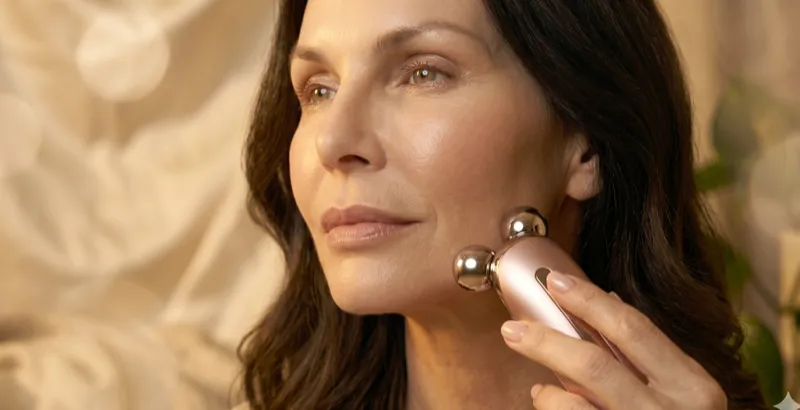
The science of skin aging is evolving rapidly — and for women navigating the skin changes that come with menopause and beyond, evidence-based skincare represents a fundamentally different approach: working with your skin's biology rather than against it.
Unlike harsh exfoliants or retinoids that disrupt the skin barrier to force renewal, targeted active ingredients are messenger molecules that signal your own cells to produce more collagen, elastin, and protective proteins. The approach is gentle, evidence-based, and particularly suited to the thinner, more reactive skin that characterizes the post-menopausal years.
Combining Device Therapy With Active Skincare for Maximum Collagen
The combination of microcurrent, retinol, and peptides represents the most potent non-surgical collagen-stimulating protocol available — each component works through a different biological pathway, and together they produce synergistic results that exceed the sum of their individual effects. Understanding why these three work together transforms anti-aging from a single-product approach to a systematic, multi-pathway strategy that addresses collagen loss from every available angle.[1]
The three pathways: Microcurrent pathway — ATP stimulation. By increasing fibroblast ATP production by up to 500%, microcurrent provides the cellular energy needed for all collagen-related processes. Think of ATP as the factory's electricity: without adequate power, the machinery cannot run regardless of how much raw material is available. Microcurrent ensures the fibroblast has the energy to synthesize collagen at full capacity. Retinol pathway — Gene activation. Retinol is converted to retinoic acid in the skin, which binds to RAR/RXR nuclear receptors on fibroblasts, directly upregulating transcription of collagen I and III genes. This is like giving the factory new production orders: more mRNA templates for collagen molecules are created, increasing the potential output of each fibroblast. Peptide pathway — Cell-surface signaling. Peptides (Matrixyl, copper peptides, GHK-Cu) bind to cell-surface receptors, activating growth factor cascades that stimulate fibroblast proliferation and collagen synthesis through pathways independent of retinoic acid signaling. This is like hiring more workers for the factory.
Clinical research confirms that the synergy is multiplicative, not merely additive. A fibroblast that has more energy (microcurrent), more production orders (retinol), more growth factor signaling (peptides), and more workers (peptide-stimulated proliferation) produces dramatically more collagen than a fibroblast receiving only one of these inputs. While no published study has measured the exact combined effect of all three simultaneously, extrapolation from individual study data suggests: microcurrent alone — 14-22% collagen increase. Retinol alone — 50-80% collagen increase. Peptides alone — 25-44% collagen increase. Combined — estimated 100-150%+ collagen increase through pathway synergy.
The practical protocol for combining all three: Morning — microcurrent treatment (5-10 minutes) → vitamin C serum (within post-treatment absorption window) → peptide serum → moisturizer → SPF. Evening — retinol (on non-microcurrent evenings) or microcurrent followed by lower-concentration retinol (on microcurrent evenings — reduce retinol concentration by one step when combining with microcurrent due to enhanced absorption). Peptide serum applied over retinol on all evenings. Night cream to seal. The key rule: when using microcurrent before retinol, the enhanced penetration means starting with a lower retinol concentration than you would use without microcurrent. Build tolerance over 2-3 weeks before increasing concentration. This triple-pathway approach represents the maximum non-surgical collagen stimulation currently achievable with at-home technology and products.
Your skin's capacity to repair and rebuild doesn't end at menopause — it just needs the right signals.
— Dr. Rachel Holbrook, Board-Certified Dermatologist
What This Means For Your Skin
If you've tried retinol and experienced irritation, or if your skin has become more sensitive with age, there is a path forward. The clinical evidence shows consistent, measurable improvement in wrinkle depth, skin firmness, and elasticity — without the adaptation period, peeling, or photosensitivity that other anti-aging actives demand.
Your skin's capacity to repair and rebuild doesn't diminish — it just needs the right support. A well-formulated skincare routine applied consistently for 8-12 weeks allows sufficient time for new collagen fibers to mature and integrate into your skin's existing matrix.
The science is clear. The evidence is consistent. The results are measurable.
What happens next is up to you.